
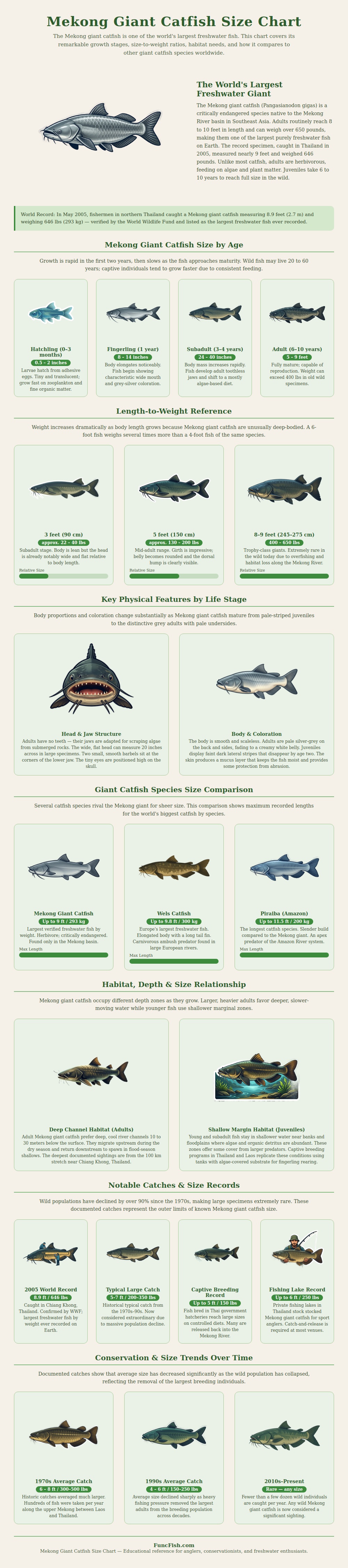
When I think of a giant catfish, I think of some sort of monstrous aquatic beast lurking in the darkness, ready to eat whatever gets too close. Most people have it figured completely backwards. When giant catfish reaches adulthood, they turn their back on meat entirely. Instead, they use their wide flat heads and mouths full of absolutely zero teeth to scrape algae from submerged rocks. As adults, they graze underwater like cows.
This makes everything different when imagining how these fish grow. They’re gaining muscle through grazing (not eating other fish), so that’s where the growth explosion comes into play (seen on the chart above). How can something gain such body mass without eating? It seems odd for a herbivore, but their heavy bony structure and scaleless skin allows them to do just that, pack on weight in a nearly unnatural fashion.
How Giant Catfish Grow and Why They Are in Danger
Where things get realy interesting is looking at the growth path. Unlike some tropical aquarium pet, these fish don’t shoot up overnight. They start out tiny and are barely visible to the naked eye. They spend their early days as very small specimens hiding in shallow edges of rivers feeding on zooplankton. They take years before they’re even remotely a respectable length. The visual guide highlights this slow burn… Even a four year old is still considered a subadult, yet it’s nearly three feet in length.
Why does this matter? That patience means all the big ones you see has survived a decade of possible threats. They can live for decades in the wild, giving them the time needed to reach those huge weights recorded in historical accounts. Captive animals tend to grow faster because they are fed consistently. That is a luxury most never should of had until conservation efforts stepped in recently.
The weight differences don’t seem as much a function of length as they do of pure bulk when you compare them. A five-foot specimen is not just a bigger version of a two-foot one. You get a totally different creature. That is what the graphic shows with the relative size bars. They show how much more the girth grows compared to the length.
That large body allow them to hold a lot of reserves for energy but also helps them remain stable and upright in swift currents. And that’s part of the reason why catching them once matured is such a challenge. Because they’re not only big, they’re built like tanks. Then if you compare them to similarly sized giant catfish from around the world, such as the Piraiba or Wels, you realize they may not always be as long, but on pure mass, the Mekong giant tend to win. So it’s not necessarily a speedster as it is a heavyweight champ of the river.
So how did we get here? Here’s one sobering answer: When you remove the biggest players from an ecosystem, it leads to a decline in average catch sizes. That’s why the average size of our catches has decreased so significantly during the past several decades. From record-breaking averages in the ’70s to these now-rare specimens, the chart reflects the decline. Not only does catching less mean less fish, but remaining fish tend to be younger, which means smaller. Why? This is because the breeding population was removed, either through over-harvesting or displacement. So that size reduction says a lot about how the environment responds to pressure beyond fishing itself.
Dam building and habitat loss interrupt their critical migrations, blocking their ability to reach necessary floodplain locations for spawning. They need those seasonal flows and deep water channels to reproduce properly. But knowing this chart isn’t about fishing competitions. Or even fishing bragging rights. It’s about perspective.
It is a glimpse at the health of one of the planet’s largest river systems. And when your eye catches a data point of a 646-pound record catch, that’s a peak almost completely unattainable in nature anymore. That’s a baseline we’ve lost as a conservation community and are attempting to reestablish with our breeding programs in hatcheries releasing back into the Mekong. Because they know that if you can get ‘em big, you give ‘em a chance to survive over time.
We want those giants back not just for the show, but for what they represent: being slow-growing, large, and complex. They are the massive trees of the aquatic world and the old growth of their ecosystem. Lose that, lose more than just giant fish. Lose the river itself. Lose its structure.