
Fishing hooks is tools that are used to catch fish. The size and the style of the fishing hook can impact how effectivly an individual is at catching a fish. Many individuals makes mistakes in choosing the proper fishing hook based off the type of fish that they are attempting to catch.
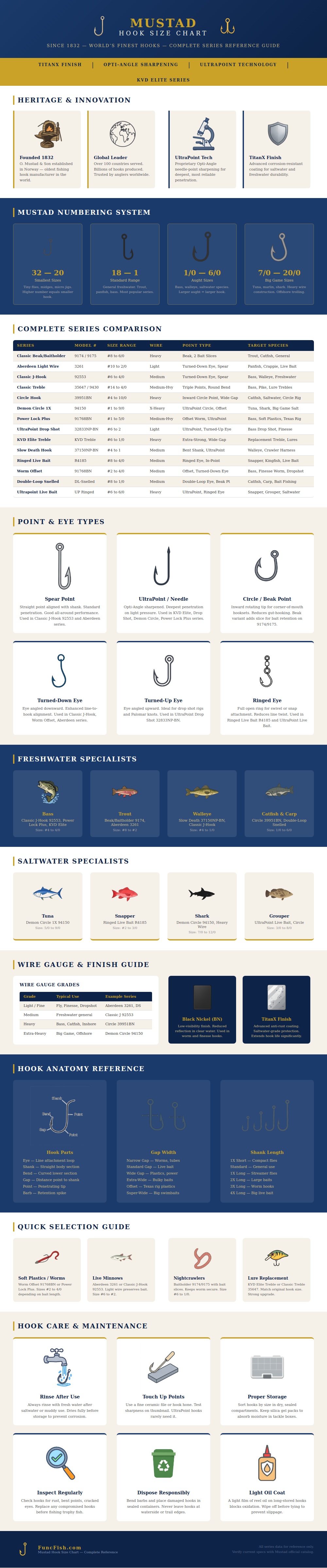
For instance, many individuals may think that the larger the number on the fishing hook, the larger the hook. In fact, the smaller the number on the fishing hook, the larger the fishing hook; size 1 will be larger than size 32. Furthermore, once the size reaches size 1, the numbers changes to include a zero.
How to Choose the Right Fishing Hook
Thus, a 1/0 size will be larger than a size 1 hook. A 20/0 size fishing hook will be much larger than a 1/0 size hook. Therefore, an individual must become familiar with these sizes of fishing hooks to ensure that they dont purchase one that may be too small or too large for the type of fish that they are attempting to catch.
The wire gauge of the fishing hook are another factor that must be considered. For instance, fishing hooks that have heavy wire will be strong and have high resistance to bending. The downside to the heavy wire fishing hooks, however, may be that the fish hook will damage the bait, or the fish hook will prevent the bait from moving natural in the water.
Fishing hooks with light wire will allow the bait to move natural in the water, but the fishing hook may bend or straighten as the fish fight with the bait. Therefore, the angler must choose the strength of the wire of the fishing hook according to the size of the fish that is being targeted, as well as the type of bait that will be used. For instance, if the individual is targeting catfish, which provides strong resistance when reeling in the caught fish, the use of a heavy wire fish hook is recommended.
In contrast, bait such as panfish will require the use of a light wire fishing hook to allow the bait to swim naturaly in the water. The point of a fishing hook is another feature that is important to consider. Fishing hooks with a straight point are standard hooks that have worked well with many different types of fish.
In contrast, a needle sharp point requires minimal effort to be pushed into the mouth of a fish. A circle point hook features a curved point, and is used to ensure that the fish hook is caught in the jaw of the fish rather than the stomach. Additionally, the eye of the hook can impact the fishing hooks success in relation to the bait.
A turned down eye fishing hook will ensure that the fishing line is aligned with the point of the fishing hook. In contrast, a ringed eye fishing hook will allow the fishing hook to swivel in relation to the fishing line, preventing it from becoming twisted. A fishing hook can be selected according to the type of bait that will be used in the fishing hook to catch the fish.
For instance, if the individual will use live minnows as the bait, an Aberdeen fishing hook should be used, as Aberdeen fishing hooks has a light wire to allow the minnow to swim. Offset worm hooks are used when using bait such as soft plastic baits in weeds, since the offset worm hook is designed to be “weedless.” Large aught fishing hooks and corrosion resistant fishing hooks are used when fishing for saltwater fish, such as tuna. Finally, the angler must maintain the fishing hooks after use.
For instance, after using the fishing hook to catch a fish in the saltwater, it should be rinsed. Additionally, the fish hook should be replaced if it develop rust or its point becomes bent. Therefore, by using the proper size, wire gauge, and point type of fishing hooks, the likelihood of the fishing hook success in catching a fish will increases.