Nightcrawler Bedding Ratio Calculator
Size bedding volume, dry mix, water correction, and keeper loading for nightcrawlers held as live fishing bait.
📌Keeper presets
⚙Bedding inputs
Bedding ratio results
Formula breakdown
🧪Material comparison grid
Peat and coir
Coir and paper
Leaf and coir
Peat and paper
Commercial mix
Paper emergency
Rinsed coir
Culture blend
📊Reference tables
| Holding plan | Target moisture | Depth window | Standard load |
|---|---|---|---|
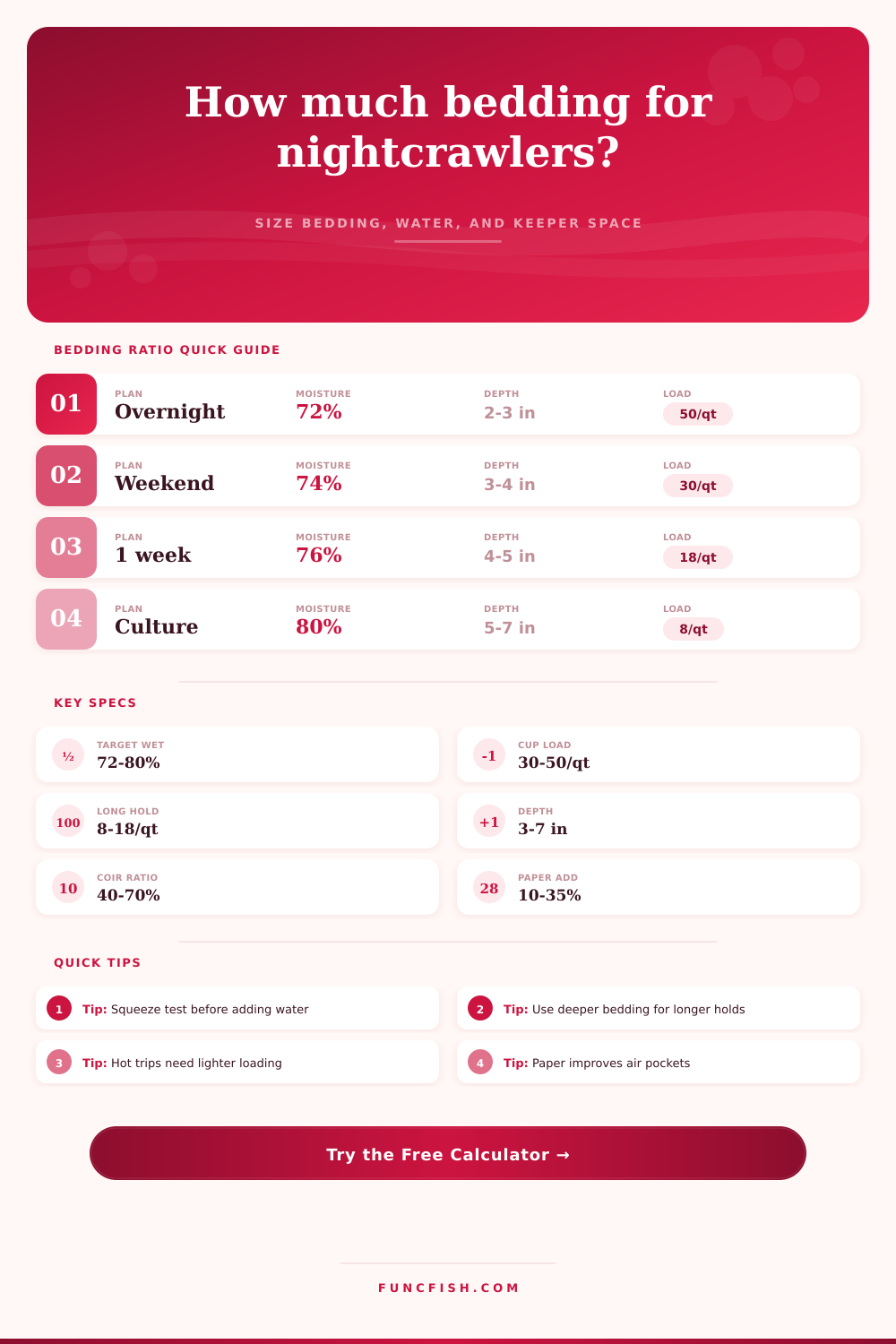
| Overnight bait cup | 72% | 2 to 3 in / 5 to 8 cm | Up to 50 per qt / 53 per L |
| Weekend cooler tub | 74% | 3 to 4 in / 8 to 10 cm | Up to 30 per qt / 32 per L |
| One-week keeper | 76% | 4 to 5 in / 10 to 13 cm | Up to 18 per qt / 19 per L |
| Two-week holding bin | 78% | 5 to 6 in / 13 to 15 cm | Up to 12 per qt / 13 per L |
| Culture starter tray | 80% | 5 to 7 in / 13 to 18 cm | Up to 8 per qt / 8 per L |
| Hot weather travel | 73% | 3 to 5 in / 8 to 13 cm | Up to 15 per qt / 16 per L |
| Bedding mix | Dry density | Moisture target | Ratio note |
|---|---|---|---|
| Peat and coir bait blend | 5.4 lb/ft³ / 86 kg/m³ | 76% | 50% peat, 40% coir, 10% paper |
| Coir and shredded paper | 4.6 lb/ft³ / 74 kg/m³ | 74% | 65% coir, 35% paper |
| Leaf mold and coir | 5.1 lb/ft³ / 82 kg/m³ | 78% | 45% leaf, 45% coir, 10% paper |
| Peat and paper aeration | 4.8 lb/ft³ / 77 kg/m³ | 75% | 70% peat, 30% paper |
| Commercial worm bedding | 5.8 lb/ft³ / 93 kg/m³ | 73% | Use as blended, then adjust water |
| Rinsed coir only | 4.4 lb/ft³ / 70 kg/m³ | 76% | Fluff before loading crawlers |
| Crawler size | Average mass | Capacity factor | Best keeper use |
|---|---|---|---|
| Small bait crawlers | 0.8 g / 0.03 oz | 1.25 | Dense bait cups and panfish trips |
| Standard nightcrawlers | 1.4 g / 0.05 oz | 1.00 | General bass, trout, and walleye bait |
| Jumbo nightcrawlers | 2.2 g / 0.08 oz | 0.72 | Catfish and larger hook rigs |
| Canadian crawlers | 3.0 g / 0.11 oz | 0.55 | Bulk trays with cooler storage |
| Moisture reading | Texture cue | Correction | Keeper effect |
|---|---|---|---|
| Below 45% | Dusty, falls apart | Add water slowly | Crawlers dehydrate quickly |
| 55% to 68% | Clumps then crumbles | Small water addition | Good for short trips only |
| 72% to 80% | Holds shape, no drip | Target range | Balanced moisture and air |
| Above 84% | Glossy or dripping | Add dry bedding | Low air space risk |
💡Bedding ratio checks
Moisture check: The calculator treats moisture as water mass divided by finished bedding mass. If your bedding drips when squeezed, enter a high current moisture value and follow the dry-mix correction.
Loading check: Bedding can be wet enough but still overloaded. For longer holds, give nightcrawlers more volume per worm so heat, waste, and low oxygen do not stack up.
You buy premium nightcrawlers and put them in a keeper box lined with bedding. Then off you go to the tournament only to find your worms is crawling around sluggishly (or trying to) by day two. The bedding are now a stinky slime. What happened? Nothing that you did up top was incorrect. You just got the ratio incorrect. Getting the balance of space, moisture and air right make all the difference between a healthy worm and a dead one.
Most anglers treat bedding like dirt. They think if you put worms in dirt, you’re doing it right. But soil function more like a wet blanket inside a closed keeper box. Once you know how big of a box you’re using, and for what length of time, the calculator do the math. You don’t have to guess conversions or coefficients. Knowing why these numbers exist helps you avoid killing your bait.
How to Keep Your Worms Alive
Moisture content is the main variable. Because nightcrawlers breathe through their skin, they requires a moist bedding with sufficient oxygen diffusion. To do this, the bedding needs to be both loose and damp. Moisture levels below sixty-five percent are too low and above eighty percent is too high. At seventy-five percent or thereabouts, however, the bedding will hydrate the crawlers without being waterlogged. It’s a small window but it’s all that’ll work.
But then there’s that other thing: how you make it. What kind of material do you pack? For short trips, coir works best, as its fluffier light texture provides good structure and keep the bedding from packing down. However, coir doesn’t hold water as well, nor does it pack compact enough for longer trips like overnights. Dense materials such as peat hold moisture better and allow for more compact packing for long trip. But it kills air pockets required by the worms. A mixture of both will yield best results. With the tool you can pick your blend, and it will adjust the dry weight calculation based off that.
Why does this matter? Well, a pound of coir isn’t as heavy than a pound of peat. You’ll need more volume for the same supporting power when using all coir. Even if you’re below the maximum number of worms per pound, you might still be overcrowded if not accounting for density.
The common mistake is loading density. How many crawlers do you cram into a space? At what point does the waste heat and carbon dioxide reaches toxic proportions? According to the chart, about three-dozen worms per quart are manageable for a weekend trip; less than 20 will suffice for a week-long stay. Yes, you may be able to jam more in for several days but heat builds rapidly. A cooler in a hot truck acts like an oven. Metabolic heat is produced by the worms, and without anywhere to escape, they’ll cook themselves. For long trips, halving the load isn’t a safety margin (it’s survival).
And finally: Water correction. Don’t send the worms off to bed dry; don’t pour so much water into the mix all at one time that you create pockets of anaerobic sludge, which will foster bad bacteria. The ideal amount of water to top it off with depends on how dry your mix was when you recieve it. It also depends on the desired moisture content shown by the calculator. That way you won’t be drenching the bed, as so many people do. The goal is a damp sponge, not a wet towel. And the squeeze test tells you when you’ve reached the right spot. If dripping, back off. If no leaks after squeezing tightly, bingo, you’re in the zone.
A couple things make all the difference in turning a basic bait keeper into a viable, self-sustaining micro climate for your worms. They can breathe, they clean up their own waste, and they’re ready to bite when you hook them. It’s a science instead of a guessing game for taking care of baits.
Use a good starting mix. Don’t overdo the moisture levels. Give ’em space to breathe. And it would of pay off in fish caught.