Non-Slip Loop Turns Calculator
Estimate the number of turns for a non-slip loop knot using line material, diameter, breaking strength, lure motion, loop opening, drag load, and seating quality.
📌Non-slip loop presets
⚙Knot and tackle settings
Package diameter is more useful than label strength for turn count.
Measure the open space inside the finished loop, not the folded line length.
Non-slip loop recommendation
Calculation breakdown
📊Line material data
Nylon Mono
Fluorocarbon
Soft Tippet
Braid
📏Turn count by line class
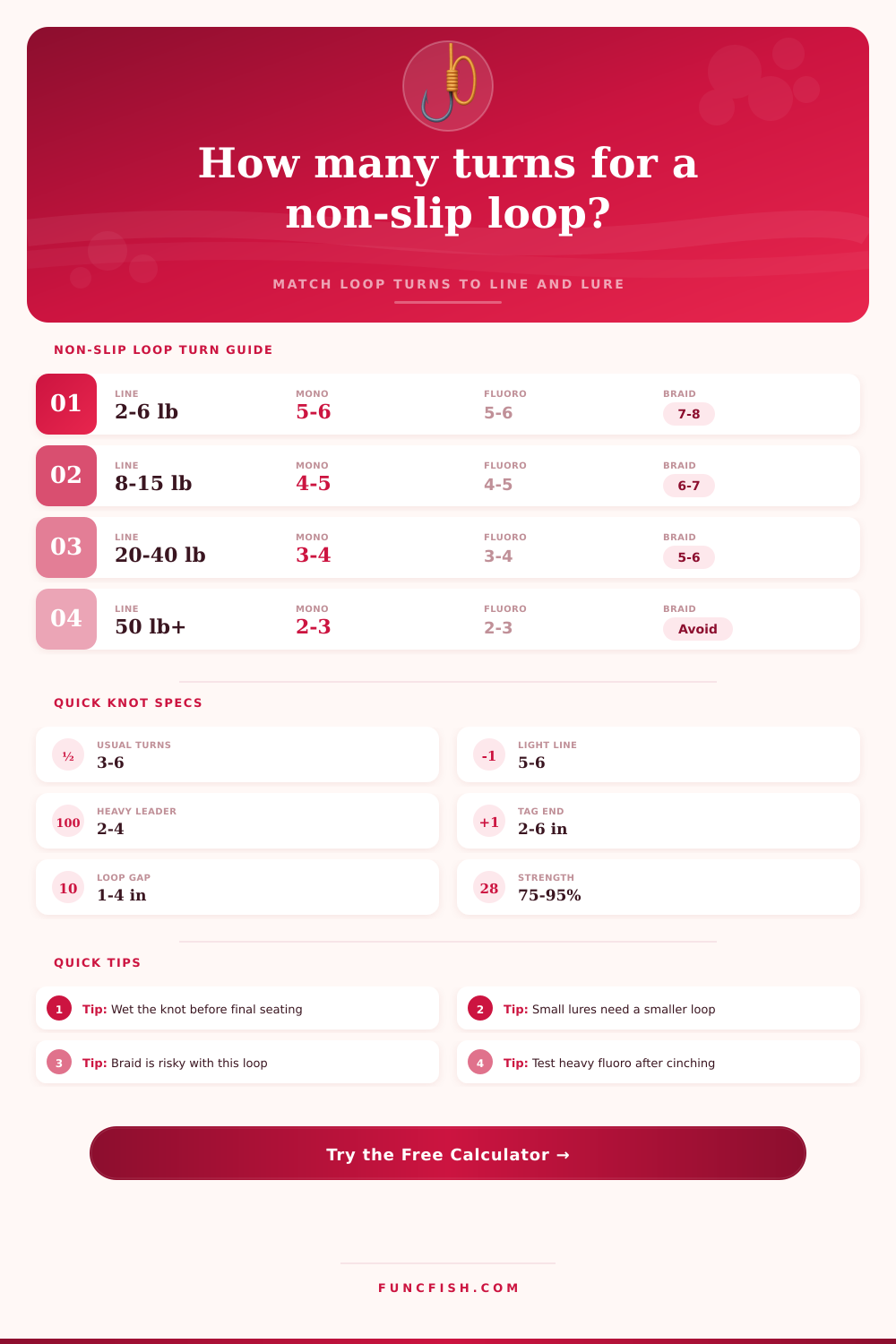
| Line class | Approx diameter | Mono turns | Fluoro turns | Braid note | Common loop use |
|---|---|---|---|---|---|
| 2-4 lb / 0.9-1.8 kg | 0.005-0.008 in / 0.13-0.20 mm | 5-6 | 5-6 | 7-8, test hard | Dry flies, micro jigs |
| 6-10 lb / 2.7-4.5 kg | 0.008-0.011 in / 0.20-0.28 mm | 4-5 | 4-5 | 6-7, slippery | Bass, trout, panfish lures |
| 12-20 lb / 5.4-9.1 kg | 0.011-0.017 in / 0.28-0.43 mm | 4 | 4 | 6+, not ideal | Inshore jigs and plugs |
| 25-40 lb / 11-18 kg | 0.018-0.024 in / 0.46-0.61 mm | 3-4 | 3-4 | Use another knot | Surf plugs, heavier leaders |
| 50-80 lb / 23-36 kg | 0.028-0.036 in / 0.71-0.91 mm | 2-3 | 2-3 | Avoid loop knot | Tarpon, offshore leaders |
| 100 lb+ / 45 kg+ | 0.039 in+ / 1.00 mm+ | 2-3 | 2-3 | Avoid loop knot | Specialty heavy bite leaders |
🎣Loop size and lure motion table
| Lure or fly type | Typical weight | Inside loop opening | Why it matters | Turn tendency |
|---|---|---|---|---|
| Tiny dry fly or nymph | Under 1/32 oz / under 1 g | 0.10-0.25 in / 3-6 mm | Prevents oversized hinge | More turns on light tippet |
| Small jig or streamer | 1/64-1/16 oz / 0.4-1.8 g | 0.20-0.45 in / 5-11 mm | Lets the fly pulse | Normal light-line turns |
| Bass popper or jerkbait | 1/8-3/4 oz / 4-21 g | 0.50-1.00 in / 13-25 mm | Supports side-to-side action | Standard 4-5 turns |
| Inshore spoon or jighead | 1/4-1 oz / 7-28 g | 0.60-1.25 in / 15-32 mm | Maintains swing under retrieve | Standard to reduced turns |
| Surf plug or swimbait | 1-3 oz / 28-85 g | 1.00-2.00 in / 25-51 mm | Clears lure eye and split ring | Check heavy leader seating |
| Large offshore live bait | 3 oz+ / 85 g+ | 1.50-3.00 in / 38-76 mm | Allows bait movement | Fewer turns, long tag |
🔧Tag length and seating reference
| Leader diameter | Starting tag length | Trimmed tag | Seat pressure | Inspection point |
|---|---|---|---|---|
| Under 0.20 mm / 0.008 in | 2.5-3.5 in / 64-89 mm | 1-2 mm | Light, steady pull | Turns stay side by side |
| 0.20-0.35 mm / 0.008-0.014 in | 3-4 in / 76-102 mm | 2-3 mm | Wet, firm pull | Loop size does not collapse |
| 0.36-0.60 mm / 0.014-0.024 in | 4-5.5 in / 102-140 mm | 3-5 mm | Seat in stages | Standing line exits straight |
| 0.61-0.90 mm / 0.024-0.036 in | 5-7 in / 127-178 mm | 4-6 mm | Heavy wet draw | Overhand knot beds fully |
| Over 0.90 mm / 0.036 in | 7-10 in / 178-254 mm | 5-8 mm | Glove-assisted pull | No crossed wraps or kinks |
⚠Condition adjustment table
| Condition | Turn effect | Strength effect | Best correction | Use caution when |
|---|---|---|---|---|
| New, wetted line | No change | Baseline | Seat slowly | Loop twists while cinching |
| Used clean line | No to +1 turn | -3% | Retie if flattened | Line shows abrasion |
| Cold or stiff leader | -1 turn often seats better | -5% | Warm and wet the knot | Fluoro coils hard |
| Salt film or grit | +1 turn if slippery | -8% | Rinse before tying | Leader feels dusty |
| Old memory coils | +1 turn or retie leader | -10% | Replace damaged leader | Knot does not bed evenly |
🐟Gear and species comparison grid
Trout Tippet
Line: 3-6 lb mono or fluoro tippet
Loop: 0.10-0.35 in
Turns: 5-6 for small flies
Bass Plugs
Line: 10-17 lb mono or copolymer
Loop: 0.50-1.00 in
Turns: 4-5 for walking action
Inshore Flats
Line: 15-30 lb fluoro leader
Loop: 0.60-1.25 in
Turns: 3-4 with a firm test pull
Surf Casting
Line: 30-50 lb mono leader
Loop: 1.00-2.00 in
Turns: 3-4, inspect for burn
Pike and Musky
Line: Heavy mono or bite leader
Loop: 1.00-2.00 in
Turns: 2-3 on thick mono only
Bonefish Fly
Line: 8-16 lb fluoro tippet
Loop: 0.25-0.60 in
Turns: 4-5 for shrimp flies
Tarpon Leader
Line: 40-80 lb fluoro or hard mono
Loop: 1.00-2.50 in
Turns: 2-3, pull test fully
Kayak Inshore
Line: 12-25 lb mono or fluoro
Loop: 0.50-1.25 in
Turns: 4 in most conditions
💡Calculator notes
Turn-count tip: The non-slip loop knot is sensitive to both slickness and stiffness. Thin or slippery line usually needs more turns; heavy stiff leader often seats cleaner with fewer turns and a longer tag.
Loop-size tip: A larger loop can improve plug, jig, and fly movement, but it also uses more tag length and can foul on hooks or split rings. Keep the loop only as large as the lure action needs.
The loop at eye is the reason many walking baits fail to perform well. It can drag and impede action or limit how far it can walk. Nine times out of ten, it’s not the bait, but the knot.
The non-slip loop is actualy pretty simple in design, but very difficult to tie right so that it performs as intended. If done right, you’ll have 80-90% line strength retention. Most anglers don’t know what affect that retention rate until they get bit off.
Tips for Tying Better Knots
Knots are about tension, they’re about how much friction you can build up and how rigid a knot will be when it comes time to stand up to big fish. Braid is slick with zero give; Fluorocarbon is stiff and slick and monofilament is stretchy and has memory. So if you use the same number of turns with all three knots? You’ll get different result from each.
A thinner line require additional wraps to generate sufficient friction to retain the load. A heavier leader needs less because its bulk give it stopping power. The calculator accounts for your line type and its diameter. It then recommends correct number of turns so the knot doesn’t slip under pressure and the thicker leader doesn’t get over-tightened or kinked.
Knot security matters but loop size matters, too. For a tiny tippet, a dry fly need a loop barely larger than hook gap to prevent unwanted fluttering in current. With a big swimbait, opposite is needed. You need inches of open loop so the bait can swing out and kick its tail.
When the loop is too small for the bait, the bait’s body will rub against leader during the retrieve. Friction causes resistance on reel, masking any subtle bite and changing action from the one intended. Based off the lure’s weight and the action you desire, the tool helps size opening in the loop to make sure you’re tying a knot that doesn’t fight the way it is retrieved.
Water is also critical because you need to wet all wraps prior to cinching. A dry knot creates friction and heat when tightened. This heat scorches the molecular structure of the fluorocarbon and nylon, weakening the line exactly where you don’t want it compromised. Saliva or just a quick dip into water bottle will create a lubricating barrier between wraps allowing them to slide together tightly without scorching. This simple action makes the difference between a broken leader at 40-pounds and one holding a wiggling 60-pound chunk of stripers on the other end of line.
These conditions impact efficiency as seen in line conditions tables. Old memory coiled line gets weaker, and line with salt crust gets weaker too. Rinsing your leaders is important, and so is tying a good knot.
Loop knots still don’t work well on braid The braid we fish today is super strong and slick, which means it’s dangerous when carrying large loads. Because of the lack of friction, they recommend more turns for braided line. And if those turns aren’t seated just right, they’ll blow up from a sudden shock load way more then a lot. Many experienced anglers avoid tying loop knots directly into braid, choosing instead to use a different knot to attach a fluorocarbon or mono leader. But if you want to do it, be precise or it won’t happen. A single off-center pull or one bad wrap will ruin your day.
There’s a lot of energy in a fish. When you’re fighting one, you need that energy transferred through your line and then out through your reel and ultimately up through your rod so it goes back to the fish. You don’t want it wasted because of a tight lure action or slipping knot.
Spending those few minutes figuring out how big your loops should be and how many times they should turn eliminates hours of aggravation on the water. What would of been an equipment failure becomes a solid connection. Tying a knot isn’t the point. It’s establishing a system where your equipement performs as intended. That focus on details is what makes luck turn into consistent catches.