
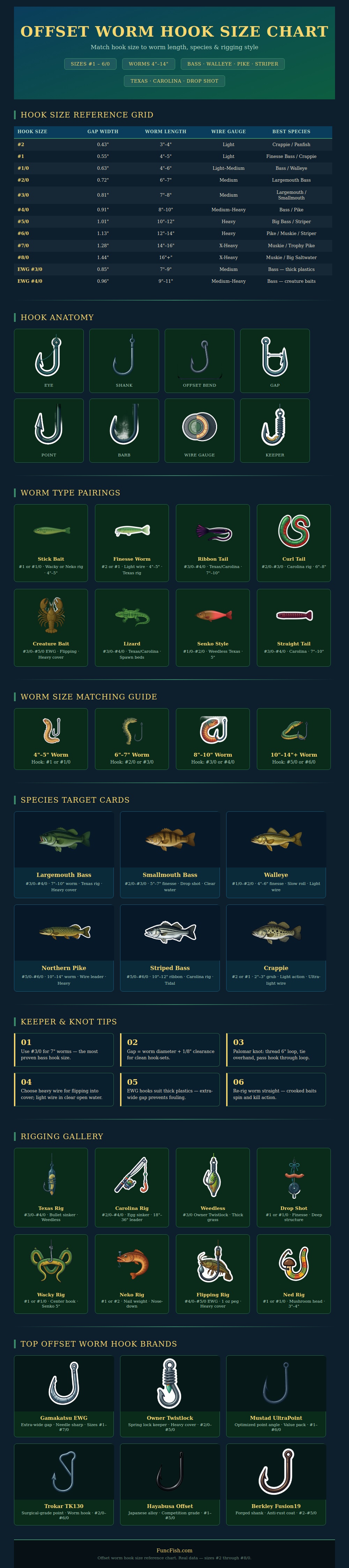
How many times have you felt that bite, set the hook, and felt that tug on the line, only to come up with nothing but an empty, limp line? There is nothing worse then seeing the rod bend and your heart racing, only to realize you have nothing but an empty, limp line. It is not bad luck. Almost always this is due to a size difference in the metal hook to the worm on the line. Getting that offset correct can be the difference between a day of lost fish to a full livewell by noon. I’ve illustrated in the chart above their correlation with both the size of the target fish and length of the worm.
No more guesswork in boat. Hook size is something most guys give little thought about. We grab what’s in front of us at the counter at the tackle store. But the width of the gap in your hook make just as big a difference. Too small and the plastic obstructs the hookset with your thick creature bait. Too large and the worm look like it is swimming on a tricycle. You want that hook to vanish inside the worm but have enough space to grab his bone on the bite. There’s a fine line between mechanics and concealment.
How to Choose the Right Hook Size
Consider the common seven-inch largemouth bass plastic worm. The numbers point right at that sweet spot; three-zero. It’s big enough to keep the bait secure yet small enough to allow wary largies to choke it down. Go one size larger to ten-inches for northern pike or stripers and you want the beefier wire because those two predator show brute force. Using a finesse hook on a trophy muskie is like trying to hang a door with a thumbtack. With all the force against the line, the hook simply can’t bends back in place when under extreme load. You lose a bit of sensitivity but gain strength to withstand the abuse of a musky hooked around cover.
What are your thoughts? The hook shape is decided as much by rigging style as it is the species. Because you need a point buried in the head of a Texas-rigged worm for weedless presentations, that’s where all those offset bends comes into play. The bend lets the eye of the hook lie flat against the bait so the bait sits straight on bottom. A crooked worm will spin and tangle up your line right away.
Creature baits paired with extra-wide gap hooks make perfect sense. These baits is designed for thick plastics, like worms with legs or appendages. The wider gap ensures the hook find flesh despite the bulky plastic getting in the way.
Tying knots is important as well. If you are using big hooks on heavy line with toothy critters such as walleye and pike, you need something strong. That’s where a palomar knot comes in. Pass the hook through and then take the other end and run it through the loop and pull tight. Seems simple enough but a poor knot means you set the hook perfectly only to lose the fish. All that time choosing the correct weight and size and a crappy over hand knot let you down at the point of connection. Don’t let the end cost you what was supposed to be a good catch.
The other key choice is whether to use a light or heavier gauge wire hook. A light wire will penetrate better on pressured fish in clear water. A heavy wire holds position in cover, but it can deflect off tough mouths if you fail to time the strike. Crappie have little mouths so they require smaller sizes with an ultra-light wire for panfish use. Even then a number two hook is frequently too large for a small grub as shown by the chart above. Going with the right size and keeping it scaled down helps keep the presentation naturaly.
To conclude. This all boils down to matching the opportunity to the offer. You match the hook size to the reaction of the fish and to what they’re eating. Whether you have the smallest worm or the biggest gear doesn’t matter. Matching the bait and the tool that delivers the bait is what matters. And when all those things comes together the fight is different. From the initial pull there’s a solid connection. The hook sets securely, and you have no doubts about what is happening at the other end of your line. Because that’s what you do, tweak all the little details; because that’s why we spend so much time doing this. It makes a missed bite a memory that you’ll share stories about long after the water turns cold. You should of used a better hook.