
The first mistake most beginning aquarists make is to purchase that little 2″ oscar at the pet shop because you think it’s going to be something you can handle as a fishkeeping project. It swims around in its small tank easily, and it is hardly bigger than my thumb. How bad can it be?
Little do you know these are some of the fastest growing cichlids out there. What starts off charming soon becomes a rude awakening…big tanks, high expenses for tank modifications, huge water changes, you name it. To prevent unexpected expenses, you learn the hard lesson about the true size of these fish. But more importantly, you appreciate the beast you’ve welcomed into your house.
Why You Should Get a Big Tank for Your Oscar
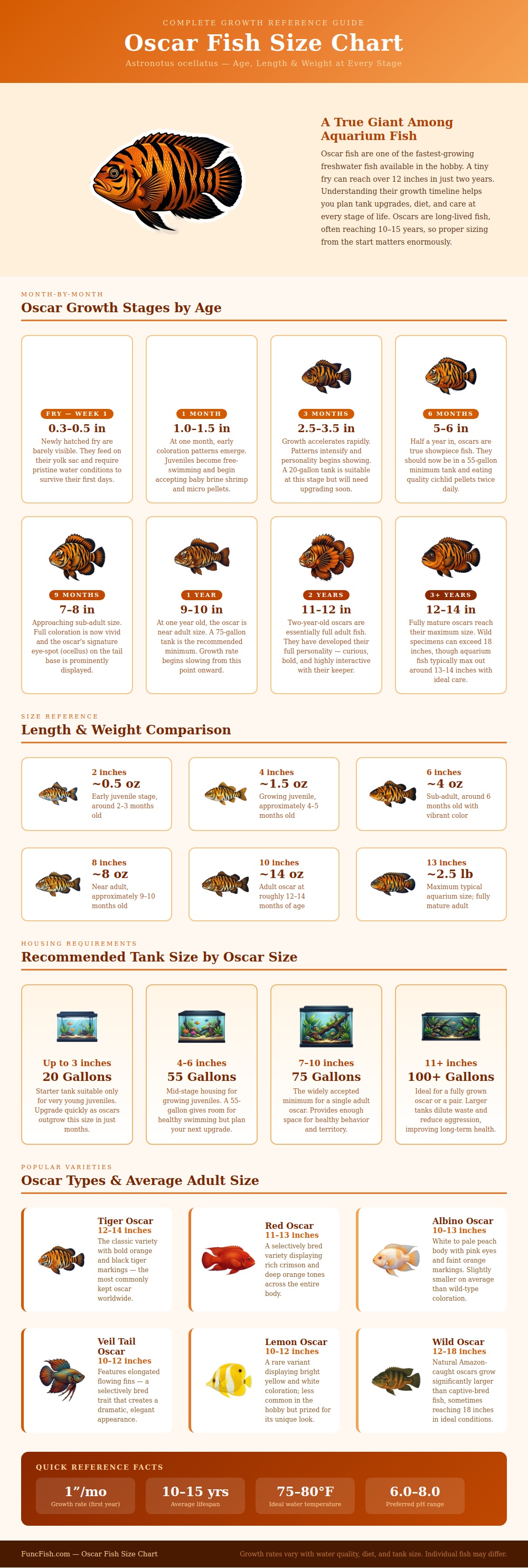
From tiny fry to a large predator within just under two years, an oscar has one of the most dramatic growth trajectories in the freshwater hobby. This growth is incredibly fast, and it’s easy to see when you break it down (see visual guide at top). At least they don’t look like much of a threat initially. A three-inch-long fish can be kept quite nicely in a twenty gallon tank. However, by six months old, that fish is pushing six inches. That means it needs much more space.
It’s a sharp learning curve, one that most hobbyists fail to realize until their oscar outgrows its environment and becomes slow due to stunting. This critical period is indicated on the graphic; you simply cannot get away with upgrading from a fifty-five to a seventy-five gallon setup; it has become a necessity.
The other key factor is food. Because of how fast they grow, oscars has an equally ravenous appetite for everything, which includes any décor item they can fit into their mouths. If you’re not careful, your decor is always at risk. While this may seem like fun (and it is), it’s actualy instinctive. In their natural environment of the Amazon, food availability can fluctuate. To develop those muscles, oscars must receives a quality source of protein consisting mainly of pellets with the occasional addition of live foods. Even if you keep them in a big tank, good nutrition are needed to reach their full potential.
Notice on the chart above how length is accompanied by weight gain? What does this tell us? These aren’t just long fish; they become heavy, too. An adult 10″ oscar weighs quite a bit and produces more than its fair share of biological waste. Good filtration are necessary!
In addition to planning your space, keep in mind that variety is also an issue. The typical oscar is a tiger oscar. You may also find veil tails, albinos, and reds. All look a little different but all basically need the same amount of space. However, if you get veils, note that their long fins makes them more likely to tear, so they are not ideal for an aggressive community tank.
Wild type oscars is capable of reaching a larger size (sometimes over eighteen inches) as compared to their captive bred versions. And your domestic specimen might top out at around fourteen inches, no slouch either. Just don’t let the small average adult size of the lemon oscar or albino fool you. They’re still going to want the same level of stable water volume and infrastructure of a serious cichlid keeping setup.
And then there’s the long term. With good care, an Oscar will easily reach 10-15 years of age, which means keeping a big, high-maintenance aquarium for a whole decade. After you’re done getting giddy about their growth, it’ll turn into the grind of filter changes and water checks.
However, this is when the individuality comes out. Adult oscars are well-known for becoming “personality fish“. They’ll interact with you, remember your face(s), and yes… Sometimes they’ll even beg at the glass for a treat. They form relationships. And as social animals, they’re smart enough to know how to do so. That is why dealing with the headache of upgrading to a larger tank later on is worth it.
The biggest mistake I see people make is to assume they’ll be able to handle the end game when they start out. They won’t. Start planning now. Save yourself a bunch of money and stress. If you can, get the biggest tank you can afford right from the beginning. This will give them some space to stretch out as they bulk up.
Also, having some space helps dilute waste and stabilizes parameters. This also simulates their tropical origin, where temperature needs to remain stable (around seventy-eight degrees Fahrenheit). Water chemistry doesn’t have to be perfect; stability trumps perfection. Preparing and being patient are in the end the keys to keeping an oscar.
The road map of that process is laid out in the chart above. Understanding this timeline today means you won’t be panicking down the road when your pet outgrows its world. Having a fish isn’t just having a fish; it’s creating an environment where a creature can thrive from fry to fully mature adult. This is what differentiates a magnificent oscar from one that struggles.