⚓ Outboard Motor Shaft Length Calculator
Find the correct shaft length for your outboard motor based on your transom height and boat type
38 cm
51 cm
64 cm
76 cm
| Transom Height (in) | Transom Height (cm) | Shaft Code | Shaft Length (in) | Shaft Length (cm) | Typical Boat Type |
|---|---|---|---|---|---|
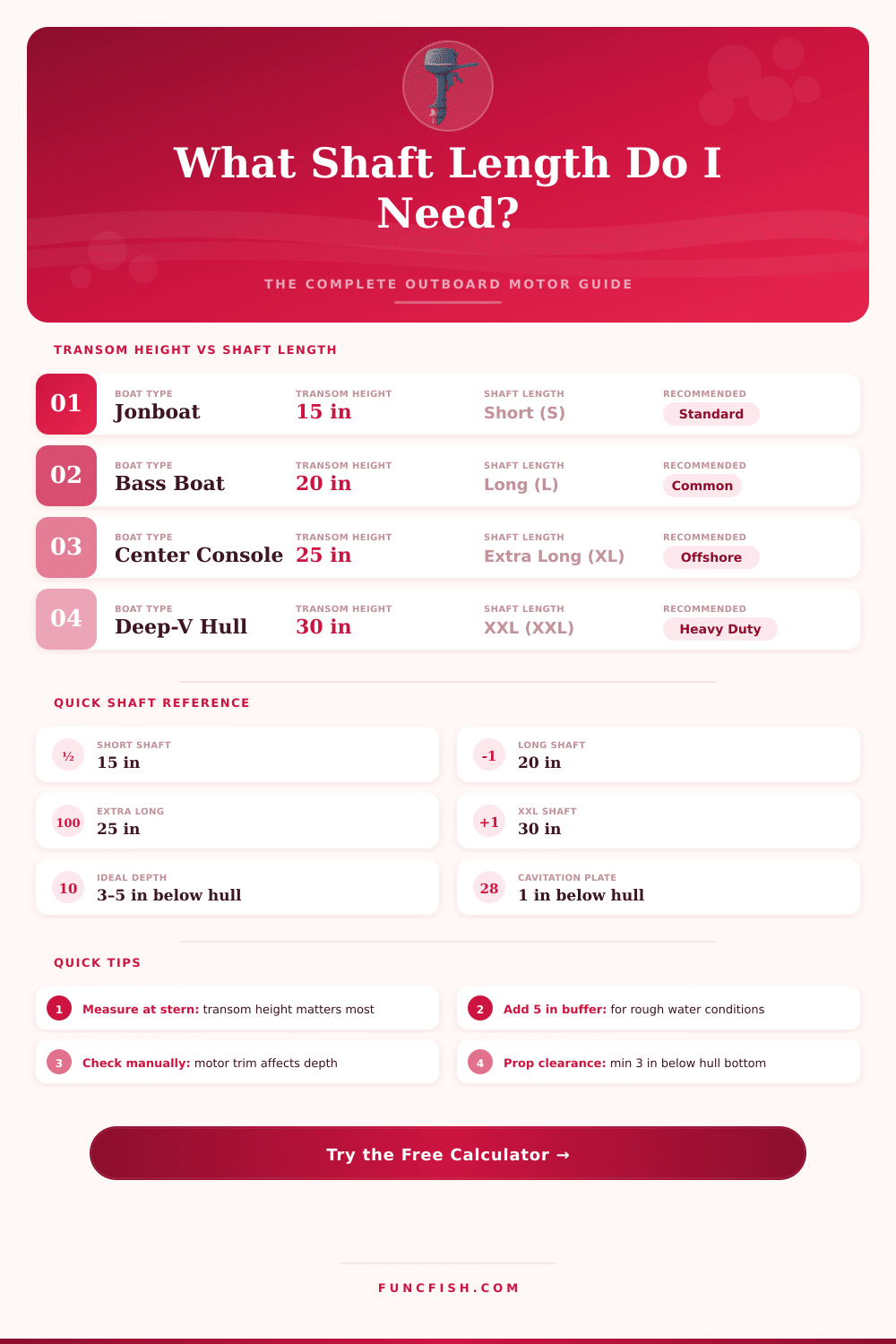
| 13–16 | 33–41 | Short (S) | 15 | 38 | Jon Boat, Inflatable, Small Tender |
| 17–22 | 43–56 | Long (L) | 20 | 51 | Bass Boat, Pontoon, V-Hull |
| 23–27 | 58–69 | Extra Long (XL) | 25 | 64 | Center Console, Bay Boat |
| 28–32 | 71–81 | XX-Long (XXL) | 30 | 76 | Deep-V, Offshore Cruiser |
| 33+ | 84+ | Custom / Triple | 35+ | 89+ | Commercial, Large Offshore |
| Boat Type | Typical Transom (in) | Typical Transom (cm) | Recommended Shaft | HP Range |
|---|---|---|---|---|
| Jon Boat (small) | 15 | 38 | Short (S) 15 in | 2–25 HP |
| Aluminum V-Hull | 20 | 51 | Long (L) 20 in | 25–75 HP |
| Bass Boat | 20 | 51 | Long (L) 20 in | 75–150 HP |
| Pontoon Boat | 20 | 51 | Long (L) 20 in | 40–115 HP |
| Flats / Skiff | 20 | 51 | Long (L) 20 in | 40–90 HP |
| Center Console | 20–25 | 51–64 | Long or XL | 90–300 HP |
| Deep-V Offshore | 25–30 | 64–76 | XL or XXL | 150–350 HP |
| Inflatable / RIB | 15 | 38 | Short (S) 15 in | 2–30 HP |
| Offshore Cabin | 25–30 | 64–76 | XXL 30 in | 200–400 HP |
| Motor Class | HP Range | Common Shaft Lengths | Min Prop Clearance | Cavitation Plate Depth |
|---|---|---|---|---|
| Small | 2–15 HP | Short (15 in / 38 cm) | 1.5 in / 3.8 cm | 0–1 in below hull |
| Mid | 20–60 HP | Long (20 in / 51 cm) | 2.5 in / 6.4 cm | 0–1.5 in below hull |
| Large | 75–150 HP | Long or XL (20–25 in) | 3 in / 7.6 cm | 1–2 in below hull |
| X-Large | 175–350+ HP | XL or XXL (25–30 in) | 4 in / 10 cm | 1.5–2.5 in below hull |
Election of the right shaft length for the pole of your outboard motor is key for good working ship setup. Here the main point: the available shaft lengths limit themselves to some usual types. For transoms with height of 15 inches or less, one uses short pole, on the other hand long poles answer for 20-inch transoms.
In addition exists the XL-type in 25 inches, and for truly high transoms, between 30 and 31.5 inches (one chooses XXL). The most many ships end with the standard 20-inch long pole that is the most popular option.
How to Pick the Right Shaft Length for Your Outboard Motor
For guessing the shaft length of your present pole, the process is easy. Take flexible tape and start at the inner upper part of the mounting spot, where it clamps to the transom, later extend it down until the anti-cavitation plate. This is the flat horizontal part, that sits right above the propeller.
The resulting distance so shows your shaft length. If it reaches around 15 inches, then you deal with a short shaft length engine.
For little ships under 15 feet, for instance dinghies or aluminum bodies, short or even ultra-short poles usually answer well, according to the transom height of 40 centimeters or more. If the transom goes past 50 centimeters, then you need a long shaft length system. Here shows clear distinction.
Boats with low transom, as inflatables or little floating platforms, match with short poles, while deeper hulls, as sea ships, requires the longer model four reach the water correctly.
No right shaft length cause troubles. If you mount a long shaft length engine on a short transom, the propeller ends about 6 inches too below, so almost 14 centimeters; than should be. The impact is bad.
A transom lever can help, because it moves the engine to the right position. Many engines themselves have a bit of adjustment space, around 2 inches, through the mounting holes, which is useful when the sizes are a bitaway from the standard.
For trolling engines the rules fully differ. With them the shaft length does not play a role. What truly matters, is the vertical distance from the mounting place, commonly the brim or the gunwale, down until the water surface.
The supports must stay under at least one foot under the water. The math is simple: measure from the gunwale to the water, add 12 inches, and round to the nearest available shaft length. For instance, if your gunwale is 18 inches above the water, add 12 and you get 30 inches, so choose at least 36-inch pole.
The lengths for trolling engines range according to the kind of your ship. Drift boats work well with 42-inch pole. Carolina-ships and alike models require 54-inch version.
For designs with higher brim, one could use 60-inch or even 72-inch pole. If your brim is 34 inches above the water, then 72-inch shaft length becomes needed. Longer than strictly needed is the safer choice.
One always can use longer pole with no full depth, but short one can not extend.