Hook Size for Panfish Calculator
Choose a panfish species, size class, bait profile, hook style, line test, rig depth, and water clarity to estimate a balanced hook size and rig match.
📌Panfish presets
⚙Hook and rig inputs
Use bait width across the thickest part, not full bait length.
Panfish hook recommendation
Detailed breakdown
🧰Panfish bait, hook, and line grid
Waxworm
Cricket
Small Jig
Micro Plastic
Dough Bait
📏Species and size class reference
| Species | Small nibblers | Average keepers | Large hand-size fish | Trophy slabs or jumbos | Typical hook lane |
|---|---|---|---|---|---|
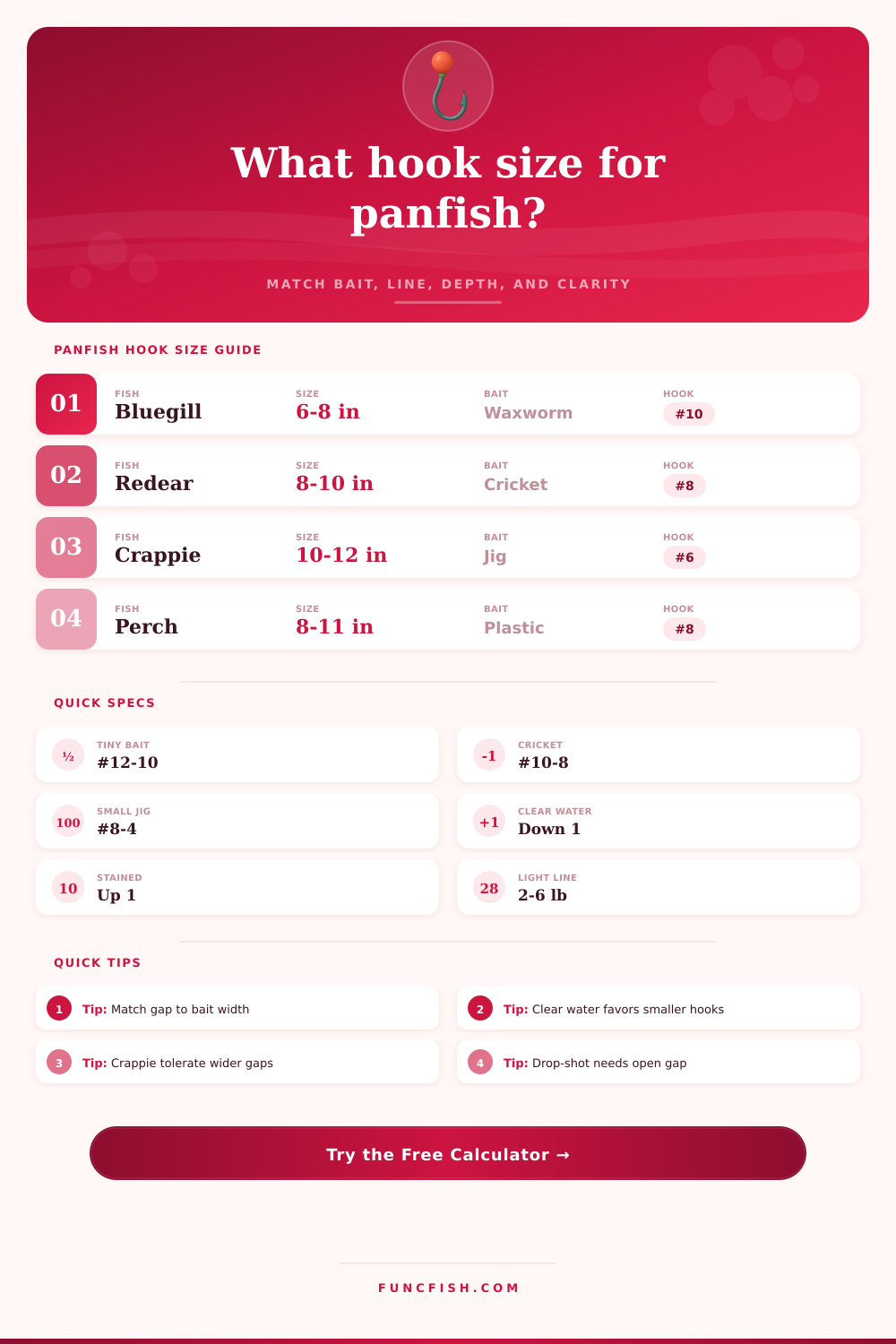
| Bluegill | 3.5-5 in / 9-13 cm | 5.5-7 in / 14-18 cm | 7.5-9 in / 19-23 cm | 9.5-11 in / 24-28 cm | #12 to #6 |
| Redear sunfish | 4-6 in / 10-15 cm | 6.5-8.5 in / 17-22 cm | 9-11 in / 23-28 cm | 11.5-13 in / 29-33 cm | #10 to #4 |
| Crappie | 6-8 in / 15-20 cm | 8.5-10.5 in / 22-27 cm | 11-13 in / 28-33 cm | 13.5-16 in / 34-41 cm | #8 to #2 |
| Yellow perch | 5-7 in / 13-18 cm | 7.5-9 in / 19-23 cm | 9.5-11.5 in / 24-29 cm | 12-14 in / 30-36 cm | #10 to #4 |
🎣Bait, hook, and line comparison table
| Bait profile | Best hook styles | Common sizes | Line test | Rig fit | Notes |
|---|---|---|---|---|---|
| Waxworm / spike | Aberdeen, long shank | #12, #10, #8 | 1-4 lb / 0.5-1.8 kg | Float or tiny jig | Thin wire keeps bait lively and leaves point exposed. |
| Cricket / grasshopper | Baitholder, Aberdeen | #10, #8, #6 | 2-6 lb / 0.9-2.7 kg | Float around cover | Use enough gap that the cricket body does not block the point. |
| Small jig | Jig head, Aberdeen | #8, #6, #4 | 3-6 lb / 1.4-2.7 kg | Jig float or vertical | Crappie and perch often need a wider bite gap. |
| Micro plastic | Jig head, drop-shot | #10, #8, #6, #4 | 2-6 lb / 0.9-2.7 kg | Drop-shot or float | Match hook length to the plastic body, then confirm gap. |
| Dough / pellet bait | Baitholder, octopus | #12, #10, #8 | 2-4 lb / 0.9-1.8 kg | Float or tight-line | Small hooks hide well, but the point must stay clear. |
🔧Hook style reference
| Hook style | Strength | Best use | Calculator effect | Panfish caution |
|---|---|---|---|---|
| Aberdeen | Fine wire, long shank | Waxworms, crickets, crappie minnows | Neutral gap with easy removal | Can bend if pulled hard around brush. |
| Baitholder | Medium wire with barbs | Crickets, dough, soft bait | Adds slight bait-holding bias | Downsize in clear water to reduce bulk. |
| Jig head | Fixed weight and hook | Crappie brush, perch flats | Wider gap for moving bait | Check that the jig hook is not too stout. |
| Drop-shot hook | Open gap, compact shank | Deep fish and vertical bites | Requires extra exposed point | Nose-hook plastics lightly for better movement. |
| Octopus / circle style | Short shank, turned point | Dough balls, small live bait | Moderate gap with holding power | Avoid oversized circles on small bluegill. |
| Long shank | Easy handling, narrow gap | Perch and small sunfish | Slight downsize for tiny mouths | Too much shank can lever out of crappie. |
💧Depth and clarity adjustment table
| Condition | Hook adjustment | Line adjustment | Float / drop-shot depth cue | Reason |
|---|---|---|---|---|
| Clear water | Down one size when bites are light | Lean toward 1-4 lb / 0.5-1.8 kg | Set bait just above fish level | Smaller profile looks natural and draws less attention. |
| Light stain | Use calculated size | Use normal recommendation | Float depth can match the strike zone | Balanced visibility and finesse. |
| Stained water | Up one size for bait presence | Add about 1 lb / 0.5 kg if cover is close | Keep bait slightly higher than fish | A little more profile helps fish locate bait. |
| Muddy or low visibility | Favor wider gap and brighter jig | Use 4-6 lb / 1.8-2.7 kg | Shorten drops until bites repeat | Fish often feed by silhouette and vibration. |
| Depth over 10 ft / 3 m | Keep point more exposed | Avoid overly stretchy heavy mono | Drop-shot spacing matters more | Deep bites need cleaner hook penetration. |
💡Calculator notes
Gap check: After bait is threaded, at least one-third of the hook gap should remain open. If the bait plugs the bend, move one size larger or use a slimmer bait.
Line check: Panfish hooks work best when line, bait, and hook wire match. Very heavy line can make a correct hook fish like an oversized one in clear water.
Hook size is an important factor in panfish fishing because teh size of the hook will determine if the panfish will successfully stay on an hook. If the angler chooses a hook size that is too large for the species of panfish that is being targeted, the panfish will likely ignore the bait. Alternatively, if the hook size is too small for the species of panfish that is being targeted, the panfish will likely spit out the bait prior to any hookup occurring between the fish and the bait.
By considering the conditions in which one is fishing, an angler can make a more better decision regarding the size of the hook to be used rather than relying upon a memorized chart of hook sizes to use for each species of panfish. The mouths of panfish can vary in size, even within the same species of panfish. For instance, a six-inch bluegill may have a mouth that is too large to allow the fish to take a hook that a crappie of the same length could easily take.
How to Pick the Right Hook Size for Panfish
Additionally, different species of panfish has different feeding behaviors. The bluegill and redear species tend to eat with bite-like movements, whereas the perch species tend to slash at the bait that is being used. These two variables, the size of the fishs mouth and the species of panfish, are accounted for in the calculator.
In addition to the size of the panfish, another variable that impacts the size of the hook that should be used are the width of the bait that is to be used in fishing. For example, if using waxworms as bait, the bait is small enough that when the angler is threading it onto the hook, it may cover the point of the hook. In such cases, no gap exist in which to hook the panfish.
Baits like crickets or small jigs are larger in size such that more of the hook is taken up by the bait. By entering the width of the bait that will be used in the calculator, and by entering information regarding the species of panfish that will be targeted, the calculator can provide recommendations regarding hook size to ensure that the point of the hook remains exposed from the bait when the panfish eats. In addition to the size of the panfish and the width of the bait, there are other variables regarding the fishing conditions that can impact the size of the hook that should be used.
For instance, in clear water, using a heavy line may make the hook appear larger to the panfish; however, if the water is stained, the heavy line may be invisible to the panfish, allowing for the use of a larger hook. Additionally, the depth at which the panfish are to be targeted can also have an impact upon the size of the hook. For instance, if using a deep drop-shot rig, there must be a larger gap in the hook than if fishing with a shallow float rig.
Each of these variables are included in the calculator to assist in providing angers with an understanding of how each of these variables may impact the size of the hook that is to be used. The conditions in which panfish are to be fished may change, and the ideal conditions may not always match the information included in a text-based discussion of panfish hook size. For instance, the water may be stained to three feet of depth in one part of the area in which panfish are being targeted, yet the water may be clear at eight feet of depth in another location in the same water area.
Such variables as water clarity and depth can be manipulated in the calculator to determine if the hook size that is currently in use will still be effective with different types of fishing conditions. Hook style is another factor in the hook size equation. For instance, an Aberdeen hook will easily slide out of a bluegills mouth, which may be desired if the angers wishes to release the fish.
A baitholder hook will hold the bait, such as a cricket, in place and may be employed if the panfish are taking only light bites of the bait. Additionally, jig heads will provide the bait with weight, which can change the movement of the bait in the water. These hook styles can be selected in the calculator to ensure that the recommended gap size for the hook takes into consideration the way in which that type of hook will interact with the bait that will be used in fishing.
Many anglers make mistake in fishing for panfish. Some anglers may use the same size of hook for many years when targeting panfish. As the panfish increase in selectivity, the angers may need to alter the size of the hook that is used.
Additionally, some anglers may change to a larger size of hook when they discover that they are missing strikes with the panfish. Instead, though, the issue may be that the bait is covering the point of the hook. By re-entering the information regarding the species of panfish and the size of the bait in the calculator, the angers can determine if the hook size that is currently in use is the correct size for the species of panfish that are being targeted.
The reference tables that is provided in the page contain information about the typical sizes of the hooks for the different species of panfish. These tables provide a starting point in deciding the size of the hook that should be used, especially for anglers who are not yet familiar with the various species of panfish. The tables also provide information regarding line test in relation to the size of the panfish and the water conditions in which the panfish are to be targeted.
Angers do not need to remember any of the information contained in the tables, as the calculator will provide recommendations to the angers regarding hook size. The tables are provided for those who would like to see the logic behind the calculator be made visible to all viewers of the calculator. The goal in using this calculator is not to provide an angers with a single magic number for the size of the hook that should be used when fishing for panfish.
Instead, if the angers are experiencing short-strikes with the fish, the gap in the hook may need to be opened slightly, or the bait itself may be slimmed. If the angers are experiencing successful hookups but the panfish are smaller than the angers expected, the angers may simply need to use a lighter line. By paying attention to each of these variables, including the size of the hook, the size of the bait, and the conditions of the water in which the panfish are to be fished, the angers can ensure that their fishing rig is effectively performing its assigned tasks.