Particle Bait Soak Time Calculator
Estimate soak, simmer, cooling, water cover, and usable prep window for hemp, maize, tiger nuts, peas, wheat, tares, peanuts, and mixed particle bait.
🐟Fast Fishing Presets
⚙Particle Prep Inputs
Calculation Breakdown
📊Batch Spec Grid
📋Particle Soak And Simmer Reference
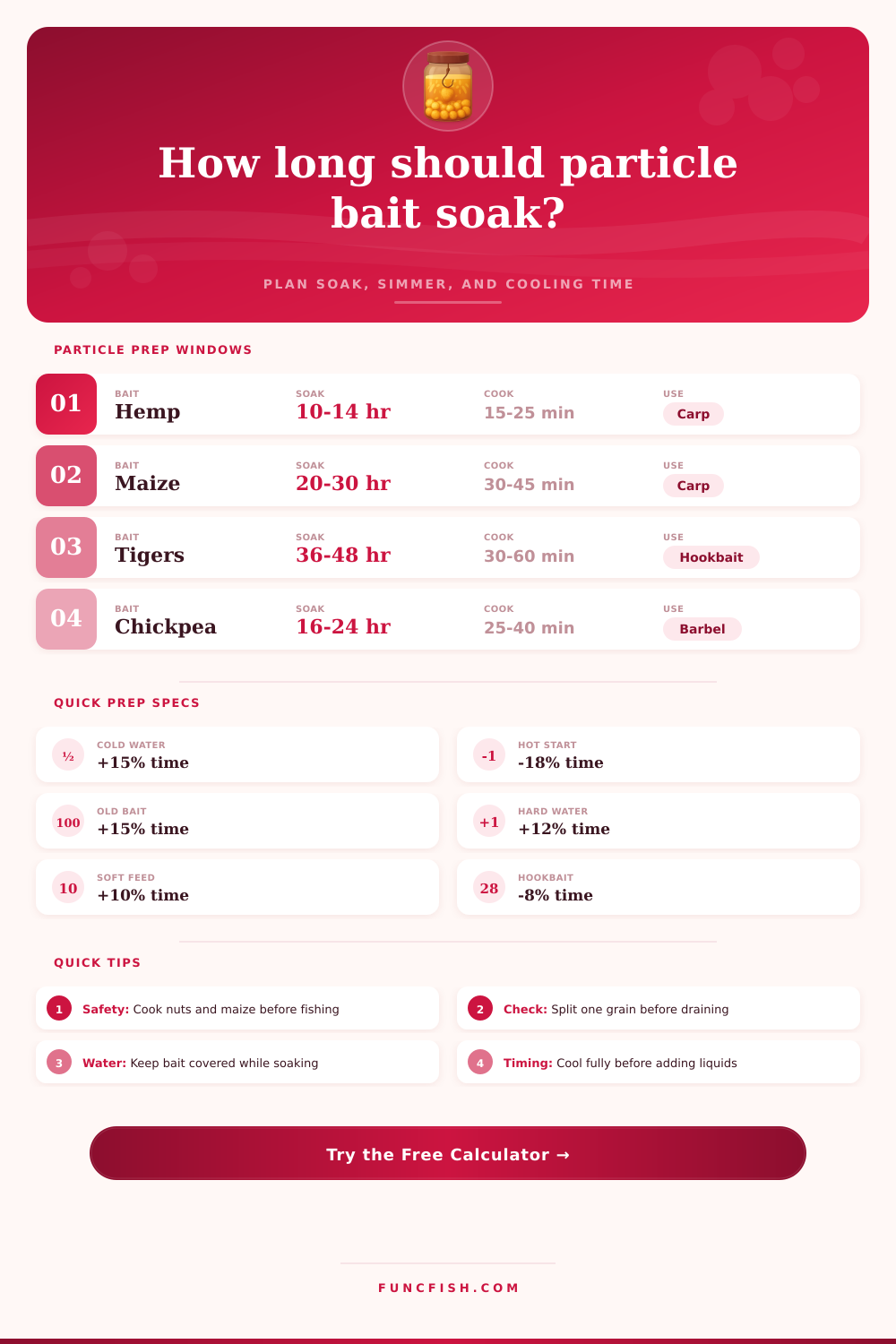
| Particle | Base Soak | Base Simmer | Expansion | Prep Note |
|---|---|---|---|---|
| Hempseed | 12 hr | 20 min | 1.7x | Ready when shells split and white shoots show. |
| Whole maize | 24 hr | 40 min | 2.2x | Needs heat until the center is soft but not chalky. |
| Tiger nuts | 40 hr | 45 min | 1.8x | Long soak supports safer nut hydration before fishing. |
| Chickpeas | 18 hr | 32 min | 2.4x | Check by splitting a pea between finger and thumb. |
| Maple peas | 18 hr | 30 min | 2.1x | Good for firm winter feed when not overcooked. |
| Wheat | 12 hr | 18 min | 2.0x | Stop when grains swell and begin to split. |
| Tares | 10 hr | 20 min | 1.9x | Keep firm for hook presentation on small hooks. |
| Peanuts | 24 hr | 35 min | 1.6x | Use a proper soak and heat cycle before adding to mix. |
| Pigeon conditioner | 18 hr | 28 min | 2.0x | Mixed grains finish at different speeds, so average the batch. |
| Small birdseed blend | 8 hr | 12 min | 1.8x | Small seeds need less time and can turn mushy quickly. |
🌡Adjustment Multipliers Used
| Condition | Soak Effect | Simmer Effect | Best Use |
|---|---|---|---|
| Cold shed water below 55°F / 13°C | Raises soak time 10-25% | Slight increase | Winter carp, bream, and barbel batches. |
| Kettle hot-start soak | Cuts soak time about 18% | Normal simmer | Short-notice maize, hemp, wheat, and maples. |
| Old, hard, very dry particles | Adds about 15% | Adds about 8% | Stored grains or bulk sacks near the end of use. |
| Hard chalky water | Adds about 12% | Adds about 5% | Areas where peas and maize stay firm longer. |
| Heavy salt, sugar, or thick liquids | Adds about 8% | No direct change | Best added after basic hydration has started. |
| Soft feed target texture | Adds about 10% | Adds about 18% | Spod mixes, bream feed, and quick breakdown beds. |
🎣Gear And Species Comparison Grid
| Species Focus | Common Gear | Particle Match | Target Texture | Typical Prep Window |
|---|---|---|---|---|
| Carp on gravel pits | Hair rig, size 4-8 hook, 12-20 lb line | Maize, tiger nuts, pigeon mix | Firm outside with soft center | 24-52 hr including cooling |
| Tench on weedy lakes | Lift float or method feeder, size 10-14 hook | Hemp, wheat, peanuts | Soft feed with a few firm pieces | 14-34 hr including cooling |
| Barbel and chub rivers | Feeder or rolling lead, size 6-12 hook | Chickpeas, maples, hemp | Firm enough to resist current | 20-40 hr including cooling |
| Bream shoals | Open-end feeder, size 12-16 hook | Wheat, hemp, birdseed | Soft feed with cloudy liquor | 10-28 hr including cooling |
| Canal roach and rudd | Pole or light float, size 16-20 hook | Tares, hemp, wheat | Small, firm, not mushy | 10-24 hr including cooling |
| Spod or bait boat work | Spod rod, boat hopper, or large baiting spoon | Pigeon mix, maize, small seeds | Mixed split and whole particles | 18-42 hr including cooling |
💧Water Cover And Container Reference
| Dry Batch Size | Minimum Water Cover | Container Headroom | Practical Check |
|---|---|---|---|
| 1 lb / 0.45 kg | 1.4-2.2 qt / 1.3-2.1 L | Use at least 3 qt / 3 L pot | Bait stays covered after the first hour. |
| 3 lb / 1.36 kg | 4-7 qt / 4-6.5 L | Use 2 gal / 8 L bucket | Stir once when grains first swell. |
| 5 lb / 2.27 kg | 7-11 qt / 6.5-10 L | Use 3 gal / 12 L bucket | Leave space for foam during heating. |
| 10 lb / 4.54 kg | 14-22 qt / 13-21 L | Use 6 gal / 24 L bin | Split across pans for even simmering. |
✅Prep Timing Tips
When you’re making a particle bait and your tigers is rock-hard after waiting out several hours, it’s easy to panic. The right combination are present, yet there’s no timeframe. The particle bait soak time calculator removes the guesswork from the process and becomes a buffer against the chaos of fishing prep. Feed the calculator certain variables and it’ll give you a window based off your particular conditions.
Two seemingly small input requests direct the hydration routine, with one being the most obvious. Water temperature. Soaking a handful of hemp in your warm kitchen requires much less time then if you put it in cold garage. The second, water hardness, isn’t as widely known to most anglers, but has an impact nonetheless. As you might expect, chalky water affect the breakdown of skins and starches and sometimes requires additional time for the optimal soft center desired by fish.
How to Use a Bait Soak Time Calculator
There are other behind-the-scenes factor: batch size and expansion rate. Maize (dry) is absorptive. It swell up as it takes in water. Fill your bucket all the way full with dry maize and what will happen? Right, you’ll have an overflow when it starts to get wet. Look at this reference chart on the page and you’ll see just how much space you need, depending on type of particles. Wheat behaves one way, chickpeas another, tiger nuts yet another. Knowing their expansion rates can save you from spills. It also makes sure that each grain gets its fair share of the precious water early on in the soaking process.
When it comes to texture, nature meets preference. What do you want? You can choose firm hookbaits that holds up to tough fishing or soft baits that break up quickly in the water to feed easily. This is when the simulator calibrates the simmer time. If you want a soft texture that breaks down quickly in the water, a rolling boil may work to soften your maize for a nice spod mix. But if you want a firmer hook presentation, don’t use tiger nuts as their fragile shell would of been destroyed with such heat. The trick here is the sweet spot between firm and pliable where they will hold up to the handling but also present nicely.
Freshly harvested bait acts different than old stock. A sack of maize stored since last fall will be harder and dryer. Parched kernels takes longer to soak up moisture and need more energy exposure time. The calculator accounts for this by adding extra time for older, drier bait. That’s where folks go astray. Same time on the clock for year-old stock as with new crop and then they ask why doesn’t it have any color in the center. The math adjusts for this age process all on its own.
The pros know there’s more than just crunching numbers; there are tricks that no algorithm can learn (like when to quit). More than any clock, your fingertips will tell you if it’s ready. Split it in half between your thumb and forefinger. Is the interior white and dry, or does it bend with a soft center? Did it snap or did it bend? Either way, you’ve got a ballpark number from the calculator and then your senses fill in the blanks. That mix of touch and data is what makes them consistant.
There’s a second level of complexity introduced with liquid additions and fermentation. Adding salt, for example, or other heavy sugars at the beginning of a soak will change the osmotic pressure and may slow down water absorbtion. Typically, soaking in plain water initially works best; this lets the particles hydrate completely before adding attractive liquids towards the end as things cool. You can input these additives into the tool to account for them, and have it predict whether they’ll shorten or lengthen your total prep time.
Making particle bait is a precise but patient process. It’s turning tough, lifeless seeds into something that will tempt fish. And all the while, you can just focus on catching one. Once you have an exact idea of how long until you’ll have bait in the pot, you quit worrying about the pot and start thinking about the bite. And that peace of mind is priceless. That confidence is worth more then any perfect batch of soaked grain.