Pellet Softening Time Calculator
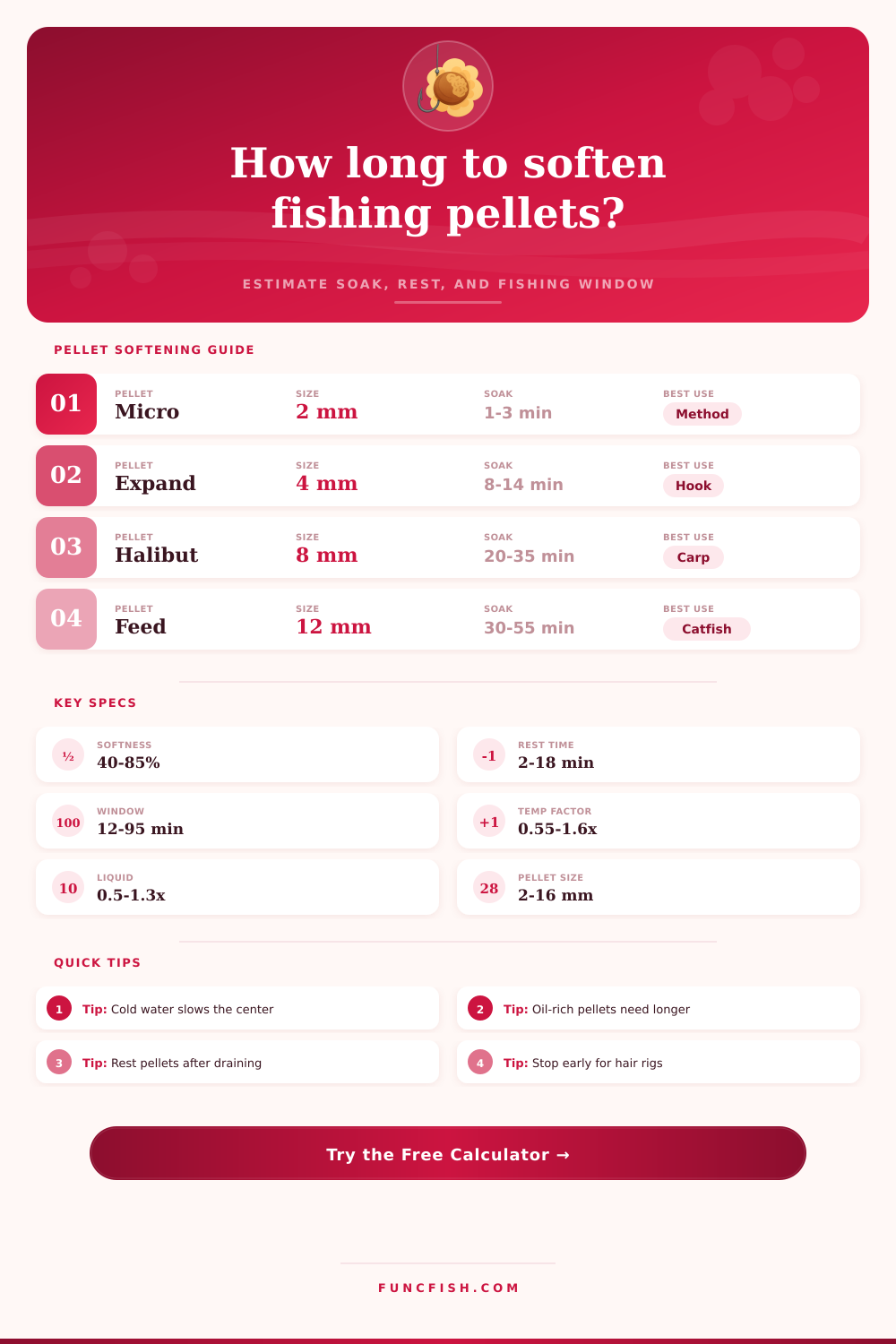
Estimate fishing pellet soak time, drain rest, hookable window, and liquid absorption for method feeder, hair rig, catfish, carp, trout, and coarse fishing pellets.
📌Scenario presets
⚙Pellet and soak inputs
Pellet softening estimate
Formula breakdown
🧪Pellet material data grid
Micro Fishmeal
Expander
Halibut Oily
Trout Feed
Absorption values are approximate grams of water per gram of dry pellet at full saturation. The calculator uses target softness to estimate the practical amount needed before over-softening.
🎣Gear and species comparison grid
Carp Method Feeder
60-75%Pellets should squeeze into a feeder and break apart after impact, with a damp crumb edge and a slightly firmer middle.
Hair Rig Hookbait
35-55%Stop early so the pellet drills, bands, or hairs without cracking. Resting finishes the center more gently than soaking longer.
Catfish Cup Bait
70-90%Larger feed pellets can be softened deeper because the bait is held in a cup, mesh, or packed bait holder.
River Barbel Feeder
50-70%Keep enough structure to survive current and feeder compression, especially with oily pellets and cool river water.
📊Reference tables
| Pellet diameter | Typical first soak | Rest time | Best target softness | Common fishing use |
|---|---|---|---|---|
| 2 mm micro | 1 to 3 min | 2 to 5 min | 60 to 80% | Method feeder, groundbait top-up |
| 4 mm small | 4 to 10 min | 4 to 8 min | 50 to 75% | Method feeder, small hookbait |
| 6 mm medium | 8 to 18 min | 6 to 12 min | 45 to 70% | Band pellet, carp, trout, bream |
| 8 mm large | 14 to 32 min | 8 to 16 min | 35 to 65% | Hair rig, barbel, carp |
| 12 mm extra large | 26 to 55 min | 10 to 20 min | 35 to 60% | Catfish, sturgeon, specimen carp |
| 16 mm jumbo | 42 to 90 min | 14 to 28 min | 30 to 55% | Big fish bait holder or drilled bait |
| Liquid condition | Speed factor | Absorption effect | Texture effect | Calculator note |
|---|---|---|---|---|
| Cold lake water below 10°C | 1.35 to 1.65x slower | Lower early uptake | Firm center longer | Increase rest instead of oversoaking |
| Room temperature water | 1.00x baseline | Predictable uptake | Even edge and center | Best calibration point |
| Warm water 30 to 40°C | 0.55 to 0.80x faster | Fast outer uptake | Can split expanders | Use intact-pellet safety setting |
| Sweet liquid | 0.92 to 1.05x | Slightly higher tack | Sticky surface | Good for feeder binding |
| Oil-emulsified liquid | 1.12 to 1.30x slower | Lower water contact | Slicker shell | Useful for oily hookbaits |
| Salted water | 1.05 to 1.18x slower | Firmer outside | Better shape hold | Helpful in warm weather |
| Species or approach | Pellet type | Diameter range | Softness target | Rig or feed match |
|---|---|---|---|---|
| Carp method feeder | Micro fishmeal | 2 to 4 mm | 65 to 80% | Compressed feeder mould |
| Carp hair rig | Halibut or coarse carp | 6 to 12 mm | 35 to 55% | Band, drill, or hair stop |
| Barbel river feeder | Oily marine pellet | 6 to 10 mm | 50 to 70% | Cage feeder or bait dropper |
| Catfish bait holder | Catfish feed pellet | 8 to 16 mm | 70 to 90% | Bait cup, mesh, or paste cage |
| Trout pond bait | Trout feed pellet | 3 to 6 mm | 45 to 65% | Band, paste wrap, or loose feed |
| Panfish chumming | Soy and corn pellet | 2 to 5 mm | 75 to 90% | Crumble cup or tiny feeder |
| Target feel | Softness input | Finger test | Risk if too long | Best correction |
|---|---|---|---|---|
| Firm center | 35 to 45% | Dents but springs back | Cracked drill hole | Rest covered, do not soak more |
| Hookbait soft | 50 to 60% | Pinches at edge | Band cuts into pellet | Shorten soak by 10% |
| Feeder bind | 65 to 75% | Clumps with thumb pressure | Sticky paste in mould | Drain earlier and fluff |
| Mash ready | 80 to 90% | Breaks under light pinch | Turns to soup | Add dry pellet crumb |
💡Softening tips
Carry-over hydration: pellets keep taking up water after the visible soak ends. For hookbaits, draining early and resting covered usually gives a stronger skin than leaving them submerged until they feel ready.
Mixed pellet batches: calculate from the largest pellet if hook integrity matters, or from the average pellet size if the goal is feeder bind. Dry crumb can rescue over-softened method mixes.
A few minutes can be the difference between a mushy mess and perfect hookbait. There you are standing with your bucket of pellets soaking up water. If you leave them there for 30 more seconds, those suckers will be falling off your rig at the bottom of lake. It feels like alchemy until you realize it is just physics.
Pellets is basically sponges ready to drink, but how fast depends solely on the temperature of the water and what’s inside them. For most people, it’s guesswork or a loose set of directions based off the best-case scenario: room temperature and perfect pellet density. In reality, that doesn’t happen. Fishmeal micros is different than a bucket of oily halibut pellets, and they’re not even close to being as dense. Water and oil don’t mix; oil slows hydration immensely. Denser binding agents forms a protective layer between the core and outside world, keeping dryness well beyond when surface softens.
How to Get Perfect Pellets Every Time
That’s where this calculator comes in. Once you input temperature of your soaking liquid and pellet type, it does the work for you. You won’t have to wonder if that last-minute 10 minutes of soaking will make things better or worse.
Temperature is the variable that nobody will admit ruins their plans more often then any other. Molecular movement drop off sharply as the mercury drops. The diffusion rate of water also drops. A perfect soak time in July can make the pellet rock hard in January when it’s cold. To adjust for this, the tool applies a temperature factor to the base diffusion rate. In other words, if you’re fishing a cold river, know that edge will hydrate much faster than the center. Carry-over hydration does most of the work. Resting the pellets after draining is even more important here since you will be walking back to the bank.
Soak time is important, but so too is what kind of liquid you use. While plain old tap water will get in there fast, using emulsified flavors or other liquids changes how it soaks into surfaces. Salted water typicaly makes them firmer to the touch on the outside. This can help keep more structure in high current scenarios. These variables are accounted for in the calculator, with the speed factor changing depending upon your selected liquid type. Knowing if it is pure water or an oil-emulsified flavoring affects the absorption rate by slowing it down. A little tackiness can be good for feeder binding without turning it all to soup.
What’s soft? What’s not? Those words has different meanings until they’re expressed in real-world terms. For instance: Do you need a pack with a moist crumb to release on contact (like for a method feeder), or do you want something firmer in the middle but still wet enough to form a solid grip around your knot (as with a hair rig)? The device converts those tactile requirements into minutes. Is it mushy enough yet? Or should you continue cooking until outer edge is squishy? In short, it helps avoid error of expanding pellets beyond their breaking point; they’ll rip when forced too far.
No single all-conditions pellet prep setting applies everywhere; each batch has some variation from oil content to dryness. Some pellets is fresh out of the bag while others have been opened and stored through humid days, losing moisture. You can fine tune your settings by telling the calculator your starting condition… A dry pellet will require longer and more liquid than one that’s been sitting open on a humid day in your tackle room. A small tweak, yes, but also one that recognizes real world variability that many guides shouldn’t of factor in when setting their settings.
So how do you know? Well, in short, it’s all about balancing the right amount of softness (to make the fish take the bait) against the right amount of strength (so it doesn’t tear apart as you’re rigging it and swimming it down). Before you get into all the variables that help you fine tune it, you have the basic starting point from the species/diameter table on the page. But then the art comes into play, where to draw the line in each situation depends on knowing why the times change. It is partly a waiting game, but it is also a matter of mastering the hydration curve, getting the bait to be juuuust right at the moment you’re looking for it.
It is all about the same thing, give it something that looks natural, but also stay steady. River or lake, chasing barbel or chasing carp, the same rules apply. The water goes in, the warmth determines pace and the softer stuff has a limit on how soft it can be before it falls apart. Nail the variables and the rest slots into place. Don’t guess, work out and then go with it. Precision requires patience, and in coarse fishing, that is where being precise matters.