Pendulum Cast Power Calculator
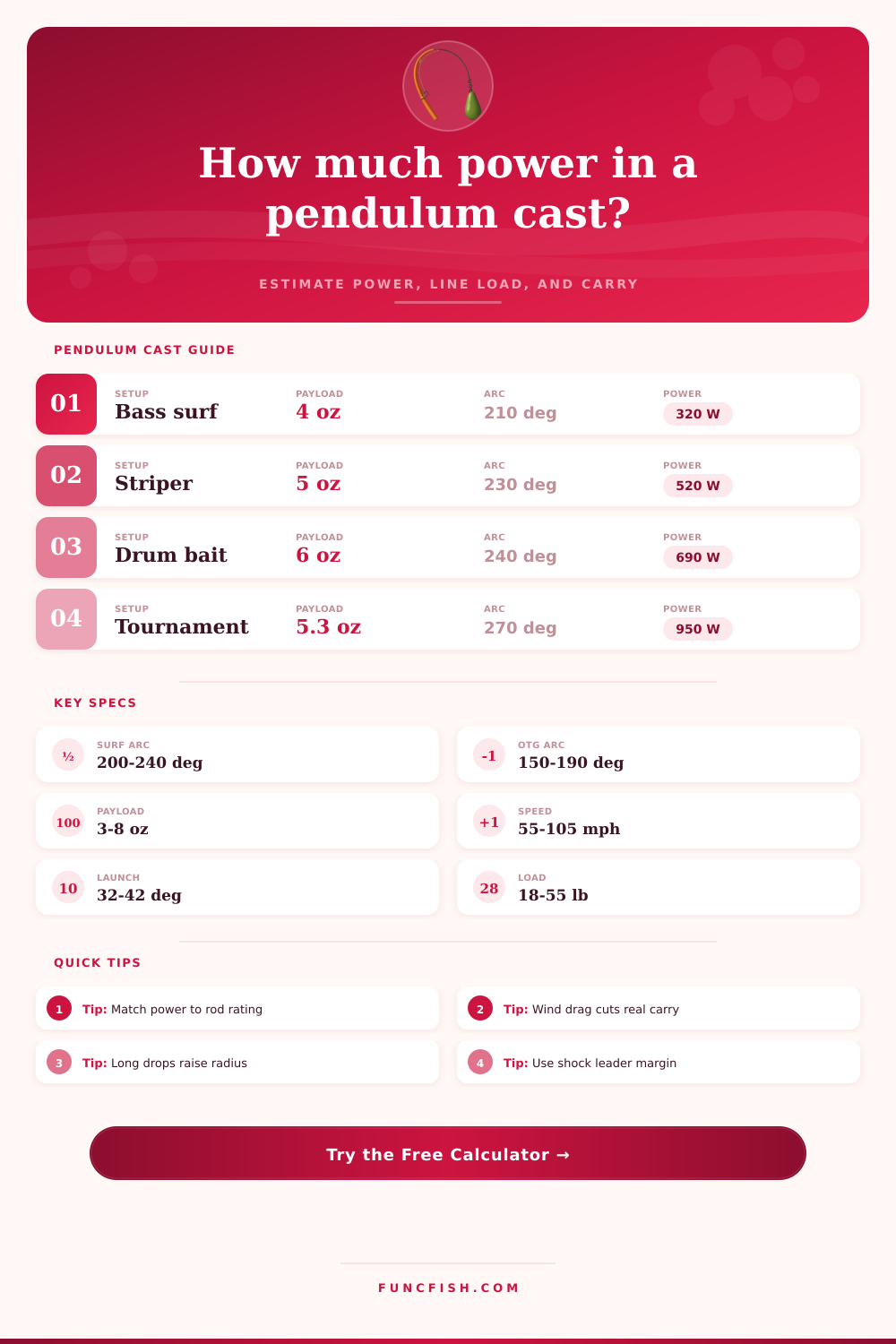
Estimate the mechanical power, payload energy, line tension, and drag-adjusted carry distance created by a fishing pendulum cast.
📌Scenario presets
⚙Cast and tackle inputs
Pendulum cast power results
Calculation breakdown
🎣Rod and leader data grid
Light Surf
Medium Surf
Heavy Surf
Tournament
📊Pendulum arc reference
| Cast style | Typical arc | Best payload | Power profile | Line load note |
|---|---|---|---|---|
| Off-the-ground cast | 140-190 degrees | 3-6 oz / 85-170 g | Shorter acceleration path, moderate power | Lower peak tension than full pendulum |
| Fishing pendulum | 200-245 degrees | 4-7 oz / 113-198 g | Long smooth load with strong rod compression | Leader margin becomes important |
| Full pendulum field cast | 250-300 degrees | 125-175 g / 4.4-6.2 oz | Maximum path length and high release speed | Requires clean timing and rated tackle |
| Heavy bait pendulum | 180-225 degrees | 6-10 oz / 170-283 g | High energy at reduced speed | Bulky bait raises drag and shock load |
🧮Power, speed, and load table
| Payload | Release speed | Energy | Typical power | Approx load |
|---|---|---|---|---|
| 3 oz / 85 g | 70 mph / 31 m/s | 42 J | 220-330 W | 14-20 lb |
| 5 oz / 142 g | 82 mph / 37 m/s | 95 J | 430-620 W | 28-40 lb |
| 6 oz / 170 g | 90 mph / 40 m/s | 137 J | 620-880 W | 40-58 lb |
| 150 g / 5.3 oz | 105 mph / 47 m/s | 165 J | 840-1150 W | 48-68 lb |
| 8 oz / 227 g | 78 mph / 35 m/s | 138 J | 560-790 W | 46-66 lb |
🐟Species and setup comparison
| Target | Common rig | Payload range | Release speed | Leader range |
|---|---|---|---|---|
| Striped bass | Plug or bait surf rod | 3-6 oz / 85-170 g | 65-90 mph | 40-60 lb mono |
| Red drum | Fishfinder bait rig | 5-8 oz / 142-227 g | 58-82 mph | 50-80 lb mono |
| Carp | Distance lead clip | 3-5 oz / 85-142 g | 70-95 mph | 30-50 lb leader |
| Pike | Spoon with wire trace | 1.5-4 oz / 43-113 g | 55-82 mph | 30-50 lb braid |
| Shore tuna | Heavy popper or metal | 3-5 oz / 85-142 g | 70-95 mph | 60-100 lb leader |
| Shark | Heavy bait pendulum | 8-12 oz / 227-340 g | 48-70 mph | 80-130 lb leader |
🔀Line and wind comparison grid
Thin mono
0.92xModerate air drag, forgiving stretch, common for field and clean beach casts.
Braid with leader
0.96xLow diameter helps carry, but low stretch makes shock leader sizing less forgiving.
Bulky bait rig
0.68xBait shape and splashy clips reduce ballistic range even when launch speed is high.
Aero lead
1.08xStreamlined tournament-style weights preserve more speed during the flight phase.
📐Shock leader sizing reference
| Payload | Common rule | Minimum leader | Safer pendulum leader | Why it matters |
|---|---|---|---|---|
| 3 oz / 85 g | 10 lb per oz | 30 lb | 40 lb | Pendulum timing can spike the initial load. |
| 5 oz / 142 g | 10 lb per oz | 50 lb | 60 lb | Good margin for plug, bait, and sinker rigs. |
| 6 oz / 170 g | 10 lb per oz | 60 lb | 70-80 lb | Useful when wind and bait drag raise force. |
| 8 oz / 227 g | 10 lb per oz | 80 lb | 90-100 lb | Heavy baits need extra abrasion and shock margin. |
💡Calculation notes
Power note: The calculator treats the payload as the accelerated mass and estimates average power over the final acceleration path. Rod bend, spool friction, bait tumble, and caster timing can move real numbers up or down.
Leader note: Peak pendulum load is not the same as static sinker weight. Use the calculated dynamic load with a safety factor, then compare it to rod rating and leader strength.
“The target is three-hundred-yards away at that structure. You’re standing on the shore with a weight as heavy as lead tied to the end of your line. An overhead cast would be difficult, it’s simply an exercise of arm strength. So, instead, anglers employ the pendulum cast, which magically transforms rotational momentum into distance; but once you look past the magic and look into physics, it makes sense.
The device offered estimations of mechanical power, giving angler insight into just how much oomph they’re generating and if their tackle could support it. For example, most newbies think they gain distance by swinging harder but nope. They gain distance by keeping a constant speed during the wider part of their swing and keeping tension on the line to transfer energy well. Swinging too hard and losing tension on the line cause the weight to lag and fall out of sync at the release point.
How to Cast Further and Safer
The calculator also takes into account the fact that different people has different rods and can enter their exact rod length and drop configuration. Why is that important? This is because as you swing, the weight gathers more centrifugal force the farther away it is from you until you release it. A longer rod mean a greater radius, but the more important factor is the drop length which is distance from the rod tip. What you’re doing is loading up a braided or monofilament spring.
On the results side are those key metrics that make a real difference from guesswork to strategy. How much work did my body perform over the length of cast? How much was average swing power? Then there’s peak pendulum load, which is the main way most leaders fail. This isn’t caused by steady weight, but by sudden tension that spikes during acceleration. That spike can be double or triple the actual mass of your sinker. In other words, it’s a violent surge of force that occurs in a fraction of a second.
The estimated carry distance takes into account air drag, depending based off the type of rig used. Even if two rigs launch at the same speed, one with a heavier chunk and another more sleek and aerodynamic will fly further. Know this and you won’t get frustrated when a plug outdistances a live shrimp setup despite equal efforts.
You will never argue with the appropriate safety factor for your shock leader. While the common minima are shown in the reference table on the page, you should of always add margin. As the drag increases, so does drag (exponentially) as speed increases, especially if bait shape isn’t regular and you’re casting in windy conditions. Increased resistance mean more line load at release time. What might be a manageable surge for a 60-pounder can rip a 50-pounder apart. Better a lost cast than bent rod tip and broken off terminal tackle. The size of your rig and the wind change how much tension is on the line; the calculator will show that trade-off.
The variable that no spreadsheet captures is timing. When the weight hits its lowest point on the arc, it should be moving at its fastest speed and that’s when you let go of the line. Letting go too soon result in less height. Letting go too late results in either the weight slamming into your feet or wrapping the line around your rod tip.
That’s where all the practice comes into play; once you dial in the settings on the tool, you need to practice with it for your specific application. For example, if I’m practicing for tournament casting or bass fishing, those are both common loads and casting paths for experienced casters. Those presets represent their baseline. They help prevent us from setting ourselves up with unrealistic expectations about our initial casts.
But all the wind does is change everything: where it travels and how accurately it lands. A headwind serves as a brake, eating into your speed rapidly; a tail breeze increases range. And a crosswind will make you adjust your launch angle to account for side-to-side drift. For these variables, the calculator lets you plug in air conditions, so it simulates their impact on your final distance. It is not a substitute for feel, but it gives you a number to compare against. It gives you something to hold onto when things get hairy and you know you’ll need an extra twenty percent of energy to fight a gust, helping you concentrate your physical effort where it’s needed most.
The bottom line: The pendulum cast is all about balancing force with control. I’d rather have some power behind my cast to hit my mark. However, I don’t want too much, or I’ll exhaust myself by the fifth attempt and snap my leader off. That’s where these numbers comes into play. They’ll help you see if your setup is dialed-in for the conditions. They can also show if it’s time to shorten your drop length, switch line types, or just ease-up on the swing of your arc.
From there, you’ll know exactly what those numbers mean when it comes to your set up and that’s when you go from guessing to knowing how to fish with intention. That’s what separates an average caster from a consistent one.”