Hook Size for Pike Calculator
Match northern pike hook size to bait length, bait girth, hook family, tooth-proof leader test, cover, water clarity, and seasonal strike activity.
📌Pike hook presets
⚙Pike rig inputs
Pike hook match
Recommended hook size, gap, leader margin, and rig fit will appear here.
Full pike hook breakdown
🧰Pike bait, hook, and leader comparison
Spoons and spinners
Hard jerkbaits
Soft swimbaits
Dead bait rigs
📊Pike reference tables
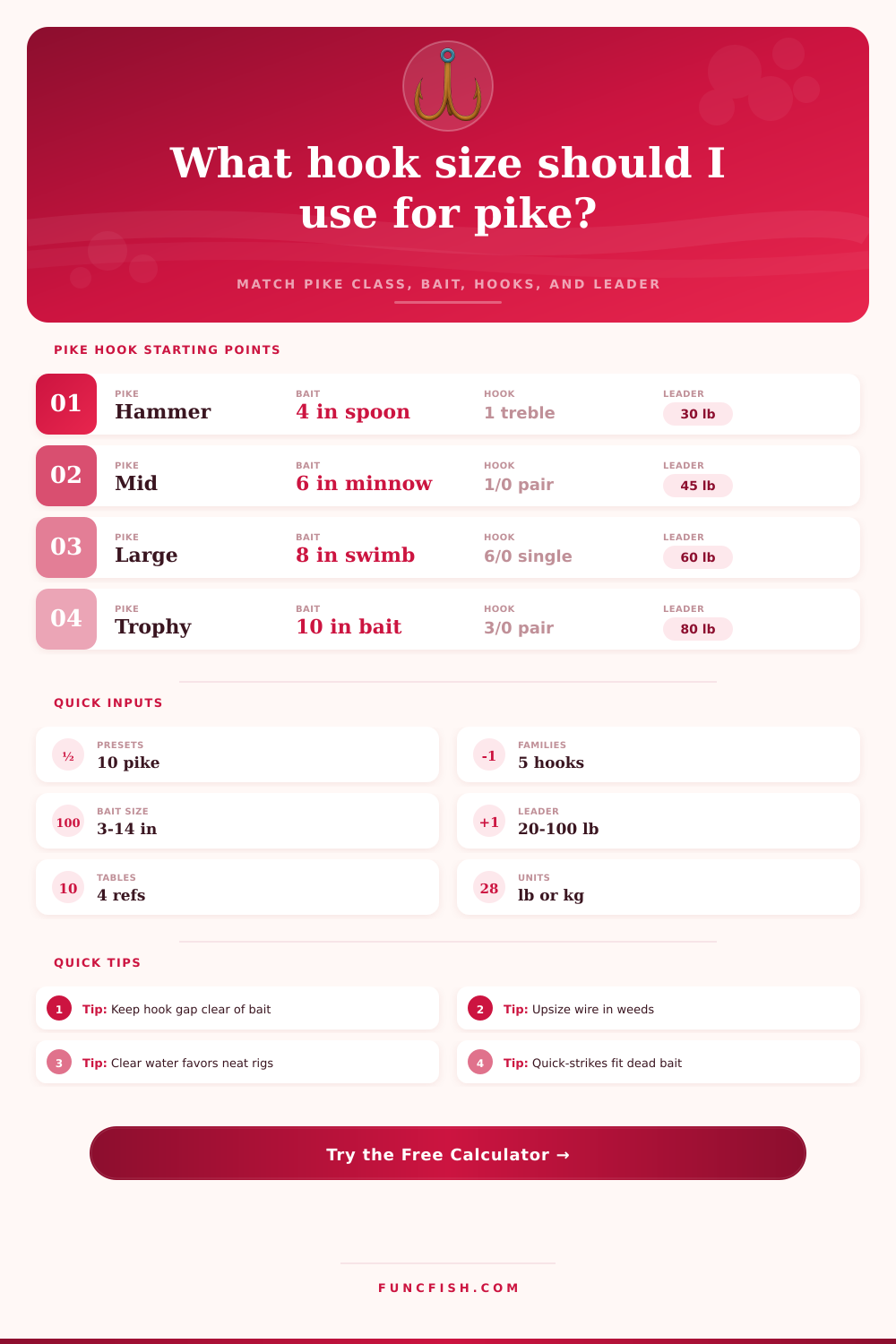
| Pike size class | Typical length | Bait length | Starting hook | Leader range |
|---|---|---|---|---|
| Hammer handle | Under 24 in / 61 cm | 3 to 5 in / 8 to 13 cm | #2 to #1 treble or 1/0 single | 20 to 35 lb / 9 to 16 kg |
| Jack pike | 24 to 30 in / 61 to 76 cm | 4 to 7 in / 10 to 18 cm | #1 to 1/0 treble or 2/0 to 4/0 single | 30 to 50 lb / 14 to 23 kg |
| Quality pike | 30 to 36 in / 76 to 91 cm | 6 to 9 in / 15 to 23 cm | 1/0 to 2/0 treble or 4/0 to 6/0 single | 45 to 65 lb / 20 to 29 kg |
| Large pike | 36 to 42 in / 91 to 107 cm | 8 to 12 in / 20 to 30 cm | 2/0 to 3/0 treble or 6/0 to 8/0 single | 60 to 80 lb / 27 to 36 kg |
| Trophy pike | Over 42 in / 107 cm | 10 to 14 in / 25 to 36 cm | 3/0 to 4/0 treble pair or 8/0 to 10/0 single | 80 to 100 lb / 36 to 45 kg |
| Hook family | Best pike use | Common pike sizes | Gap priority | Notes |
|---|---|---|---|---|
| Treble hook | Spoons, jerkbaits, topwater | #2 to 4/0 | Medium | Smaller size numbers hold compact hard baits cleaner. |
| Single J hook | Spinnerbaits, streamers, live bait | 1/0 to 10/0 | High | Good when cover or release handling favors one point. |
| Quick-strike rig | Dead bait, large suckers, ice sets | #1 to 4/0 pair | Medium | Two small hooks often beat one oversized hook on long bait. |
| Swimbait hook | Soft paddletails and line-through baits | 4/0 to 12/0 | Very high | Wide enough gap must clear the plastic body. |
| Circle / wide J | Live bait with steady pressure | 2/0 to 9/0 | High | Use steady load; avoid a hard cross-body snap set. |
| Bait profile | Length range | Girth cue | Hook family fit | Leader cue |
|---|---|---|---|---|
| Spoon or inline spinner | 3 to 6 in / 8 to 15 cm | Thin metal body | Treble or single trailer | 30 to 50 lb wire |
| Hard jerkbait | 5 to 8 in / 13 to 20 cm | Moderate body | Treble set | 45 to 65 lb wire or titanium |
| Soft swimbait | 5 to 10 in / 13 to 25 cm | Thick plastic | Swimbait or stinger | 50 to 80 lb wire |
| Live sucker | 5 to 12 in / 13 to 30 cm | Round baitfish | Circle / J or quick-strike | 45 to 80 lb wire |
| Dead bait | 6 to 14 in / 15 to 36 cm | Long body | Quick-strike pair | 45 to 100 lb wire |
| Condition | Hook adjustment | Leader adjustment | Why it matters |
|---|---|---|---|
| Clear water | Lean tidy or one step smaller | Use supple wire or heavy fluoro | Bulky hardware can reduce follows into bites. |
| Heavy weeds | Choose wider gap or single point | Add 10 to 20 lb margin | Plants load the leader during the fight. |
| Cold water | Keep points exposed and moderate | Do not overpower small bait | Soft takes need quick penetration. |
| Fall forage | Allow larger hooks on big bait | Favor 60 lb and above | Large pike often eat deeper around ciscoes and suckers. |
💡Pike sizing notes
Gap check: Pike baits are often long but not always thick. Size the hook so the point clears the bait body, not just because the lure looks large.
Leader check: Wire is the default pike choice. Heavy fluorocarbon can work best in clear water, but the calculator penalizes it when cover and trophy class rise.
When you decides on the bait you will use to catch pike, you must also consider a hook size that you will use. Pike are long fishes with teeth. Pike are built to eat bait that provide some resistance.
The hook you select for your bait must perform two separate task when you are fishing for pike. First, the hook must stay inside the bait long enough to achieve a solid hookset. Second, the hook must be strong enough to survive the initial strike from a large pike.
How to Choose the Right Hook Size for Pike
It is difficult to determine the proper size of the hook that you should use because the bait profile, the water condition, and the size of the pike will all play a role in determining the correct size of the hook. Length is not the only factor that will impact your decision of the proper size of the hook. The girth of the bait will also affect the proper size of the hook.
For instance, a six-inch spoon will have the same length as a six-inch sucker. However, the sucker will have a different shape then the spoon. You must ensure that the hook can clear the body of the bait.
This variable will allow you to enter the length of the bait and the girth of the bait to determine the gap that the hook should have based off the bait that you will be using. The girth of the bait is important when fishing for pike because pike will usually strike the middle of the bait rather than the entire bait. For example, if you switch from slim jerkbaits to swimbaits, the hook that you used for the slim jerkbait may not provide enough gap for the larger, thicker swimbait.
The size of the pike will also play a role in the size of the hook that you use. For small pike that are 2 feet or less in length, you can use small hooks because small pike has smaller mouths and create less torque when being held. However, if the pike that you are targeting are in the range of 36 inches to 42 inches, it is likely that you will need a larger hook size.
The calculator will adjust for the different size of the pike that you target to ensure that you are not using a hook that is too large for smaller pike. Using a hook that is far too large for smaller pike may create issues with the hookup rate of your bait with small pike. The material of the leader and the test of the leader can also impact the size and types of hook that should be used.
If you choose a wire leader, the hook will have to stand up well to the weeds or wood in the water. However, pike can also see wire leaders in clear water. Fluorocarbons are more difficult to see in clear water, but they do have less forgiveness around getting wrapped around wood.
The calculator will include the material and the test of the leader in the calculations to assist anglers with determining the strength of the leader relative to they setup. Water clarity and the type of cover in the area will play a role in the size of the hook that is used. If the fishing location is open water with high visibility, using smaller hooks will be more effective.
However, when fishing in vegetation such as cabbage or pads, you should use a larger hook to help ensure that the bait does not become hooked on the vegetation. The season that the fishing is occurring will also play a role in the size of the hook. In the winter when the water temperature are low after the spawn of the pike, the pike will mouth the bait rather than crush it.
In this case, smaller and sharper hook will be more effective. During the fall when the pike are more active, they will eat the bait more deeply, so larger gaps and stronger wire will be required in the hooks that are used. Using only one size of hook year-round is a common mistake by anglers.
Using the same size of hook on every type of bait is not a variable that should be ignored. The size of the hook should match with the length and the girth of the bait. The calculator will provide a suggestion as to the hook family and the size of the hook.
Based off the behavior of the pike, you can make small adjustment to the hook size. If the pike are striking the bait but shortly after introducing it into the water, a larger gap will be required in the hook. If the pike are swallowing the bait, the gap can be smaller.
The hook has to survive the initial strike and fight with the pike, but also allow the pike to take the bait deep enough into the water for the point of the bait to effectively perform its purpose.