
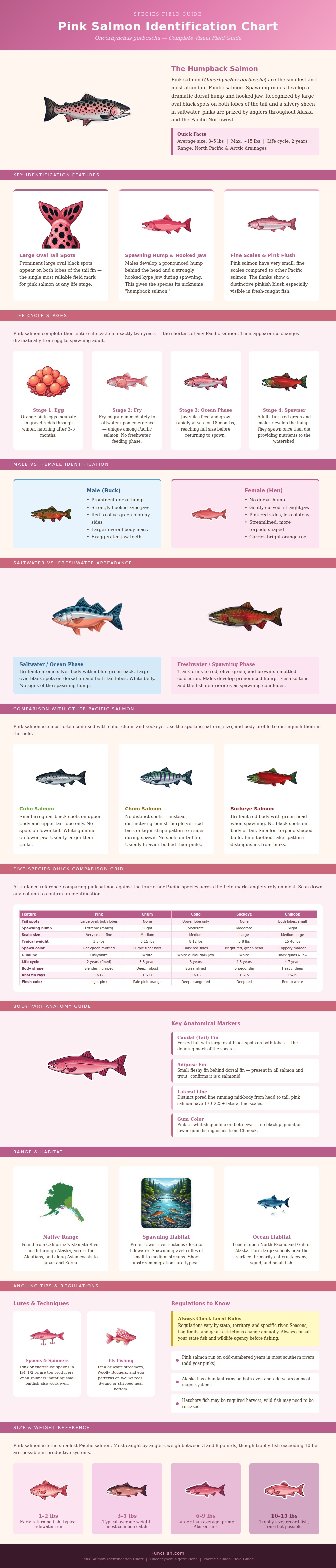
Eventually, every salmon angler hits a point in his life when he loses confidence in a heartbeat. After you pull one out of the water that weighs like it could feed your family, you notice its shape isn’t quite right. It’s humped up in the back, and color turns more of a strange pinkish shade, now what? Trophy fish or a protected species? Because repercussions of being wrong vary from losing a fish to landing yourself in hot water, the correct answer depends on your location.
After knowing what to look for, it’s often easier than folks realize. In fact, one of the best indicators is actualy right at the rear of the fish. According to infographic above, pink salmon have big, oval-shaped, black spots on their tail fin located in both top and bottom lobes. These do not change throughout their life cycle, while their body color does greatly change once they reaches fresh water.
How to Identify Pink Salmon
So if you see spots on both sides of the forked tail, you’re probably dealing with a pink. And it’s the one field mark that stands true when adrenaline clouds other details. One identifying feature of river salmon is that they goes through a pretty gross change when it’s time to spawn; they get what we call a “kype” (which is just another term for a hook on the jaw) and a severe dorsal hump on their back, hence name humpback salmon. These are not just random names; they describes exactly how the fish look.
The females stay more straight-backed and streamlined, without a hooked or humped jaw. That helps anglers identify the sex of the fish fairly easy, but what matters more then whether it is male or female is knowing: Can I keep it? The size can help with correct ID too. In general, pink salmon are smaller than other Pacific salmon species, averaging 3, 5 lbs. And rarely exceeding 10 pounds. So if your fish doesn’t feel right for its supposed species, re-examine those tail spots.
You may be holding a coho, which can have similar colors but lacks tail spots on the bottom lobe. You might also have a chum, which shows tiger stripes instead of well-defined spots. And sockeye will be uniformly red with no black spotting at all, so sometimes knowing what they don’t look like is as helpful than knowing what they do.
It’s all complex enough for the average angler, but add into that how the runs occur. The life cycle for pinks is simple; they live for two years and then spawn in odd or even years depending on their river systems. Because there is so much available habitat, Alaska can accommodate both years’ worth of runs each year, whereas typically southern rivers does one or the other, alternating each year. So instead of hoping that fish arrive sometime during the season, anglers can target certain windows knowing what should of happening. Fish a southern river where it’s an off year? There won’t be any wild pinks no matter what time you head out there.
Gear strategy will follow the behavior of species and anglers tend to stick with fairly simple gear tactics. For instance, during their ocean phase, pinks feed aggressively near surface levels and small spoons and spinners is extremely effective. Fly fishermen may choose to use white or pink streamer-type flies that mimic baitfish and keep their retrieve steady not frantic. It is not so much about outwitting a clever predator as it is about getting the right movement at the right depth so the fish react to vibration instead of flash.
It’s always best to be sure of your local regulations; they’re all over the place when it comes to harvest restrictions. There are places where you have to catch only hatchery fish and let any wild fish go, again, pay attention to fin clips and such. Others will shut down for a few weeks at a time to allow for spawning runs, and “I didn’t know” is seldom an acceptable excuse when the law dogs come calling later. Be sure to check the latest with your state’s wildlife agency, not your old fishing diary.
So in short, how do you tell if they’re pink? Pay close attention and be patient. First look at the tail. Both lobes should have spots. The overall size should match the local average. Do all this and the easy stuff matches up, you probably got ‘em! Don’t worry if you are tired or if the water doesn’t care about your impatience. Being observant will reward you with more than just a fish; it will save you from a costly mistake. So keep your eye on the tail and the rest will fall into place.