Pink Salmon Weight Calculator
Estimate pink salmon weight from fork length, maximum girth, body depth, humpy phase, ocean or river phase, sex and maturity, run timing, condition, confidence, and units.
📌Pink salmon presets
⚙Measurements and salmon phase
Model: pink salmon are estimated from fork length and squared girth, then cross-checked with body depth. Ocean brightness, river time, humpy development, sex, maturity, run timing, condition, and confidence widen or narrow the range.
Pink salmon weight estimate
Enter measurements and calculate to see the estimate.
Calculation breakdown
📊Pink salmon phase grid
Ocean bright
Estuary staging
Early humpy male
Full humpy male
🐟Salmon comparison grid
Pink salmon
Small two-year salmon with strong male hump during spawning.
Coho salmon
Deeper adult body and stronger average size than pink salmon.
Sockeye salmon
Compact, thick-bodied salmon with dense red spawning profile.
Chum salmon
Longer frame with lower girth than most coho of same length.
Chinook salmon
Largest common salmon, needing a much different coefficient range.
📋Reference tables
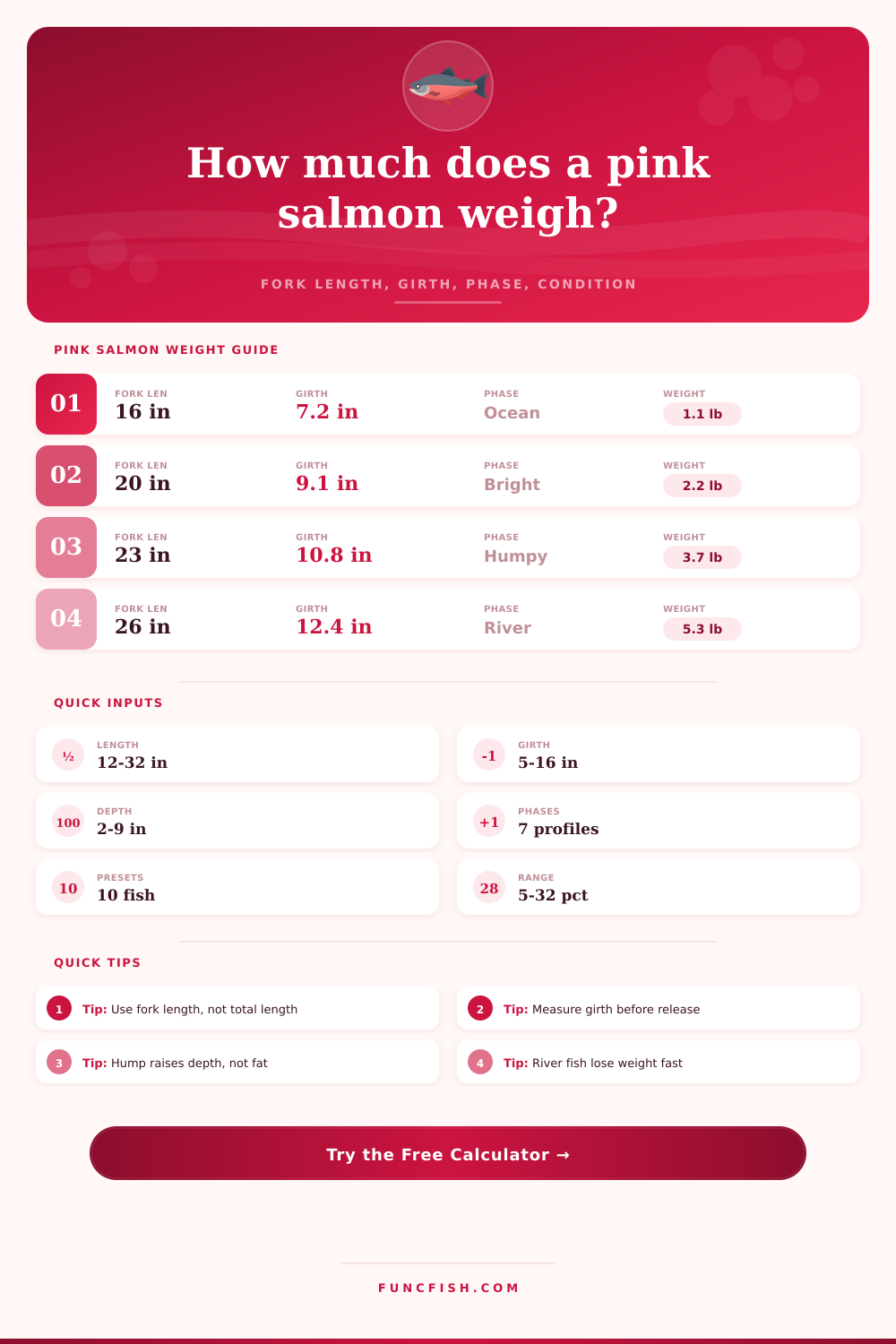
| Fork length | Typical girth | Bright fish estimate | Field class |
|---|---|---|---|
| 14 in / 36 cm | 6.0-6.8 in / 15-17 cm | 0.7-0.9 lb / 0.3-0.4 kg | Small adult or jack |
| 18 in / 46 cm | 7.8-8.6 in / 20-22 cm | 1.5-2.0 lb / 0.7-0.9 kg | Common adult |
| 22 in / 56 cm | 9.8-10.8 in / 25-27 cm | 2.8-3.8 lb / 1.3-1.7 kg | Good pink salmon |
| 25 in / 64 cm | 11.3-12.3 in / 29-31 cm | 4.5-5.8 lb / 2.0-2.6 kg | Large pink salmon |
| 28 in / 71 cm | 12.6-13.8 in / 32-35 cm | 6.4-8.0 lb / 2.9-3.6 kg | Exceptional pink |
| Humpy phase | Body clue | Calculator effect | Best measurement |
|---|---|---|---|
| Chrome ocean body | Silver, no back ridge, firm belly | Raises mass slightly | Fork length and girth |
| Silver pre-hump | Slight ridge, still full-bodied | Near neutral | Girth before depth |
| Early humpy back | Male ridge developing | Depth is partly discounted | Girth plus fork length |
| Full humpy male | High back, often less belly | Lowers depth mass factor | Do not count hump as fat |
| Post-spawn profile | Thin belly and soft body | Large downward adjustment | Use wide range |
| Ocean / river phase | Reserve trend | Weight factor | Range note |
|---|---|---|---|
| Saltwater ocean bright | Highest body reserve | 1.06 | Tight if measured fresh |
| Nearshore beach bright | Full but starting migration | 1.04 | Standard field range |
| Estuary staging | Stable to slight loss | 1.01 | Good girth matters |
| Lower river fresh entry | Early reserve loss | 0.98 | Moderate variation |
| Upper river spawning reach | Clear reserve loss | 0.90 | Wider range |
| Spent or post-spawn water | Very low reserve | 0.78 | Use broad estimate |
| Confidence setting | Use when | Base range | Bias to watch |
|---|---|---|---|
| Scale checked or fresh measured fish | Scale or full wet-tape measurements are available | About 5 percent | Scale slime and water weight |
| High measured confidence | Fork length, girth, and depth were recorded | About 8 percent | Fork versus total length mix-up |
| Standard quick field tape | Fast release with direct girth reading | About 12 percent | Girth tape not square |
| Rough moving fish | Fish moved or tape followed a curve | About 20 percent | Girth often reads high |
| Photo-only or memory estimate | Length or girth is reconstructed later | About 30 percent | Perspective inflates depth |
Weights are field estimates for pink salmon body form. A certified scale is required for exact weight, and spawning condition can move real fish outside a formula range.
💡Pink salmon measuring tips
Pink salmon tail tips vary by handling and photo angle. Fork length keeps the estimate steadier than pinched total length, especially on released fish.
A male pink salmon can gain dramatic back height while losing belly reserve in freshwater, so girth should outrank body depth during the humpy phase.
Pink salmon change there physical shape and their physical mass as the pink salmon change from the ocean to the gravel. A person may be able to look at a pink salmon and attempt to guess the weight of the pink salmon. However, a person may find it to be difficult to do so due to the fact that pink salmon change between the ocean and the gravel.
For instance, male pink salmon develops a hump. This hump increase the height of the pink salmon, but does not necessarily increase the mass of the pink salmon. Thus, to account for the fact that pink salmon may change their shape and mass, it is necessary for a person to use specific measurements to determine the weight of an pink salmon.
How to Estimate a Pink Salmon’s Weight
The calculator help to determine the weight of a pink salmon by using the length of the pink salmon’s fork, the girth of the pink salmon, the depth of the pink salmon, and the details of the phase of the pink salmon. Each of these measurements will help to provide a better estimate of the weight of the pink salmon. For instance, the length of the pink salmon’s fork is one of the most important measurement of the pink salmon because the length of the pink salmon’s fork will remain the same even if the tail of the pink salmon is pinched.
The girth of the pink salmon is another of the most important measurements because the girth will tell a person the volume of the pink salmon’s middle. Additionally, since the pink salmon may have different physical conditions to each other, the importance of the pink salmon’s girth is more importanter than its length. The depth of the pink salmon is another measurement that help to provide an estimate of the pink salmon’s weight, though it may be somewhat misleadingly.
For instance, due to the fact that the pink salmon may have developed a back ridge when it is a male, the depth of the pink salmon would indicate a different weight to the pink salmon than it would appear to another observer of the pink salmon. The humpy phase option will allow a person to separate the mass of the pink salmon’s back ridge from the actual mass of the pink salmon’s belly. The ocean versus river setting are used to account for the fact that pink salmon may lose fat reserves once they exit the saltwater.
The pink salmon’s sex and maturity setting is another important measurement because the pink salmon will contain the mass of the eggs of the females, or will be lean as the male pink salmon has no longer eaten after the spawning season. The run timing is important to account for pink salmon that may have spent the spring and summer in the ocean, or have spent the fall and winter in the ocean burning through the fat reserves of there bodies. Additionally, the pink salmon’s condition factor can be used to adjust for when the pink salmon may be heavier or thinner than the pink salmon should be of that length.
Finally, the confidence setting can be used to indicate the confidence in the measurements of the pink salmon. For instance, if the measurements of the pink salmon were rushed, or if the pink salmon were measured from a photograph, the confidence in those measurements may be less than if they were taken of an actual pink salmon in its natural habitat. Each of these measurements is important because pink salmon have the potential to change their physical shape faster than any other species of salmon.
For instance, pink salmon that are in the ocean may have a girth that is around 46 percent of their length, but pink salmon that are in the gravel may have a girth that is below 40 percent of their length. Thus, their girth may be lower despite their height being greater. Because of the different coefficients of each of these measurements, the pink salmon tool must account for the fact that pink salmon change their physical shape during their lifetime.
Furthermore, there are reference tables within the tool that show the factors of the girth, depth, and weight of pink salmon during each of the phases of their life. Thus, pink salmon of the same length may have a different weight; two pink salmon of the same length may weight more than a pound to each other depending on the phase of their life cycle. Many individuals may make mistake in determining the weight of pink salmon; for instance, they may count the pink salmon’s hump as the pink salmon contains fat, or they may use the total length of the pink salmon to the tip of its tail as its length rather than the length of the pink salmon’s fork.
Furthermore, many individuals may assume that pink salmon in the gravel have the same weight as when they enter the gravel. The calculator is set up to avoid these potential mistake by using separate options to account for the different phases of pink salmon. For instance, the calculator discounts the depth of pink salmon once it develops a hump.
Additionally, the calculator creates a condition index that allows individuals to compare the weight of the pink salmon to what would be expected of a pink salmon of that length and phase. Thus, the condition index allow individuals to understand whether the pink salmon is within the expected weight parameters. Various factors in the real world may affect the weight of pink salmon, but the numbers of the pink salmon calculator cannot account for all of those factors.
For instance, the water temperature that the pink salmon lives in may affect the weight of the pink salmon. The length of the pink salmon’s migration into the gravel may also impact its weight. Finally, the number of days that the pink salmon has spent on its spawning ground may also have an impact upon the weight of the pink salmon.
For instance, if the pink salmon is thin it may still be healthy; it may have entered the gravel later in the spawning season. In contrast, pink salmon that begin their spawning season early will have more fat early in the season that they will burn through while spawning, thus decreasing their weight. However, despite the different factors that may impact pink salmon, the weight estimation tool provides an individual with a starting point in estimating the pink salmon’s weight.
The confidence range that is illustrated for each pink salmon measurement is provided to account for the uncertainty that may exist in measuring pink salmon in their natural habitat. For instance, field measurements will always be less certain than measurements that are taken while a pink salmon is calm and using wet-tape to measure the pink salmon. Thus, the calculator widens the range of pink salmon measurements to account for this potential uncertainty.
This information is important to know when making a decision about the pink salmon, such as whether to keep or to release the pink salmon. By measuring pink salmon each season, an individual may be able to train there eyes to identify how the girth of the pink salmon may change with the phase of the pink salmon. Thus, the calculator can be used as an additional tool to confirm the observations of the individual’s training of there eyes.
Furthermore, individuals should remember what each of the inputs mean about the pink salmon when in the water. Thus, a good estimate of the pink salmon’s weight will respect both the pink salmon’s measurements and the biology of that pink salmon; the biology of pink salmon change the measurements that can be made of pink salmon between the tidewater and the spawning grounds of the pink salmon.