
You might think platy fish is going to stay little forever when you purchase them. That mindset sets the wrong expectations about how much you’ll be able to fit in your tank. You end up looking at a bunch of small, colorful fish in one tank and figure your house set-up can handle that number…permanently. No. Platys are fast growers that can gets very large. Additionally, if you aren’t ready for it, they will breed like rabbits. Knowing what size these fish realy get can prevent overcrowding and stress before it’s too late.
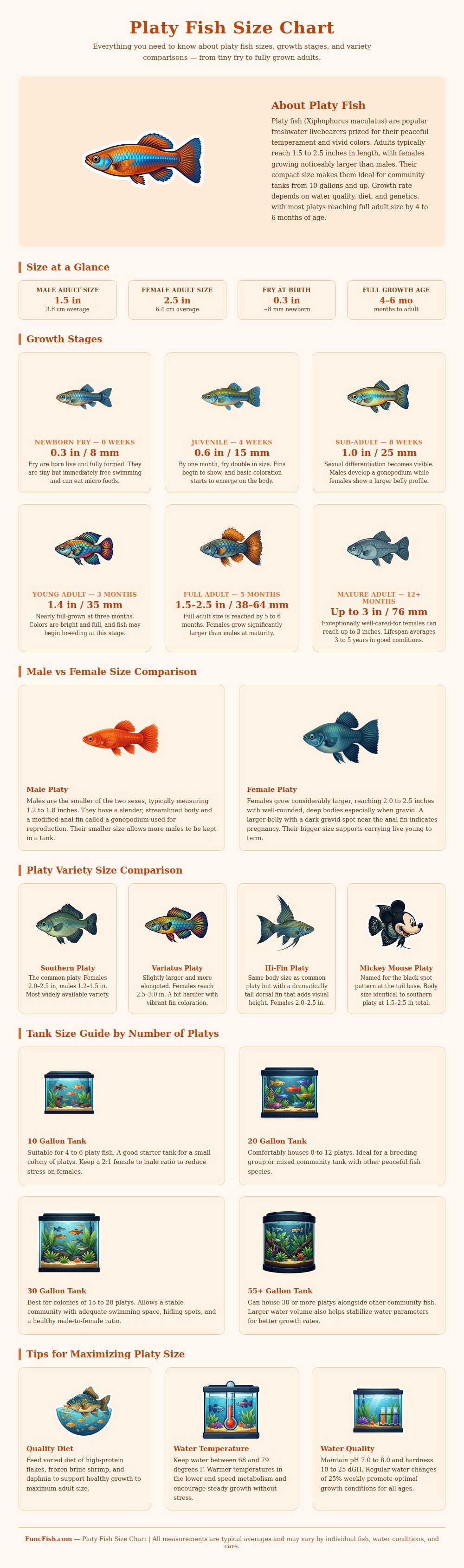
There is sexual dimorphism, meaning male and female platys aren’t equal in size. Even though they appear alike from the retailer’s tank, there are subtle variations in body form that reveal their ultimate size. The male will never be longer than perhaps an inch and a half. He’ll stay small and slender. His body is built for quick movement and agility. From day one, the female is constructied differently. Her body is more rounded with a deeper body form that only increase over time. A mature female can easily be twice as large than a male.
How Big Do Platy Fish Get?
Why does this matter? It alters the amount of space needed by each fish once they reaches adulthood. What about speed? How much time does it take for platies to grow up? They’re not turtles. They don’t take years before reaching their full size. In fact, most adult platies will be at full size in 4-6 months after being born. That’s not a lot of time to make a big impact on a tank. I’ve seen people adopt fry that were mere millimeters in length, then watch them rapid transform into large, finned-out adults with well-defined coloring. From juvenile to sub-adult can occur swiftly. And often, some gender traits will appear during this stage (for example, a rounded belly in females or a mating organ in males).
Be careful, if you don’t gauge your tank space soon enough, you might wake up one morning to discover your tanks been over-run. Don’t get me wrong. Starting small doesn’t have to mean you’ll stay small. Sure, 10g is fine for a juvenile pair of platies, or even some adult platy (unless they spawn). However, what happens when your platies do? They grow up, mate, and suddenly you’ve got a lot more volume than you had originaly planned for. Many newbies fail to realize how much volume they’re going to need. Two females per male? That’s great, as long as no one harasses anyone else. But this means more volume and thus, more biological load as your colony expands. More ammonia spikes. Decreasing water quality. Stalled growth (in a tight space). For optimal size and health: Plan for their adult size when choosing a tank!
What you feed your platy is hugely important. If food isn’t rich in protein (e.g., not flake), then it will stunts its growth and prevent it from reaching its maximum size. It’s also best to provide a diverse diet. Freezing brine shrimp is an excellent source of protein and will promote healthy growth. Lastly, maintain stable water parameters. As mentioned earlier, platies come from Central America, where water is moderately hard and has a slight alkalinity. The closer your aquarium conditions resemble this natural environment the better. Regular water changes are essential for platy keeping. Stagnant water inhibits growth and fosters ill health, transforming a healthy showpiece into a messy bunch.
When choosing between varieties like the Mickey Mouse pattern, the Hi-Fin, or the Southern Platy, the choice is based off appearance. It is not because one will grow longer than another. All these varieties top out at about the same length. That means that each should of have space to spread out and claim some territory. And that’s where the hi-fin comes into play, it just has a tall dorsal fin, which adds an interesting vertical look to the tank. But it doesn’t need any more width.
If you’re considering getting a community tank, consider buying with the adults in mind, not the day you purchase them. That little fish may be cute as a button right now, but they’ll be much bigger when they grow up. Plan for that size from the beginning so you won’t have to move your fish later on because the tank is too small. Provide enough room for everyone. Maintain clean water conditions. Feed them well. They’ll repay you with healthy, bright colors and good growth if you do.
Plan ahead.