Post-Spawn Recovery Timing Calculator
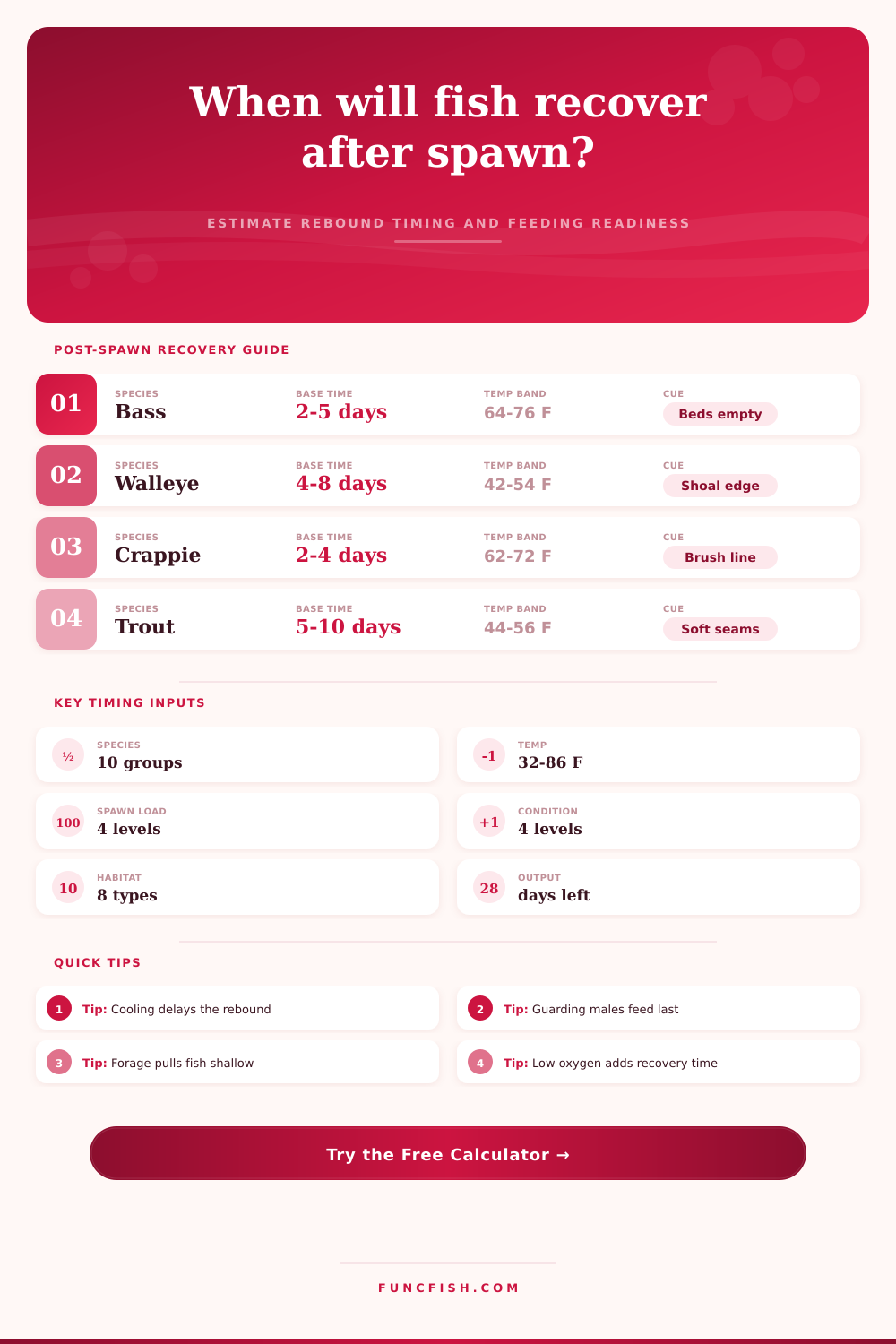
Estimate how many days fish need to rebound after spawning by combining species biology, water temperature, role, body condition, oxygen, forage, and recovery cover.
📌Scenario presets
⚙Recovery timing settings
Post-spawn recovery estimate
Calculation breakdown
🧮Recovery factor grid
Grass edge
Rock break
Current seam
Open basin
📊Reference tables
| Species group | Typical post-spawn rebound | Preferred recovery temperature | Common holding shift |
|---|---|---|---|
| Largemouth bass | 2-5 days after leaving beds | 64-76 F / 18-24 C | First drop, grass edge, bluegill colony edge |
| Smallmouth bass | 3-6 days, longer for guarding males | 58-70 F / 14-21 C | Rock break, gravel flat edge, current push |
| Crappie | 2-4 days when schools regroup | 62-72 F / 17-22 C | Brush, stake beds, dock shade, channel lip |
| Bluegill | 1.5-3.5 days outside colony peak | 68-82 F / 20-28 C | Weed edge, colony rim, shaded bank cover |
| Walleye | 4-8 days after shoal or river spawn | 42-54 F / 6-12 C | Adjacent breaks, current seams, first basin lip |
| Northern pike | 4-7 days after marsh exit | 40-52 F / 4-11 C | Drain mouths, reed edges, shallow flats near depth |
| Rainbow trout | 5-9 days depending on current and food | 44-56 F / 7-13 C | Soft seam, riffle tailout, undercut edge |
| Chinook salmon | 6-12 days for non-terminal feeding context | 44-55 F / 7-13 C | Deep pool edge, tailout, travel lane |
| Temperature condition | Timing effect | Readiness signal | Calculator adjustment |
|---|---|---|---|
| Inside preferred band | Normal recovery pace | Fish hold near exits and cover | 0-8 percent faster |
| Slightly cold | Metabolism slows | Shorter feeding windows | 8-18 percent slower |
| Slightly warm | Fast but oxygen-sensitive | Early and late windows matter | 5-16 percent slower |
| Large daily swing | Position changes often | Stop-start feeding behavior | 2-25 percent added load |
| Cooling front | Delayed rebound | Fish slide to deeper or protected edges | 18 percent timing penalty |
| Habitat type | Recovery value | Feeding contact | Best species match |
|---|---|---|---|
| Grass edge or pad stems | High cover, high ambush value | Fast when forage is present | Bass, bluegill, pike |
| Brush pile or laydown | High shade and security | Good midday recovery contact | Crappie, bass, catfish |
| Rock break or riprap | Stable oxygen and depth change | Strong with wind or current | Smallmouth, walleye, trout |
| Deep edge near flat | Lower stress, slower visibility | Best at low light | Bass, crappie, stripers |
| Current seam or riffle edge | High oxygen and drift food | Can shorten recovery | Trout, salmon, walleye |
| Open basin | Low cover, low structure lock | Depends on bait schools | Stripers, crappie, walleye |
| Comparison factor | Speeds recovery | Slows recovery | Field note |
|---|---|---|---|
| Body condition | Thick fish with bright color | Thin sides, frayed fins, visible stress | Spent fish may feed lightly before fully recovered |
| Forage position | Bait, insects, or fry close to cover | Empty pockets or scattered bait | Forage can pull fish before comfort is perfect |
| Oxygen | Wind, current, clean water, vegetation balance | Stagnant pockets, algae stress, heat | Low oxygen delays feeding more than cover does |
| Role after spawn | Roaming females and regrouping schools | Nest guarding males and exhausted migrants | Guarding behavior can mask actual appetite |
| Weather trend | Several stable warming days | Cold front, heavy stain, rapid level change | Position often lags one day behind the weather |
💡Timing tips
Separate biological recovery from catchability. A fish can be mostly recovered but hard to contact if the best recovery cover is separated from forage or wind-driven food.
Use the result as a timing window. Check the first feeding rebound around the calculated window, then update days since peak spawn and trend if a front or temperature swing changes conditions.
The post spawn lull isn’t a myth or a bad luck streak; it’s biology. After spawning, the fish has been beat up and their metabolism has crashed as they hide in cover to rest and recover. They don’t begin feeding again until they’re good and ready.
Use the calculator at the top of this page to get an estimate of the remaining days until there recovery period ends depending on conditions, temperature and species.
How to Calculate Fish Recovery Time
The first important input is species behavior. A nesting smallmouth male on a rock bed may require a week or longer while a large female largemouth may recover in as little as two or three days. It’s simply a matter of different energy cost. The tool recognizes this and allows you to make the right selection of the post spawn role. This could be a guarding male that’s too stressed to bite or it might be a roaming female working her way back towards some type of cover. As seen in the page’s reference table, guarding behavior will greatly extend the recovery time vs. This is different than schooling fish like crappie, which regroup quite fast.
The next lever is temperature. Metabolism are slow in cold water. Recovery is slower. When a cool snap occurs immediately post spawn, it’s like hitting the pause button on the rebound. That’s why the calculator factors the current water temp plus the weather trend into the equation. If there’s been a stable warming trend it speeds things up. On the other hand a cooling penalty will add days to the calculation. You need to pay just as much attention to the weather report as you do your fish finder. If the air is cooling, they’re holding tight.
Interestingly enough, the speed of their recovery greatly depends on habitat type. Bass from brush piles or grass edges will bounce back quicker than bass in deep basins or open water. Why? There is cover, which makes them feel secure. This reduces stress levels so their metabolism can return to normal more quickly. Based off the most likely places the fish might be positioned, the tool gives varying recovery times. If you’ve been fishing an area with lots of nearby hydrilla, the estimated recovery time decreases because it assumes your bass have crawled into this vegetation. Conversely, if they’re spread out and suspended above an open-water basin, the timeline grows longer.
The last two variables are body condition and oxygen levels. Fish coming off a hard winter are thinner and it takes them awhile to get up to speed. Even if the days has been long enough for them to feed already, fish in stagnant backwaters eat more slowly because of the low oxygen. The calculator also considers these factors to create a readiness score that lets you know when to expect your first good feeding period. It’s not a guarantee, but it’s way more useful than guessing.
This period of time is when anglers make their biggest mistake by fishing the wrong piece of structure. Anglers will remain on those spawning flats while they’re waiting for the fish to leave. The fish have headed towards the first piece of cover. It could be a laydown, a weed line or just a drop-off. Your task is to find where they are hiding and then wait for the clock to hit zero.
The most difficult aspect is patience and trusting the biology. That opening window is when it can go off. A fish that has been sitting up in cover for days is now comfortable, hungry and not nearly as stressed. They’re ready to go on the attack and feed. With a tool like this you take out all the guesswork. No more wasted days going fishing on flat water. Now you can target the moment those fish recovers from their ordeal. The calculator handles the heavy lifting, leaving you to focus on presentation and patience.