⚓ Prop Pitch Speed Calculator
Estimate your boat's top speed based on propeller pitch, RPM, gear ratio & slip
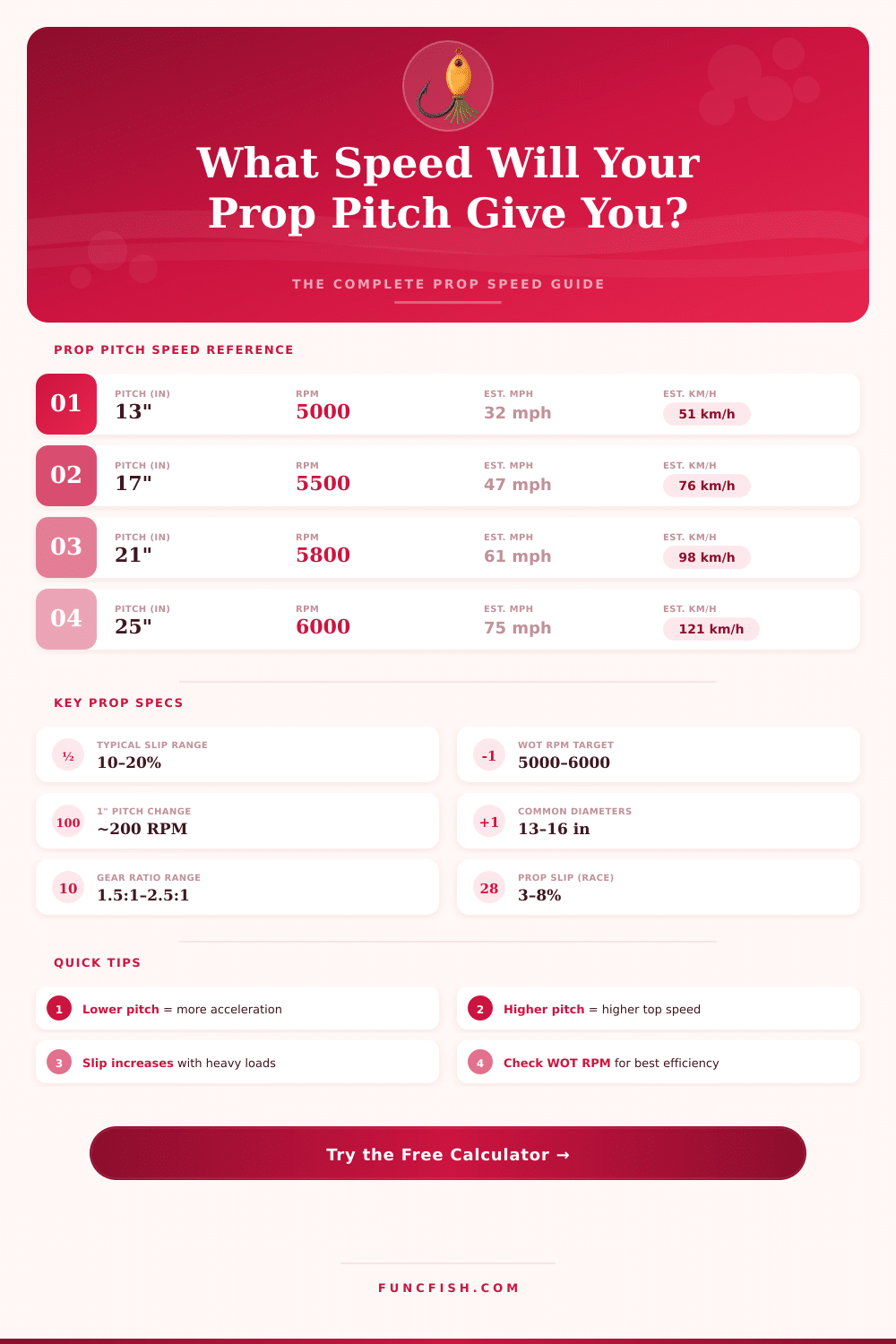
| Pitch (in / cm) | RPM 4500 | RPM 5000 | RPM 5500 | RPM 6000 | Typ. Boat Type |
|---|---|---|---|---|---|
| 13" / 33 cm | 25 mph / 40 km/h | 28 mph / 45 km/h | 31 mph / 50 km/h | 34 mph / 55 km/h | Jon / Aluminum |
| 15" / 38 cm | 29 mph / 47 km/h | 32 mph / 52 km/h | 36 mph / 58 km/h | 39 mph / 63 km/h | Small Runabout |
| 17" / 43 cm | 33 mph / 53 km/h | 37 mph / 60 km/h | 41 mph / 66 km/h | 45 mph / 72 km/h | Pontoon / Bowrider |
| 19" / 48 cm | 37 mph / 60 km/h | 41 mph / 66 km/h | 45 mph / 72 km/h | 50 mph / 80 km/h | Sterndrive Ski |
| 21" / 53 cm | 41 mph / 66 km/h | 45 mph / 72 km/h | 50 mph / 80 km/h | 55 mph / 89 km/h | Bass Boat |
| 23" / 58 cm | 45 mph / 72 km/h | 49 mph / 79 km/h | 54 mph / 87 km/h | 60 mph / 97 km/h | Performance Runabout |
| 25" / 64 cm | 49 mph / 79 km/h | 54 mph / 87 km/h | 59 mph / 95 km/h | 65 mph / 105 km/h | Offshore / Sport |
| 27" / 69 cm | 52 mph / 84 km/h | 58 mph / 93 km/h | 64 mph / 103 km/h | 70 mph / 113 km/h | Race / Hi-Perf |
| Boat Type | Slip Range | Reason | Ideal Prop Style |
|---|---|---|---|
| Bass Boat (Light) | 10–14% | Light hull, flat bottom | 3-Blade SS or cupped |
| Pontoon (Heavy) | 16–22% | High drag, wide beam | 4-Blade Aluminum |
| Offshore Sportfish | 8–13% | Deep-V, planing hull | Nibral 3-Blade |
| Ski / Wake Boat | 12–18% | Loaded, soft wake needs | 4-Blade Stainless |
| Jon Boat (Flat) | 18–25% | Flex hull, light engine | 3-Blade Aluminum |
| Race (Cleaver) | 3–8% | Surface-piercing efficiency | Cleaver / SPP |
| Walleye / Multi-Species | 12–16% | Moderate load, tiller ops | 3-Blade Stainless |
| Pitch Change | RPM Change | Speed Effect | Use Case |
|---|---|---|---|
| +1" More Pitch | −150–200 RPM | +1–2 mph top speed | Under-propped, WOT too high |
| −1" Less Pitch | +150–200 RPM | +Hole shot, less top speed | Over-propped, can't reach WOT |
| +2" More Pitch | −300–400 RPM | +3–4 mph (if in range) | Speed builds, lighter load |
| 3-Blade → 4-Blade | −100–150 RPM | Same pitch, less slip | Better handling, less ventilation |
| Alum → Stainless | +50–100 RPM | +2–5% efficiency | Less flex, more speed |
| Add Cupped Edge | −100–200 RPM | Less slip, better grip | Ventilation problems, stern-heavy |
Prop pitch shows how far the prop moves forward during one revolution. Imagine it as a screw that twists in wood. Prop pitch works similarly but in water or air instead of solid material 26 pitch would advance 26 inches for one turn if it would not slip.
Bigger prop pitch is like shifting to higher gear in a car. High pitch allows efficient cruising in high speeds, but boost from stop is then hard. Low pitch gives stronger push in low speeds, more force during reverse and helps move in ports.
What Prop Pitch Is and How It Affects Speed and Power
It also helps against headwind, because push stays strong in low speeds. Even so top speeds will be low.
Every inch of pitch is around 200 rpm on a boat. Lowering pitch increases rpm and vice versa. For instance, going from 23 to 21 pitch will increase engine rpm by around 400 revolutions.
Rule of thumb says that every 2 inches of pitch change affects rpm by 400. Less pitch forces higher rpm.
Some props have constant pitch, so the distance stays equal through the whole blade edge. Progressive pitch starts low beside the leading edge and grows to the trailing edge. For progressive pitch the number is the average of the whole blade.
Such pitch helps in uses in high speeds.
5 inch pitch twisting in 15,000 rpm would advance 75,000 inches per minit, or around 70 mph. When the plane reaches 70 mph, the prop cannot push any more. Pitch speed shows theoretical maximum for the model, without considering air drag or prop slip.
Maximum theory speed is where drag matches push.
For boats with planing hulls you choose prop pitch to reach motor maximum rated rpm at full gas. Full gas rpm in the top range gives the best boost with a bit less top speed. Middle full gas rpm reaches a bit more top speed but with slower boost.
You cannot optimize both with one prop.
Big diameter prop with same pitch moves more water per revolution. Equal rpm could boost more quickly, but top speed will not profit. Four blade prop usually has 2 inches less pitch than three blade for same rpm.
In high rpm with high pitch in big speeds the attack angle of the prop against incoming air becomes bad, because of that you want bigger bitesfrom the air in high speeds.