
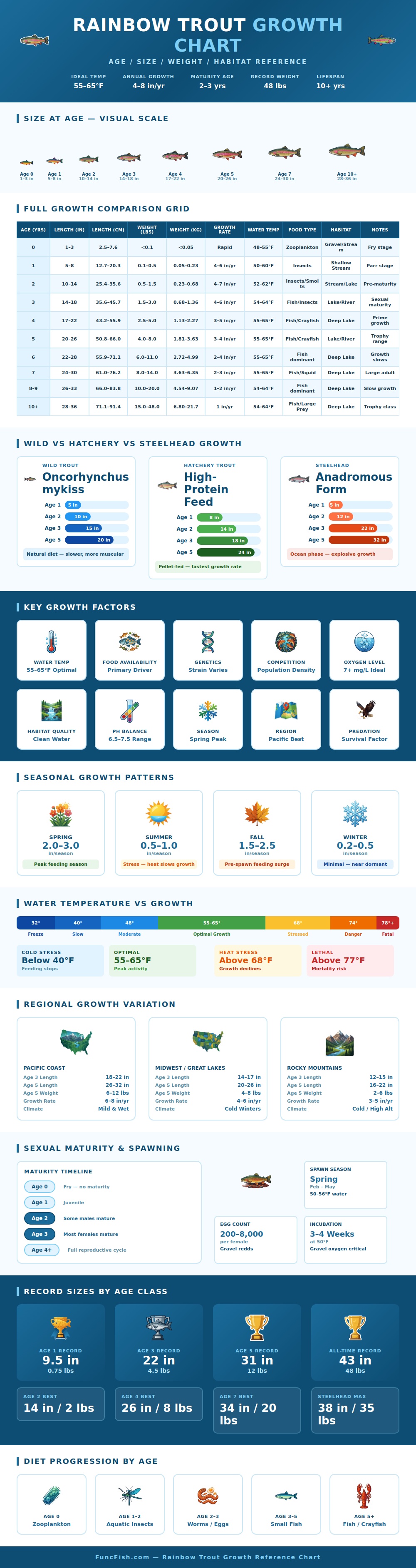
Fishing becomes less luck and more skill when we begin to understand growth patterns. You’re casting that fly in a cold mountain stream and the bite comes. The tug pulls at your line and you focus on reel. Then the fish rises and you see that pink lateral stripe. How old is this rainbow trout? Is it a five-year-old monster? Or maybe it is a two-year-old resident? Breaking down these expectations through visual scale, we get a look at how a fry becomes an adult.
Most folks think it’s a linear growth pattern, but its more nuanced different than that. There will be a lot of fast growth in length during those first few years as the fish finds its place within its habitat. You may have a one-year old trout measuring from five-to-eight inches; a three-year old could double that range. Abundant food sources such as insect larvae and zooplankton in shallow stream water drives this early spurt of growth. Competition and predation force the fish to gorge on whatever it can reach to survive. That gorging lead to dramatic body shape changes relative to size.
How Rainbow Trout Grow
When rainbow trout sexually mature (typically in their second to third year), their growth pattern change. Energy goes into reproducing instead of simply getting bigger. And so, you see fewer medium sized fish compared to numbers of large fish; this is a common observation by many angler. The graph above help illustrate this change with significant increases in weight starting at three years old while length gains slow down thereafter. In other words, a three-year-old trout won’t necessarily appear all that different than a four-year-old trout; however, it’ll be noticeably heavier in your hands.
What does this mean? It means the fish becomes denser and therefore behave differently on your line. Namely, it’s going to pull harder, take more tackle on a long run, and keep itself positioned lower in the current.
Environmental variables that affect their final size is of equal importance. Perhaps most important of all is water temperature. They will grow best at temps between 55-65 degrees Fahrenheit. If they are outside that range, they slows down their metabolism or stress out altogether. For example, cold water Rocky Mountain streams produce smaller fish than milder Pacific Coast waters due to shorter growing seasons. This is reflected in infographic which highlights the regional difference.
Why would a trophy trout caught from Colorado be different looking than one caught from Washington? It’s more than just genetics. It’s how many hours a year the water spends in that comfy thermal window.
In addition, you’ll find larger fish in areas that has shaped how their diet evolved. The younger trout will be found at stream surfaces or bottom edges eating insects. While the older ones head to slower pools of rivers and lakes to ambush crayfish and other smaller baitfish. This shifts how you target specific structure based off the size you want.
Want a three pounder? Target insect hatches and riffles. Going for bigger pounds? Look for deep water with overhead cover where the bigger prey gathers. And remember seasons matter, so spring provides best feeding times before they go elsewhere for the spawn.
Knowing how this growth works helps you be a better angler. It also lets you set reasonable expectations and ultimately increase your catch rate. It’s no longer about going against biological makeup of the species, but working with it. Knowing where the fish live, how big they get, and how old they are will make each cast more purposeful. This is true whether you’re keeping them for the dinner plate or releasing them for conservation purposes.
Next time you have your feet planted on those rocks, consider the fish below you has a story to tell in its own scales. Its story is told by time, food, and temperature.