Fishing Reel Drag Washer Stack Calculator
Estimate drag stack height, active friction faces, contact pressure, heat load, and reel drag from washer size, material, keyed plates, eared plates, spool diameter, and preload.
📌Scenario presets
⚙Stack and reel inputs
Drag washer stack result
Calculation breakdown
🧰Material data grid
Greased Carbon
Dry Carbon
Oiled Felt
Cork Composite
📊Reference tables
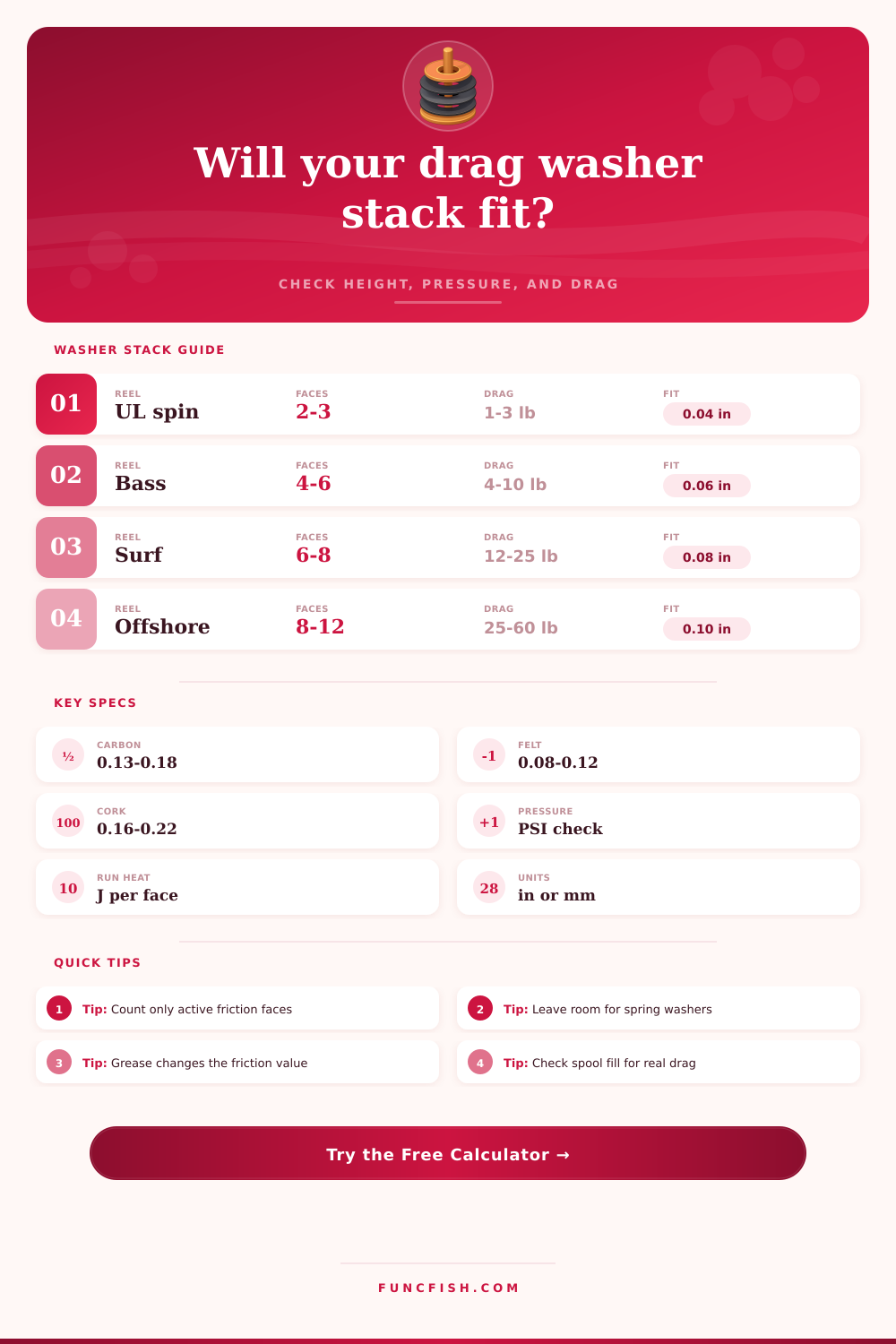
| Stack pattern | Typical parts | Active faces | Typical drag range | Fit note |
|---|---|---|---|---|
| Single friction washer | 1 friction, 1 keyed plate | 1 to 2 | 1 to 6 lb / 0.5 to 2.7 kg | Small spinning and fly reels |
| Three washer spool stack | 3 friction, 2 metal | 3 to 5 | 3 to 12 lb / 1.4 to 5.4 kg | Common spinning drag stack |
| Five washer keyed stack | 3 friction, 4 metal | 5 to 6 | 6 to 18 lb / 2.7 to 8.2 kg | Star drag bass and inshore reels |
| Seven washer alternating stack | 4 friction, 5 metal | 7 to 8 | 10 to 30 lb / 4.5 to 13.6 kg | Heavier baitcasting and surf reels |
| Multi-disc offshore stack | 5 to 8 friction discs | 8 to 14 | 20 to 70 lb / 9.1 to 31.8 kg | Check heat and plate flatness |
| Material | Friction coefficient | Pressure guide | Heat behavior | Common use |
|---|---|---|---|---|
| Greased carbon fiber | 0.13 to 0.16 | 700 to 1000 psi | Stable on long runs | Most power upgrades |
| Dry carbon fiber | 0.16 to 0.20 | 650 to 900 psi | Can start firmer | Bench power checks |
| Oiled felt | 0.08 to 0.12 | 180 to 300 psi | Compresses with heat | Small spinning reels |
| Cork composite | 0.16 to 0.22 | 350 to 600 psi | Good if lubricated | Fly and lever drags |
| PTFE smooth washer | 0.04 to 0.08 | 150 to 250 psi | Low grab, low power | Light smooth stacks |
| Fishing setup | Line class | Target drag | Suggested faces | Washer note |
|---|---|---|---|---|
| Panfish or trout spinning | 2 to 6 lb / 0.9 to 2.7 kg | 0.6 to 2 lb / 0.3 to 0.9 kg | 2 to 3 | Low startup matters most |
| Bass braid to leader | 10 to 30 lb / 4.5 to 13.6 kg | 3 to 9 lb / 1.4 to 4.1 kg | 4 to 6 | Carbon handles cover pressure |
| Inshore redfish or snook | 15 to 40 lb / 6.8 to 18.1 kg | 5 to 13 lb / 2.3 to 5.9 kg | 5 to 8 | Seal and rinse salt stacks |
| Surf striper or drum | 20 to 50 lb / 9.1 to 22.7 kg | 7 to 17 lb / 3.2 to 7.7 kg | 6 to 9 | Heat from long runs is key |
| Offshore trolling | 30 to 130 lb / 13.6 to 59 kg | 10 to 45 lb / 4.5 to 20.4 kg | 8 to 14 | Check strike and full separately |
💡Stack calculation notes
Active face count: A friction washer only contributes where it is squeezed between surfaces that can rotate against each other. Locked plates touching locked plates add height, not drag torque.
Stack clearance: A drag may feel strong on the bench but bind in the reel if the stack plus belleville or spring washers exceeds the available cavity depth.
Spool diameter: The same clutch torque produces less line pull on a full spool and more line pull on a depleted spool, so spool fill changes measured drag.
Pressure limit: If calculated face pressure is close to the material guide, add active faces, increase washer area, reduce target drag, or use a more stable material.
Fishing reels contain a drag system, and the drag system is a critical component of every fishing reel. When a fish pull on the fishing line attached to the fishing reel, the drag system creates resistance for the fishing line. The drag system use a series of washers to create friction between the washers.
The drag washer stack determines the amount of pressure that the fishing reel will apply to the fishing line. If the drag washer stack is sized incorrect, the fishing reel will not be able to provide enough pressure to the line or the drag washer stack will fail due to heat. The drag washer calculator will determine the size of the drag washer stack that will fit within the fishing reel and provide the amount of pressure that is desired.
How the Drag Washer Calculator Works
The drag washer calculator requires several specific inputs to determine the drag washer settings. These inputs will determine the performance of the drag washer. For instance, the material used to create the drag washer is one of the inputs that will affect the drag washer’s friction and heat resistance.
Additionally, the count and the pattern of the washers will determine the number of rubbing surface created within the drag washer. Other inputs are the diameter of the spool and the percentage of the line that is still on the spool. These two values will change the amount of pull that the fishing reel will exert on the fishing line.
Finally, the depth of the cavity within the fishing reel and the spring allowance of the fishing reel will determine whether the drag washer will bind or rattle within the fishing reel. Each of these measurements will allow the drag washer calculator to provide estimates regarding the active faces, contact pressure, stack height, and safe drag ranges for the drag washer. These calculations will allow the person to avoid the errors that may be made when guessing the drag washer settings.
The conditions under which the drag washer is used will change its performance from that which is measured under laboratory conditions. A new drag washer will exhibit different performance characteristics than an old drag washer that have been used in fishing environments. These used drag washers may have been exposed to salt spray or wear from the fishing line.
The settings for service condition will account for these variable in the drag washer calculator. Additionally, the choices for safety margin will allow the person to adjust the calculator to either provide smoothness when the fishing line is light or increase the strike settings for heavy fishing environments. These variables are important because a drag washer that locks up will result in a lost fish.
The limits for the pressure that the drag washer will endure are important to understand. Limits to the pressure that the material can endure will indicate the point at which the material is no longer reliable. If the pressure limit is exceeded, the washers will glaze or compress.
If the washers glaze or compress, the drag washer will either grab or fade the fishing line. The drag washer calculator will allow the person to understand when these limits are approached so that the person can add more active face to the drag washer or change the material of the drag washer. Another important factor is the heat that the drag washer must absorb.
During fishing activities, a long run of the fish will produce heat that the drag washer must absorb. The drag washer calculator will provide estimates regarding how much energy each face of the drag washer will absorb from the fishing line. If the energy that is calculated for each face of the drag washer is high, then the drag washer can have more faces or use a material that can absorb more heat.
Several reference tables is provided on the page that goes along with the drag washer calculator. These tables provide information regarding the materials and the patterns of drag washers for the different types of fishing reels. The reference tables include information for spinning reels, star drag reels, lever drag reels, and fly reels.
The tables provide examples of drag washer setups for each type of fishing reel so that the person can understand the range of drag washer designs. For instance, the drag washer that is used in a small spinning fishing reel will not exhibit the same performance as a drag washer that is designed for a trolling fishing reel. The tables provide context for the information in the drag washer calculator.
However, they are not rules that should be followed in the setup of a drag washer for a fishing reel. One of the errors that may be made is to assume that each washer within the drag washer is an active face. However, not every washer within the drag washer is an active face.
An active face is the part of each washer that can rotate against the other washers in the drag washer to produce the drag torque. Some drag washer setups may contain metal plates that lock together. Metal plates that lock together will increase the height of the drag washer but will not increase the drag torque.
The drag washer calculator takes into account the number of active faces, which is why the number of active faces may be less than the total number of washers. Another factor that a person may ignore when using the drag washer calculator is the fill percentage of the spool on the fishing reel. As a person fishes, the fishing line on the spool will decrease in amount.
As the amount of fishing line on the reel decreases, the radius of the fishing reel will also decrease. Additionally, the amount of pull on the fishing line will also increase. The percentage of the line that is on the spool must be provided at the specific test point for the fishing line to ensure the drag washer calculator provides an accurate estimation of drag for the fishing line at this current stage of fishing.
Finally, the drag washer calculator allows the person to understand the dimensions of a drag washer and the fishing conditions that is required to build an efficient drag washer. The calculator will mathematically convert these parameters and calculate the coefficients for the drag washer so that the person does not have to mathematically calculate these values for the fishing reel. However, the drag washer calculator will allow the person to understand which parameters are the most important to the fishing line and the fish being caught.
Thus, the calculator will allow the person to understand the drag washer system in relation to the fishing reel before assembling the components to create the fishing reel.