Reel Free Spool Time Calculator
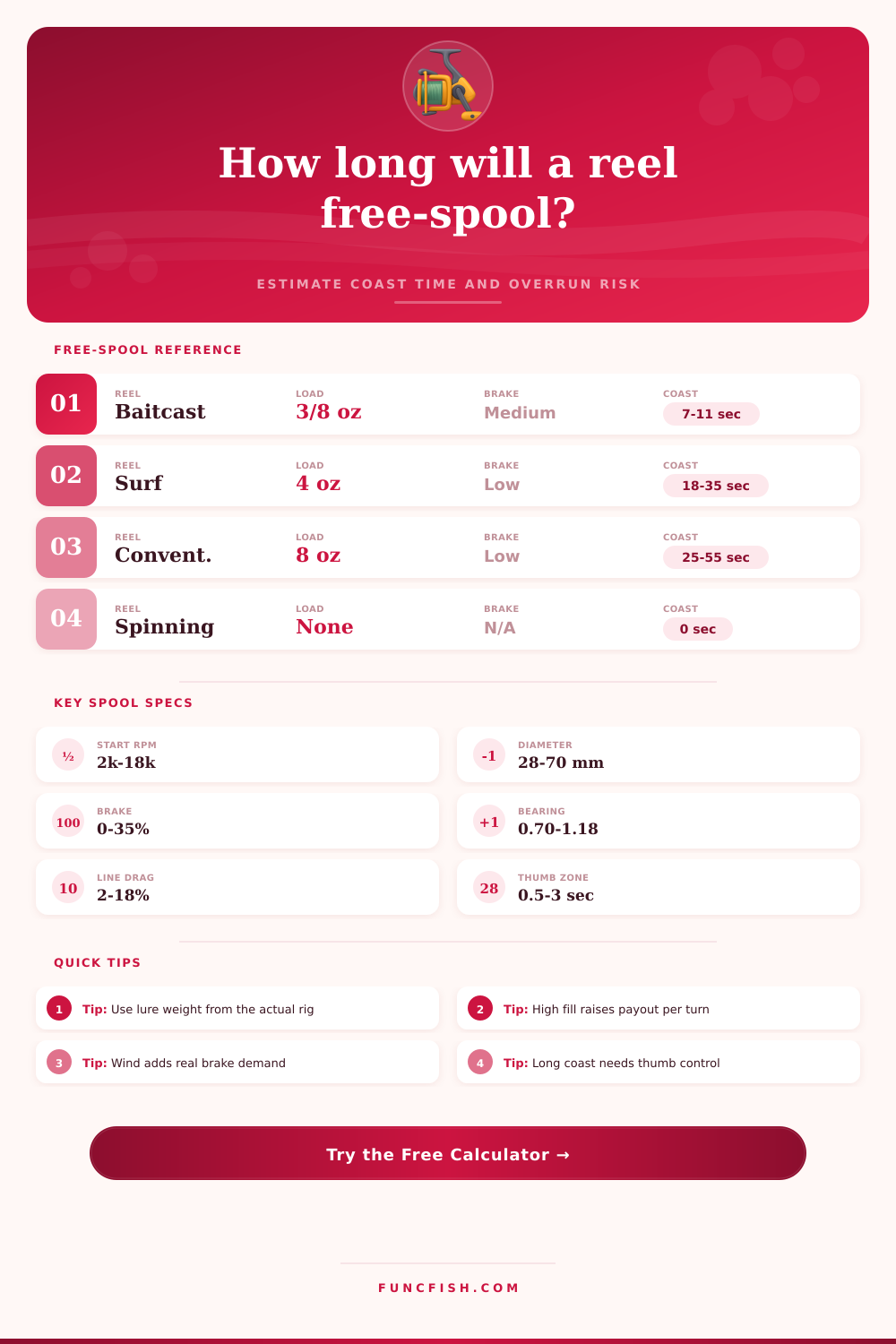
Estimate reel coast time, line payout, start RPM, brake drag, and overrun margin for baitcasting, conventional, centerpin, surf casting, and offshore reels.
📌Free-spool presets
⚙Spool and cast settings
Free-spool forecast
Calculation breakdown
🎣Reel free-spool data grid
Low-Profile Baitcaster
Centerpin Float Reel
Surf Conventional
Lever-Drag Offshore
📊Reference tables
| Reel type | Typical filled diameter | Observed free-spool range | Primary brake source | Common use |
|---|---|---|---|---|
| BFS baitcaster | 28-32 mm / 1.10-1.26 in | 4-10 sec | Magnetic brake plus light spool | Small plugs and finesse rigs |
| Low-profile baitcaster | 32-36 mm / 1.26-1.42 in | 6-14 sec | Magnetic, centrifugal, spool tension | Bass jigs, frogs, spinnerbaits |
| Round baitcaster | 38-46 mm / 1.50-1.81 in | 10-22 sec | Centrifugal blocks or spool tension | Catfish, salmon, musky lures |
| Surf conventional | 55-70 mm / 2.17-2.76 in | 18-35 sec | Mag control, oil viscosity, thumb | Pyramid sinker distance casting |
| Centerpin float reel | 114-127 mm / 4.5-5.0 in | 45-120 sec | Bearing friction and finger pressure | Float fishing long drifts |
| Offshore conventional | 50-80 mm / 1.97-3.15 in | 20-55 sec | Pinion alignment, bearing seals, drag lever | Live bait and dropback presentations |
| Line type | Typical spool effect | Drag modifier | Free-spool behavior | Best matched scenario |
|---|---|---|---|---|
| Braided PE | Low stretch, small diameter | 0.94 | Fast start, low air bow | Frogs, jigs, distance casting |
| Nylon mono | Higher memory and stretch | 1.00 | Balanced payout and control | Catfish, crankbaits, surf rigs |
| Fluorocarbon | Dense and stiffer | 1.08 | Slower start, more spool load | Jigs, clear water pitching |
| Copolymer | Moderate memory | 1.03 | Predictable mid-speed coast | General baitcasting |
| Heavy braid | Large diameter coating | 1.06 | Strong pull but more guide noise | Saltwater bait and heavy cover |
| Float mono | Large diameter and buoyant | 0.98 | Smooth drift release | Centerpin trout and salmon |
| Target species or technique | Typical rig weight | Useful coast window | Brake tendency | Thumb note |
|---|---|---|---|---|
| Bass jig pitching | 3/8-3/4 oz / 10-21 g | 4-8 sec | Medium to high | Stop spool as jig enters cover |
| Frog over vegetation | 1/2-3/4 oz / 14-21 g | 6-12 sec | Medium | Feather line over grass pockets |
| Surf pompano sinker | 3-5 oz / 85-142 g | 18-32 sec | Low to medium | Thumb hard at splashdown |
| Steelhead centerpin drift | 1/8-1/2 oz / 3.5-14 g | 45-120 sec | None to very low | Finger controls float pace |
| Catfish slip sinker | 1-4 oz / 28-113 g | 10-25 sec | Clicker or light tension | Leave enough drag to prevent loops |
| Offshore live bait | 1-8 oz / 28-227 g | 20-55 sec | Very low | Use thumb for bait turns |
| Gear comparison | Species focus | Spool inertia | Recommended spool check | Risk pattern |
|---|---|---|---|---|
| BFS shallow spool | Trout, crappie, finesse bass | Very low | Use exact lure weight below 1/4 oz | Starts fast, stops quickly |
| Standard bass spool | Largemouth and smallmouth | Medium | Measure filled diameter after spooling | Backlash near lure slowdown |
| Round musky reel | Musky, pike, stripers | High | Include heavy line and large bait mass | Long coast after lure splash |
| Surf tournament spool | Drum, pompano, stripers | High | Set brake percent from mag dial feel | Overrun during sinker turnover |
| Centerpin reel | Trout, salmon, steelhead | Large but efficient | Use drift pull, not casting force | Looping from current surges |
| Offshore lever drag | Tuna, kingfish, sailfish | Very high | Account for sealed bearing drag | Line dump on bait acceleration |
💡Free-spool calculation notes
Measure filled diameter: a nearly full spool releases more line per turn than the empty arbor. Use the line surface diameter, not the catalog spool size.
Use coast time as a tuning target: longer coast is not always better. Match the result to lure slowdown, splashdown timing, wind, and how consistently you can thumb the spool.
Spinning spools get neglected. So much of our attention goes toward line strength and lure action that we forget about how a spinning spool work. We set our baitcast reels’ magnetic brakes correctly, but then what happens when your lure stops moving? How long will it continue to rotate before the spool? How long should it be rotating? That’s the difference between a tangled mess and catching a fish.
Enter the specifications of your gear, and the free spool time calculator do the rest. Abstract mechanics become concrete seconds. The misunderstood part here is rotational inertia. Packed full of beefy mono on a fat round reel is a flywheel that doesn’t stop spinning immediately when you slow lure down. That can help out on the cast (more inertia = farther), but not so good when making pitches to cover.
Why Spool Time Matters for Your Catch
A bigger, heavier spool have more inertia and holds more energy than a tiny, light one, so the tool factors in both spool size and weight. It also accounts for bearing condition. Fresh from the factory, they should spin smoothly. However, corrosion from salt water or gunking up with too much grease will add drag and slow the spin. Know what effect overrides yours.
The other side of the equation is what kind of line you use. Small-diameter braid with very little stretch gets off the spool quickly and doesn’t impede its path (or create much drag) in the air. Mono sits higher on arbor and stretches some. It provides a gradual acceleration followed by a forgiving deceleration. The page’s reference tables shows which type of line to expect from each reel type.
A spinning rod using mono will coast longer than the same rod with braid. A center pin float reel intended for drifting for trout might coast for 1+ minutes, whereas a low-profile baitcaster meant for jig fishing around bass should shut down in seconds. If you know where the starting point is, you’ll be able to identify if your gear is not dialed-in properly.
Half of the equation is knowing your brakes. While most guys max out the magnetic brake to avoid a backlash, they also shoot themselves in the foot by limiting their castability. The calculator allows you to enter both your thumb control pressure and a percent of brake engagement. Combining these two variables provide the “over run” factor. This tells you how far past your target your line will go before coming to rest if you miss the bite by letting the spool spin freely.
If that number’s big, you’re probably running too much break on a particular lure size. Either add more tension to the spool or downsize your presentation because you can’t overcome physics with a ton of brake. The whole process is heavily influenced by wind. If it’s blowing out from behind you, it removes air drag off the line. This allows the spool to turn freely and increases the chance for overrun if you’re not applying pressure with your thumb.
If there’s a headwind, it resists turning the reel which has the naturaly effect of slowing down rotation. This also has its own wind conditions so you can compare your expectations to what is actualy happening instead of just casting on a calm day when you tested it. It makes you think about the environment as a dynamic component of the mechanical system.
Not all tuning comes from numbers; you need experience too. Set your target zone based off the calculator’s recommendation then go fishing. When it says you should of seven seconds of coasting on your jig pitch, try to hit that mark in the field. Throw it up there and let ‘er rip, observe your spool and count down.
When it continues unwinding long after you think it should, increase thumb pressure or tighten drag. What you’re aiming for isn’t a complete stoppage of the spool, but rather syncing its slowing curve with the lures’ flying arc. Free spool time is the key to mastery Because once you get your reel dialed in, there’s no guessing what’s going to happen when that fish hits the surface.
You can read water and present your bait without wondering if your reel will fail on the most critical part of the cast. It sounds trivial but it makes a bigger difference than you’d assume. Get the coasts down and the other parts of the cast will fall right into place.