Fishing Rod Taper Ratio Calculator
Calculate rod blank taper ratio, diameter drop, taper rate, action fit, and load compatibility from real blank dimensions and fishing setup details.
📌Scenario presets
⚙Rod taper inputs
Rod taper forecast
Full breakdown
📋Blank material reference grid
HM Graphite
Graphite
Composite
E-Glass
📐Taper and action reference tables
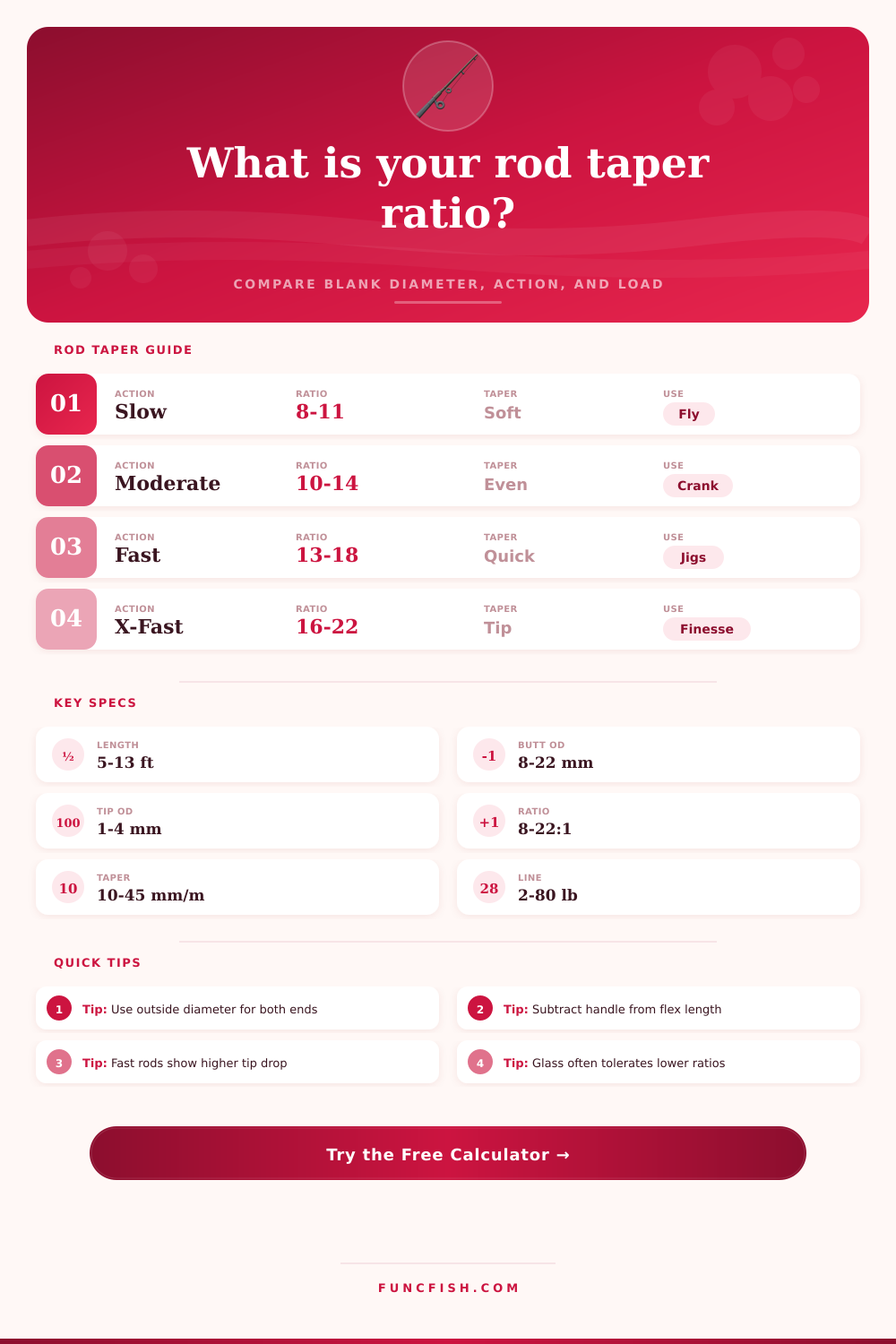
| Action band | Taper ratio | Tip share | Typical use |
|---|---|---|---|
| Extra fast | 16:1 to 22:1 | Top 20-28% | Finesse jigs, bottom contact |
| Fast | 13:1 to 18:1 | Top 25-35% | Worms, spinnerbaits, single hooks |
| Moderate fast | 11:1 to 15:1 | Top 32-42% | All-purpose casting and spinning |
| Moderate | 9:1 to 13:1 | Mid 40-55% | Crankbaits, surf, live bait |
| Slow | 7:1 to 11:1 | Full 55-75% | Fly rods, glass rods, soft bait work |
| Power | Line midpoint | Lure window | Common blank OD |
|---|---|---|---|
| Ultralight | 2-6 lb / 1-3 kg | 1-7 g | 6-9 mm butt |
| Light | 4-8 lb / 2-4 kg | 2-10 g | 7-10 mm butt |
| Medium light | 6-12 lb / 3-5 kg | 4-14 g | 8-12 mm butt |
| Medium | 8-17 lb / 4-8 kg | 7-28 g | 10-14 mm butt |
| Medium heavy | 12-25 lb / 5-11 kg | 10-42 g | 12-17 mm butt |
| Heavy | 20-50 lb / 9-23 kg | 21-85 g | 15-22 mm butt |
| Extra heavy | 40-80 lb / 18-36 kg | 56-170 g | 18-28 mm butt |
| Technique | Preferred taper | Material lean | Rod note |
|---|---|---|---|
| Bass jig / worm | Fast to extra fast | Graphite | Crisp tip and firm butt |
| Crankbait | Moderate | Composite / glass | Even load protects trebles |
| Surf casting | Moderate fast | Graphite / glass | Long lever with stable butt |
| Offshore trolling | Moderate | Glass / composite | Steady load and deep bend |
| Fly trout | Slow to moderate | Glass / bamboo | Smooth line load |
| Walleye jigging | Fast | Graphite | Light tip with quick recovery |
💡Measurement checks
Tip: Measure blank outside diameter at the butt end of the active blank, not over cork, reel seat arbors, paint buildup, or a removable fighting butt.
Tip: For multi-piece rods, subtract ferrule reinforcement from flex length before comparing taper rate with one-piece blank measurements.
A fishing rod taper is a critical component of a fishing rod because the taper of the fishing rod determine how the fishing rod blank will taper from the butt of the fishing rod to the tip of the fishing rod. The shape of the taper will determine how the fishing rod will load when a line is pulled, how the fishing rod will cast, and how good the fishing rod will fight the fish. The shape of the fishing rod taper will also determine the amount of power that is left in your hands, as well as the amount of energy that is transmitted to your lure.
While many people selects fishing rods according to the action and power ratings of the fishing rod, those ratings are only as useful as if you understand the fishing rod taper that determine that action and power for that fishing rod. The performance of a fishing rod will change according to the taper of the fishing rod. Fishing rods with a steep taper will allow the tip of the fishing rod to bend, but the rest of the rod will stay relatively straight.
What a Fishing Rod Taper Is and How to Measure It
Additionally, the steep taper will allow for quick recovery of the fishing rod after it has bent. Fishing rods with a gentle taper will allow for the bend of the fishing rod to occur further along the fishing rod blank, and it will allow for the fishing rod to load in a gentler fashion that is better for the light line and treble hooks. These different fishing techniques will require fishing rods with different tapers to accommodate the specific demand of those fishing techniques.
In order to understand the taper of a fishing rod, you must measure the fishing rod blank. In order to determine the active flex length of the fishing rod, you will need to subtract from the total length of the fishing rod the length of the handle, reel seat, and reinforced ferrule of the fishing rod. Once you have determined the length of the fishing rods active flex length, you can measure the diameter of the butt of the fishing rod and the diameter of the tip of the fishing rod.
With these three measurements, you can use a calculator to determine the ratio and the rate of the fishing rod blank. The ratio will inform you of the steepness of the taper of the fishing rod, while the rate will tell you how the steepness changes along the active flex length of the fishing rod. The material of the fishing rod will change how the taper of the fishing rod perform.
Fishing rods with high-modulus graphite blanks can have higher ratios because the high-modulus graphite fibers can recover more quickly from the bend of the fishing rod. Fishing rods with glass and composite blanks will have a more deep bend to the fishing rod, and the fibers will recover more slowly. Therefore, rods with glass or composite blanks will have a lower ratio.
By using the fishing rod taper calculator, you can determine whether your measured ratio fall in the correct window for the material of your fishing rod. If it lands within that range, the fishing rod will perform as the action label suggests of its performance. Beyond the material of the fishing rod, the power of the fishing rod will also change the way that the fishing rod blank tapers.
For example, if a fishing rod with a medium-heavy power is built for 17-pound line, then the diameter of the butt of the fishing rod must be large enough to handle the load of that line. However, the tip of the fishing rod must remain thin enough to allow for the casting of lightweight lures. In order to determine whether the fishing rod is properly constructed, you can use a load-fit score.
This score will calculate the difference between the diameters of the fishing rod, the line rating, and the weight of the lure. A low load-fit score could mean that the butt of the fishing rod is too light for the line or that the tip of the fishing rod is too fine for its line and lure weight. This weak spot in the fishing rod will cause problem when fighting fish.
In addition to the rating of the fishing rod, several other factors will influence the fishing rod taper. The amount of current in the water that you are fishing in, the snags that you may encounter in the water, and the amount of effort that you expend when you cast your line will all change the amount of stress that the fishing rod experiences. The fishing rod taper calculator will allow you to adjust for these factors to see whether the fishing rod taper is appropriate for your fishing condition.
For instance, a fishing rod that is appropriate for quiet waters may have a different taper than one that is constructed to handle the stress of current. In addition to environmental conditions, your fishing technique will play a crucial role in the fishing rod taper. For instance, jigging and worm fishing techniques require a fishing rod with a faster upper section of the fishing rod blank.
Additionally, crankbait fishing techniques will require a fishing rod blank that has an even bend along the length of the fishing rod blank to allow the treble hooks of the fishing bait to remain attached to the lure while fishing. The profile selector allows you to see how these different fishing techniques will change the ideal ratio and rate of the fishing rod. A balanced fishing rod will have its profile in the center of its action rating, but a power-butt fishing rod will have its profile shifted toward the lower half of the fishing rod to add leverage while reeling in the caught fish.
The reference tables within the fishing rod taper calculator will display the typical ratio and rate for each type of fishing rod action and power rating. Additionally, those tables will display the different fishing techniques and the materials and tapers that is associated with each fishing technique. These numbers can be used as a general reference point for fishing rods to determine where the blank of your fishing rod falls in comparison to others in the same category.
In order to increase the accuracy of the fishing rod taper calculator, you can measure the same fishing rod blank several times. By measuring the blank at slightly different points, you can determine the average of the measurements of the blank. This will allow for a more accurate calculation of the taper of the fishing rod.
While there are general-purpose fishing rods available for purchase, the most effective approach would of to purchase fishing rods that have been built with the specific taper required for your specific fishing technique. Such a fishing rod will cast further and set the fishing hook more clean. Additionally, because a fishing rod with the appropriate taper will fight the fish more efficiently, you will waste less energy in the fight with the caught fish.
These numbers will allow you to describe the characteristics of the fishing rod that you already use and love to fish.