
A sailfish puts up a good fight, espesially when he kicks his speed up a notch or two. That’s when we all want to know what we caught and everyone else guesses big time on the estimated size. That bill accounts for almost three additional feet in overall length and skews your eye estimate from the boat. You may be thinking you have a 50 pound fish in the boat but it turns out you only had a 20-pounder.
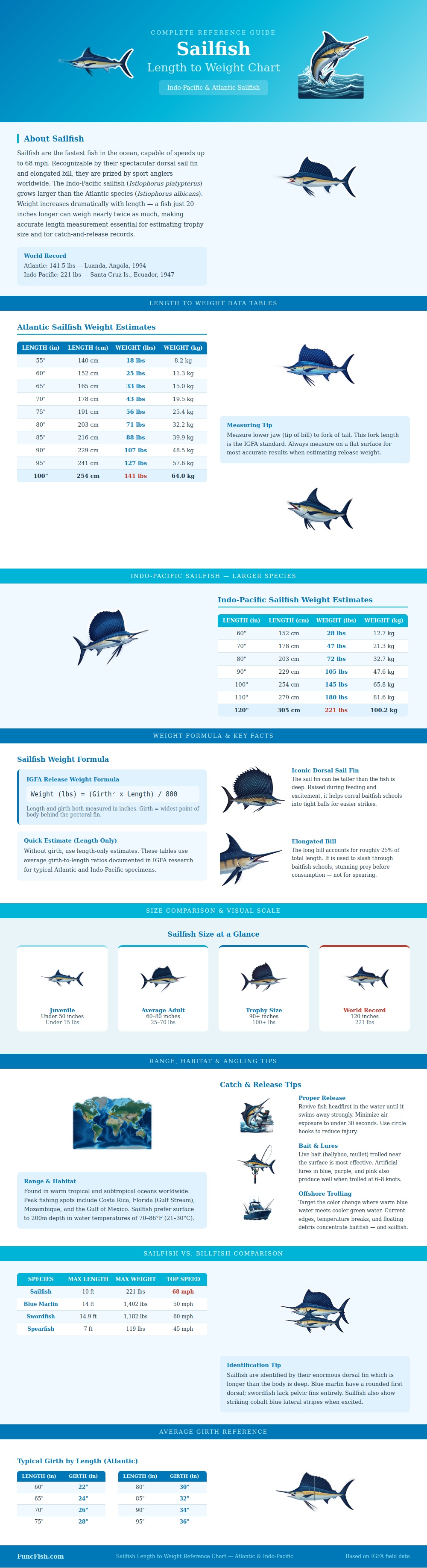
Knowing what that beast really weighed isn’t just for bragging rights. It lets you know how powerful the beast was and lets you handle him correctly for a safe release. For both Indo-Pacific and Atlantic species this chart shows you how length translates to weight. You won’t have to guess at the side of the boat after the fight.
How to Measure and Catch Sailfish
The two main species is different. In general, the Indo-Pacific species is bulkier relative to its length, while the Atlantic sailfish has a more slender body. If you’re guessing by length only, this is quite telling. When estimating weight based on length alone, a nine-foot Indo-Pacific fish will weigh upwards of one-hundred-and-five-pounds and an equal-length Atlantic fish comes in closer to one-hundred-and-seven-pounds.
As the Indo-Pacific species extends beyond that nine-foot mark, it start putting on pounds in earnest again. They can easily top two-hundred-pounds and that’s where most fishermen underestimate how hard a fish will pull. Those additional pounds make for some real giants out in the tropics that take more tackle and a lot more patience to land.
To understand how they do this, let’s talk measurement. We are not talking about accuracy here as much as consistency. How they do it on most boats is take your tape measure and start at the fork of the tail and go to the top of the lower jaw. That’s how the big fishing organizations does it too. The thing most folks overlook is that the bill counts towards the overall length. Why? Because it’s part of the skeleton. It is a permanent part. It is not an extra part like a fin.
For those who want to know their girth so they can do the math, there’s a formula for that, too. Multiply the square of the girth by the length then divide by 800. Voila! You’ve got an amazingly close guess of the fish’s weight without having to haul it out of the water and onto a scale. Remember: Hauling a sailfish up onto the deck kills it. Letting them stay in the water keeps them buoyant and lets them swim off strongly upon release.
People don’t understand the bill. People think it’s an arrow that they spear things with. They do not. They especially use that bill to cut across schools of baitfish. One swipe they stun several and then they just kind of scoop up the ball of fish. When they are doing that, if you throw live bait or another lure near their nose and up by the surface, they’ll strike aggressively. That is because it is already what they are doing.
That dorsal fin works as a sort of a net. It will corral a bunch of fish and get them all balled up. Then the bill will disrupt them. If they get excited and start chasing things, the side stripes will flare out a cobalt blue color. And then the sail will go way up over the top of the water. This shows you biological engineering for how to do something very efficienty and quickly in an open ocean environment.
To troll for sails, watch for current breaks and water temps. Sailfish like warm water. They are often found where the Gulf Stream meets cooler currents or where floating debris accumulates baitfish. On these edges is your best bet at locating active fish. Circle hooks make a big difference on survival rate of released fish. They hook up in the corner of the mouth instead of way back in their throat.
For proper revival, support the fish upright in the water. Only let them go when they give strong tail kicks. Just dropping it back into the sea isn’t enough. The fish needs to recover from the effort of fighting. Before leaving the dock, it is important to understand how large things might get so you can have realistic expectations.
While there have been world record sails pushing more than two-hundred pounds, the majority of what we catch as recreational anglers come within the realm of what is normal. Most adult sailfish average 6-7 feet long. They typically weigh between 25-70 pounds. This allows for an adrenaline-pumping fight while not needing industrial-grade tackle. That’s part of the allure of going out and chasing these beautiful and speedy predators.
Being able to get them next to the boat and really see how large they are just adds to the enjoyment. Knowing something about their biology further increases your appreciation for this animal. Realize that you’re attached to one of the ocean’s fastest creatures when you feel that initial lurch on the end of the line. It’s big enough to deserve respect because of its strength, it could of been much bigger.