Saltwater Density by Temperature Calculator
Estimate saltwater density from temperature, salinity, depth, and waterbody type, then compare specific gravity, buoyancy change, and likely layering for fishing conditions.
📌Saltwater presets
⚙Density inputs
Saltwater density results
Calculation breakdown
🌊Water type grid
Open Ocean
Coastal Shelf
Estuary
Hypersaline
📊Reference tables
| Water condition | Common salinity | Density effect | Fishing interpretation |
|---|---|---|---|
| Fresh runoff lens | 0 to 5 PSU | Much lighter surface | Can ride over salty channel water |
| Brackish creek mouth | 5 to 18 PSU | Light to moderate | Sharp edges form on slow tides |
| Average coastal water | 30 to 35 PSU | Standard saltwater | Good baseline for SG and lure sink rate |
| Evaporated lagoon | 36 to 45 PSU | Heavier than ocean water | Extra lift and strong density contrast |
| Temperature band | Approx density behavior | Layering cue | Typical saltwater note |
|---|---|---|---|
| 32 to 45 F | Cold and dense | Can hold deep stable water | Winter surf and jetty water feels heavy |
| 46 to 64 F | Dense moderate water | Clean temperature breaks stand out | Common spring and fall coastal range |
| 65 to 82 F | Warm, less dense | Salinity often controls layering | Typical flats, bay, and offshore surface range |
| 83 to 100 F | Warmest and lightest | Evaporation can offset heat loss | Back lagoons may stay dense if salty |
| Fishing setup | Density concern | Useful output | Practical adjustment |
|---|---|---|---|
| Suspending plugs | Higher SG adds lift | Specific gravity | Check pause depth after salinity changes |
| Fly line or leader | Warm low-salinity water reduces support | Buoyancy percent | Recheck sink tip response in brackish water |
| Vertical jigging | Depth compression is small but measurable | Depth density | Use it as a drift cue, not a weight rule |
| Estuary live bait | Salt wedges can stack bait | Thermal shift | Fish the denser lower edge on slack tide |
| Mixing state | Density pattern | Surface signal | Calculator adjustment |
|---|---|---|---|
| Slack tide | Most layered | Clear seam or color line | Raises layering score |
| Incoming tide | Cleaner salty push | Cooler or clearer water | Slight salinity emphasis |
| Outgoing runoff | Fresh lens over salt | Debris and stained water | Raises surface contrast |
| Wind chop | Mixed upper layer | Broken surface texture | Lowers layering score |
💡Density tips
Field check: Density changes from temperature are real, but salinity swings in estuaries usually move the number more. Measure both when runoff, tide stage, or inlet flow changes.
Fishing read: Treat the result as a water-layer clue. A stronger density contrast can slow lure sink, hold bait on edges, or mark a salt wedge below warmer surface water.
The lure goes in the water and it doesn’t sink as fast than yesterday. You think the weight isn’t right or the line isn’t right, but the problem is actualy likely in the water itself. Water is not the same throughout. Its weight vary by depth, salt content, and of course temperature. And this factor make much more difference to an angler then most give credit for.
A bait’s appearance to a fish are all about its buoyancy. Density tells us, allowing us to stop guessing what’s wrong with our suspending plug and begin reading the water like pros.
Understanding Water Density for Better Fishing
But this doesn’t always make sense. The calculator above will do all math for you. It makes complicated fluid dynamics easy to understand in terms of percentages. But what does that mean? What’s behind these numbers?
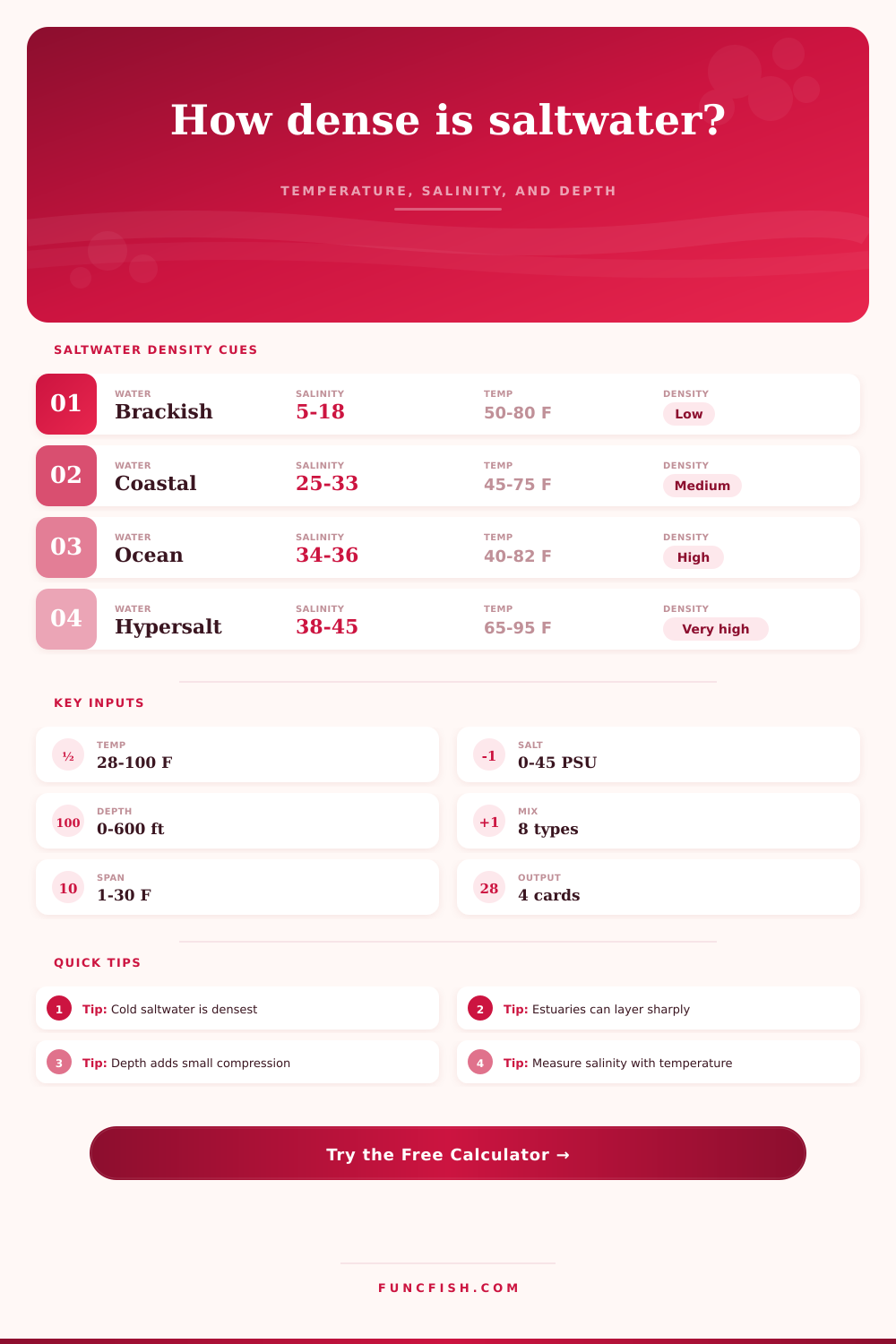
The biggest lever is temperature. Warm water floats. Cool water weigh more. That’s basic physics. But it matters on the water. As cool nights causes the surface to cool in fall, it sink. It forms stable layers and holds baitfish tight to structure. When it warms in summer, the surface heat up and lightens. It floats over deeper cooler denser water. Layering sets up different zone where fish like to hang out.
The same is true for salinity, espeshally in estuary and coastal area. Saltwater is denser than freshwater. As a river flow into the sea, it forms a freshwater lens atop heavier saltwater. The boundary between the two become a hotspot. Predators will set up here to intercept bait swept into current shear zone.
Likewise, the tool allow you to compare various water types, from the open ocean to a brackish creek, illustrating how increasing salinity affects the specific gravity of the water. Parts per thousand changes can make a lure hover out of reach in strike zone or hang lifeless inches above it.
Another factor is depth and while its impact isn’t as pronounced, it certainly adds another layer of thought. The deeper you venture into the water column, the more pressured it becomes which causes it to gets denser. This doesn’t mean anything for fishing in shallow water like surf casting or fishing shallow flats. However, if you’re fishing deep blue water looking for tuna or vertical jigging off a drop-off, the added density give an amount of lift in your tackle that’s measurable. It doesn’t seem like much, I know, but when you’re trying to keep a bait in a small narrow window, every bit of buoyancy helps.
“Temperature is the most visible thing; that’s why most anglers are so focused on it. It’s the easy thing to see, it’s the summer heat and they’re feeling the cold snap. But they completely overlook the salt component. If you measure both salinity and temperature, then you have the whole picture. After a storm, for instance, there may not be any change to the temperature. However, the salinity will suddenly drop. This thins out the surface layer realy well, which affects how your line sinks. People make that same mistake by thinking warm water is always light water. But you can also have these really super-dense hypersaline lagoons with high temperatures because the salt has been concentrated by evaporation.”
This is explained in greater detail on the page along with a handy reference table that breaks common scenarios down. From there, it could of help you make sense of which way the wind is blowing, so to speak, are your conditions leaning more towards mixed or layered?
For example: Wind chop will break up those thermal layers, mix the water column and make density more even. Slack tide can cause those layers to reform and increase the contrast between the bottom and the surface water. Knowing about these mixing state lets you better interpret what the calculator spits out.
This doesn’t require a degree in oceanography. Just pay attention. What’s the water temp? If you’re near an ocean, estimate salinity. What about wind and tide? Then sit back and let it work its magic.
It spits out a buoyancy percentage which tells you exactly how much extra lift your bait is getting vs. Freshwater. Freshwater. Now take that figure and either increase weight or your retrieve speed accordingly.
Because here’s the thing, the water changes all the time. And your reading of it shouldn’t stay the same. Sure, cold water is the densest of all, but only if you consider salt content. So keep that in balance and you’ll find more fish.