🐟 Saltwater Fish Weight Calculator
Estimate your catch weight from length & girth — supports 10+ saltwater species in imperial & metric
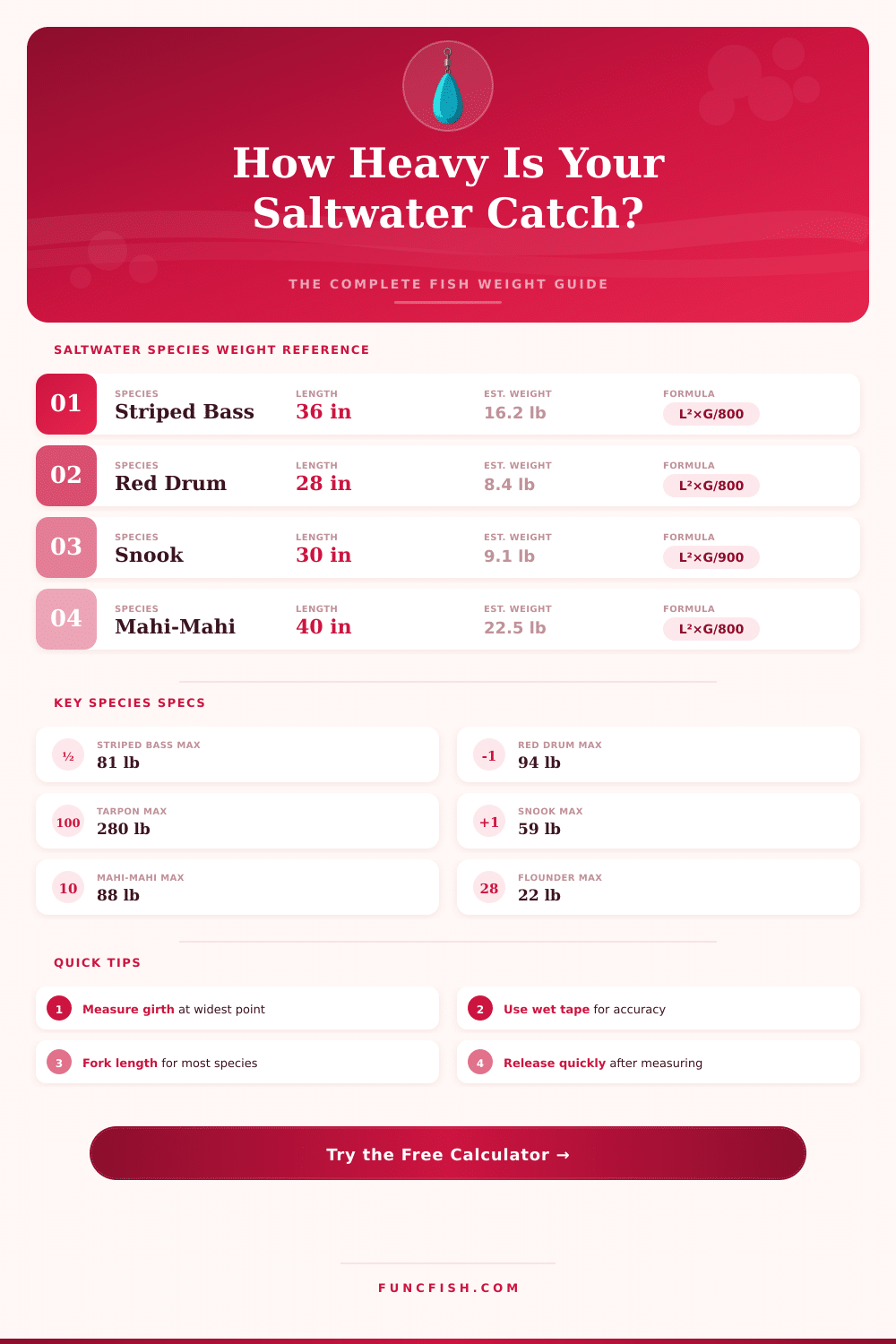
| Species | World Record | Avg. Trophy Size | Divisor | Length Factor | Typical Girth Ratio |
|---|---|---|---|---|---|
| Striped Bass | 81.88 lb (37.1 kg) | 30–50 lb | 800 | L² × G / 800 | 0.55–0.60 |
| Red Drum | 94.2 lb (42.7 kg) | 20–40 lb | 800 | L² × G / 800 | 0.58–0.65 |
| Tarpon | 286 lb (129.7 kg) | 80–150 lb | 850 | L² × G / 850 | 0.52–0.58 |
| Snook | 59.1 lb (26.8 kg) | 15–30 lb | 900 | L² × G / 900 | 0.50–0.55 |
| Mahi-Mahi | 87.5 lb (39.7 kg) | 15–40 lb | 825 | L² × G / 825 | 0.50–0.58 |
| Flounder | 22.7 lb (10.3 kg) | 3–10 lb | 750 | L² × G / 750 | 0.62–0.72 |
| King Mackerel | 93 lb (42.2 kg) | 15–40 lb | 870 | L² × G / 870 | 0.45–0.52 |
| Cobia | 135.9 lb (61.6 kg) | 30–70 lb | 810 | L² × G / 810 | 0.54–0.62 |
| Grouper (Gag) | 80.5 lb (36.5 kg) | 15–35 lb | 820 | L² × G / 820 | 0.60–0.68 |
| Bluefish | 31.12 lb (14.1 kg) | 5–15 lb | 860 | L² × G / 860 | 0.48–0.55 |
| Species | 20 in / 51 cm | 30 in / 76 cm | 40 in / 102 cm | 50 in / 127 cm |
|---|---|---|---|---|
| Striped Bass | 3.5 lb / 1.6 kg | 10.1 lb / 4.6 kg | 24.0 lb / 10.9 kg | 46.9 lb / 21.3 kg |
| Red Drum | 3.8 lb / 1.7 kg | 11.2 lb / 5.1 kg | 26.0 lb / 11.8 kg | 51.8 lb / 23.5 kg |
| Tarpon | 2.9 lb / 1.3 kg | 9.2 lb / 4.2 kg | 24.5 lb / 11.1 kg | 52.8 lb / 24.0 kg |
| Snook | 2.6 lb / 1.2 kg | 8.2 lb / 3.7 kg | 19.1 lb / 8.7 kg | 37.4 lb / 17.0 kg |
| Mahi-Mahi | 3.1 lb / 1.4 kg | 10.0 lb / 4.5 kg | 23.5 lb / 10.7 kg | 46.7 lb / 21.2 kg |
| Flounder | 4.5 lb / 2.0 kg | 13.0 lb / 5.9 kg | 29.9 lb / 13.6 kg | — |
| Method | Description | Accuracy | Conversion Factor |
|---|---|---|---|
| Total Length | Tip of mouth to end of tail | Baseline (1.00x) | None needed |
| Fork Length | Tip of mouth to fork of tail | +2–5% adjust | Multiply by 1.03 |
| Standard Length | Tip of mouth to base of tail | +5–8% adjust | Multiply by 1.06 |
| Length + Girth | Length² x Girth / Divisor | ±5% of actual | Species-specific |
| Length Only | Species-specific factor | ±15% of actual | Species-specific |
Get crisp skin on saltwater fish fillets is more hard than one could believe. When the fillet touches the hot pan it commonly curls upward. Like this happens to every cook, and the skin stays soft instead of crispy.
Using a fish press, one fixes that by pushing the fillet down against the surface. The pressure helps the skin dry and crisp up, while the flesh cooks evenly inside. At first sight, a fish press looks like a hamburger press.
Get crispy fish skin and weigh your fish
One commonly used model is from stainless steel, weighing around 1.8 kilos, which matches about four pounds. It ships quickly in United States and Canada.
Even so a fish press has an entirely other purpose, when we talk about the real weight of caught fish. Fishermen commonly want to know how much their catch weighs, and there are several ways to estimate that on the spot. For holes, common is length times width times width, divided by 800.
One can adjust the divider up or down according to the weight of the fish compared to average. Some fishermen created apps that work without internet, so you just need to measure teh length and width to receive a rating.
Even so these calculations not always work. Long but slim fish can give a wrong result. For instance, a slim 31-inch fish could seem to way 8.5 pounds according to the chart, but actually it only has 3 or 4 pounds.
The heaviest fish not necessarily is the longest, and vice versa.
For truly weighing fish, use a scale with a mouth clip; that works well. Simply set the clip to the center of the bottom jaw. If the scale has only a hook, one can add a separate pair of mouth clips and subtract their weight.
There are also kits special for weighing fish, or one uses a landing net, where the edge and the handle rest below, so that only the fish weight is measured. Length sometimes one prefers to weight, because weight changes, but fish never shrinks.
Fish loses weight after capture also. Blood loss, throwing up and waste all add up, but water loss is the main one. Fish constantly move water in their bodies through a process called osmoregulation, and after capture that balance quickly breaks.
In the nutrition side, fish gives rich protein, little fat and few calories. The most many species have only 1 to 5 percent of fat. When one cooks fish, if it simply loses water and no oil is added, the total calories stay almost the same.
So weighing the raw fish before cooking helps for tracking that. Fish beats red meat, that commonly is rich in packed fats, and plant proteins, that usually comes with extra carbs. Here said, eating only fish on a long-term basis is notbest, because it is too lean, which can cause dry skin, hormone crashes and constant hunger.