Season Length Remaining Calculator
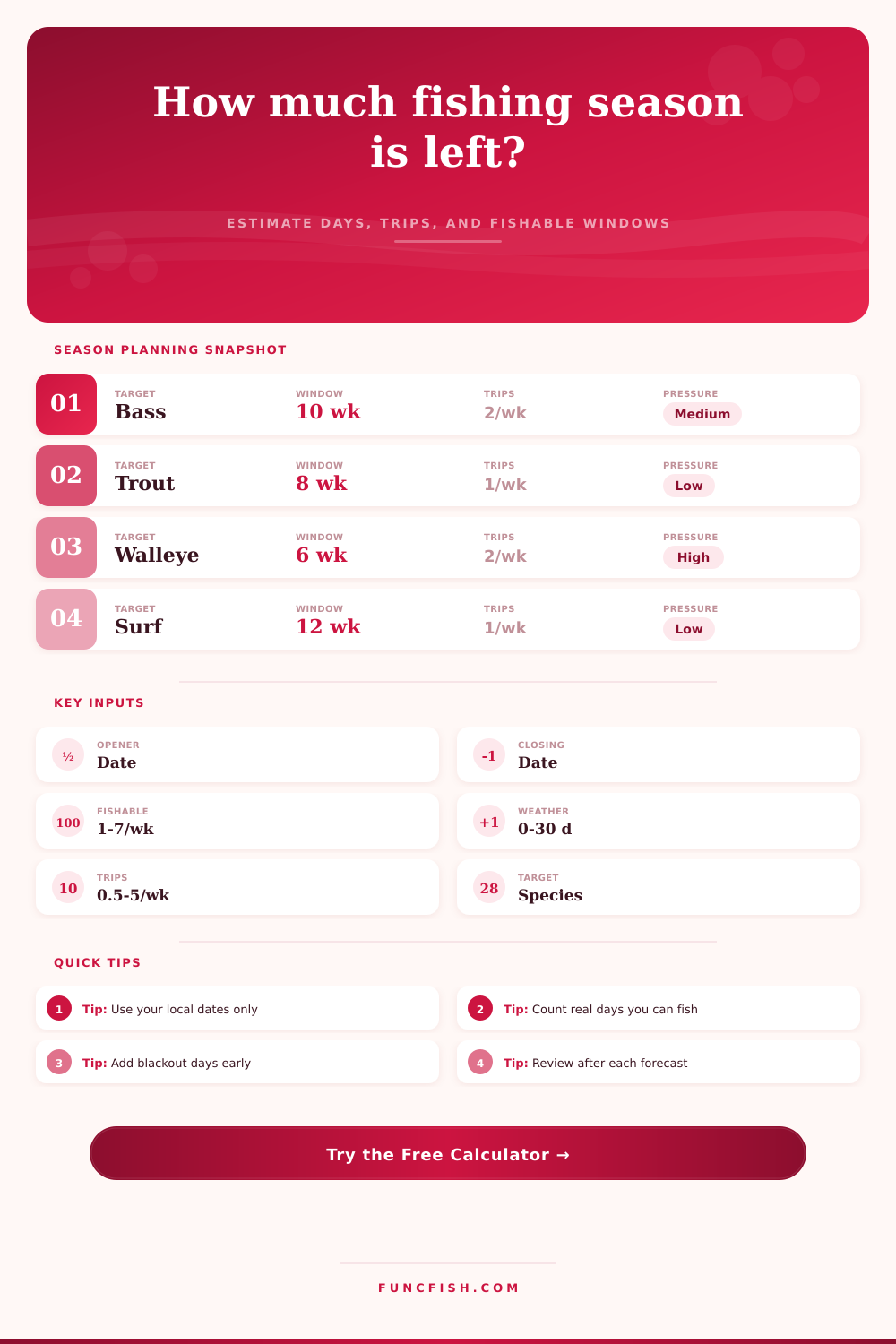
Estimate how much usable fishing season remains from your own opener, closing date, current date, weekly availability, blackout days, expected weather losses, trip frequency, and target species.
📌Season planning presets
⚙Calculator inputs
Remaining season plan
🎣Gear and species comparison grid
📊Reference tables
| Season situation | Planning meaning | Calculator input to adjust | Common result |
|---|---|---|---|
| Before opener | Entire local window is still ahead | Keep current date before opener | Full span remains |
| Inside season | Today through closing date can count | Use actual current date | Active plan |
| Final month | Blackouts compress quickly | Raise priority or reduce goal | Higher pressure |
| After closing | No supplied dates remain | Move to the next local window | Zero days left |
| Fishable days per week | Typical angler pattern | Monthly openings | Planning caution |
|---|---|---|---|
| 0.5 to 1 | Occasional single window | 2 to 4 days | Goals should be modest |
| 1.5 to 2 | Weeknight plus weekend mix | 6 to 9 days | Weather can erase rhythm |
| 3 to 4 | Flexible local access | 13 to 17 days | Rest days still matter |
| 5 to 7 | Daily or travel-focused plan | 21 to 30 days | Watch fatigue and conditions |
| Blackout type | Examples to count | When to enter it | Effect on output |
|---|---|---|---|
| Personal calendar | Work, family, travel, events | As soon as known | Reduces fishable capacity |
| Weather cushion | Wind, storms, unsafe water | Use likely lost days | Protects against overbooking |
| Gear reset | Repair, respool, boat work | Before long trips | Lowers practical trip count |
| Access limits | Ramp closures or low water | When locally confirmed | May raise schedule pressure |
| Target species | Trip shape | Gear planning note | Season strategy |
|---|---|---|---|
| Bass or panfish | Short to medium trips | Keep a ready bank or boat kit | Use frequent small openings |
| Trout or walleye | Timing-sensitive windows | Prep light and low-light rigs | Protect prime periods |
| Pike or muskie | Longer casting blocks | Build in leader and lure checks | Reserve recovery days |
| Surf or offshore | Condition-led trips | Stage heavy gear before windows | Carry larger weather buffers |
💡Planning notes
There’s something odd about opening up your calendar and realizing the fishing season is coming to an end far quicker then you have time off work for. You dream about days with perfect conditions like peaceful mornings and long lunch breaks on the water in the middle of summer. But, more times than not, those perfect day get chopped up into bite-size frustrations by work deadlines, family functions and the changing nature of mother-nature.
The problem isn’t determining the season finale date. Rather, it’s determining how much of the season you can reasonably use before the ice appears or the season shut down for regulation purposes. This is what I like to call “the illusion of availability“. You open up your calendar and realize there are still 30 days remaining. Now you think you’ll be able to fish for 30 days too. Big mistake. Not all calendar days are fishing days. Life has some natural obstacles that must be considered when determining how many days you can get on the water. Sometimes wind is blowing so hard it’s dangerous to go. Sometimes you can’t leave work. Some days you just want to sit back and relax from last trip. Some days are blackout days that you don’t even realize is cutting into your season.
Plan Your Fishing Time Wisely
The tool up top will help you swap out actual calendar days with what days you actually has capacity. It makes you look at the distinction between having time vs. You have access to the time. First you input the outer boundaries with your local opening and closing dates. Then you subtract the known lost days. That’s where folks mess up because they overestimate there own availability and underestimate weather.
What do you plan to catch? Is it bass? You’re likely going to spend an afternoon every now and again catching them during a couple of hour window at lunchtime or on a weeknight after work. Maybe it’s trout and there’s a small window when they will bite for a week before the next good window comes along; that will change things. How about pike in the fall? That may require long stretches of casting back-to-back where you’ll need more free time instead of just a few hours here and there over several weeks.
The calculator will allow you to enter average length of time your trip will take and how frequently you can make that trip. From there it will compare that to your available fishable time. If you set a goal of fourteen trips then the calculator will tell you either way whether that is realistic or sets you up for disappointment. When the needle on the pressure gauge reaches full, it will be clear that you need to cut something back or accept that you won’t be able to achieve all of your goals.
And it’s about setting expectations as well at the end of the season. Those closing days will feel like they is getting shorter and a single storm can ruin an entire week of possibilities. Adding a weather buffer today helps you be realistic about what you’re up against. You’re not planning for the best year; you’re planning for a real one.
The reference tables on the page shows the breakdown of available fishable days by month and how that translates to openings. A fisher with one trip per week has potentially four days a month, so if a couple of those go bad due to weather, you’ve just halved your season. People are often surprised because they set goals based off the best case scenario and then find that things do not work out as expected.
This exercise pushes you to choose. Do you prefer fewer trips but longer ones that require significant time off? Or do you prefer taking shorter more frequent trips just to maintain your skill? If you run these numbers you’ll find out exactly what you CAN’T fit into your schedule. And then you won’t worry anymore about the days you couldn’t go because you can focus on the time you actualy have available.
You are going to be missing the season no matter what you do. All you can control is making the most of the window in which you do it. When you know for sure how little time is left there’s no more stress, just time to relax with what you’ve got left.