⛵ Semi-Displacement Hull Speed Calculator
Calculate maximum hull speed, Froude number, speed-length ratio & power requirements for semi-displacement hulls
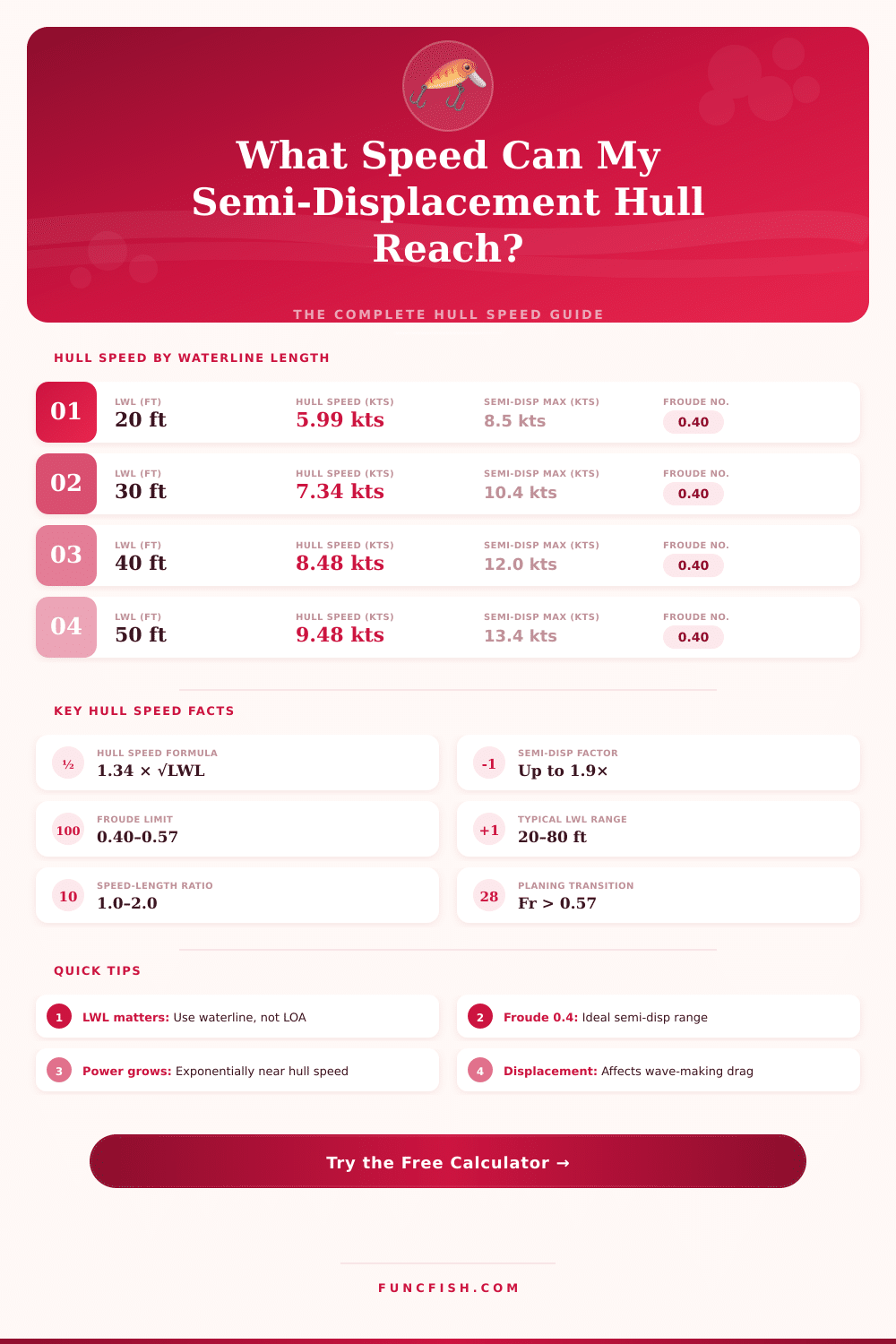
| LWL (ft) | LWL (m) | Displacement Hull Speed (kts) | Semi-Disp Max Speed (kts) | Speed-Length Ratio | Froude No. |
|---|---|---|---|---|---|
| 20 ft | 6.1 m | 5.99 kts | 8.5 kts | 1.34–1.9 | 0.40–0.57 |
| 25 ft | 7.6 m | 6.70 kts | 9.5 kts | 1.34–1.9 | 0.40–0.57 |
| 30 ft | 9.1 m | 7.34 kts | 10.4 kts | 1.34–1.9 | 0.40–0.57 |
| 35 ft | 10.7 m | 7.93 kts | 11.2 kts | 1.34–1.9 | 0.40–0.57 |
| 40 ft | 12.2 m | 8.48 kts | 12.0 kts | 1.34–1.9 | 0.40–0.57 |
| 45 ft | 13.7 m | 8.99 kts | 12.7 kts | 1.34–1.9 | 0.40–0.57 |
| 50 ft | 15.2 m | 9.48 kts | 13.4 kts | 1.34–1.9 | 0.40–0.57 |
| 60 ft | 18.3 m | 10.38 kts | 14.7 kts | 1.34–1.9 | 0.40–0.57 |
| 70 ft | 21.3 m | 11.21 kts | 15.9 kts | 1.34–1.9 | 0.40–0.57 |
| 80 ft | 24.4 m | 11.99 kts | 17.0 kts | 1.34–1.9 | 0.40–0.57 |
| Vessel Type | Typical LWL | Displacement Range | Cruise Speed | Max Semi-Disp Speed | Typical Power |
|---|---|---|---|---|---|
| Downeast / Lobster | 28–42 ft | 12,000–35,000 lb | 12–18 kts | 13–16 kts | 250–500 hp |
| Full Disp. Trawler | 36–65 ft | 25,000–120,000 lb | 7–10 kts | 10–14 kts | 150–600 hp |
| Pilot Boat / Utility | 30–50 ft | 15,000–60,000 lb | 12–20 kts | 14–18 kts | 400–1200 hp |
| Patrol / Rescue | 25–45 ft | 10,000–50,000 lb | 15–25 kts | 16–22 kts | 500–1800 hp |
| Semi-Disp Cruiser | 22–40 ft | 8,000–30,000 lb | 14–22 kts | 15–20 kts | 300–800 hp |
| Research / Survey | 40–80 ft | 40,000–200,000 lb | 8–12 kts | 10–14 kts | 400–1500 hp |
| Froude Number (Fr) | Speed Regime | Hull Behavior | Power Demand | Efficiency |
|---|---|---|---|---|
| Fr < 0.30 | Slow Displacement | Wave drag minimal, hull in water | Very Low | High (economical) |
| Fr 0.30–0.40 | Displacement | Normal wave system forms | Low–Moderate | Good |
| Fr 0.40–0.50 | Semi-Displacement | Stern wave grows, bow rises slightly | Moderate | Moderate |
| Fr 0.50–0.57 | Upper Semi-Disp | Hull begins to lift, high drag hump | High | Low |
| Fr 0.57–0.70 | Transition | Hull climbs over bow wave | Very High | Very Low (hump) |
| Fr > 0.70 | Planing | Dynamic lift, hull on top of water | Decreases | Increases again |
| D/L Ratio | Hull Classification | Typical Vessel | Speed Potential | Notes |
|---|---|---|---|---|
| < 100 | Ultra-light | Racing sailboat, fast powerboat | Very High | Excellent semi-disp capability |
| 100–200 | Light | Sportfisher, patrol craft | High | Good semi-disp / planing hybrid |
| 200–300 | Medium | Downeast, lobster boat | Moderate | Ideal semi-disp range |
| 300–400 | Heavy | Full trawler, research vessel | Limited | Primarily displacement operation |
| > 400 | Ultra-heavy | Commercial fishing vessel | Low | True displacement only |
Hull speed, sometimes called displacement speed, is the speed at which the wavelength of a boat’s bow wave matches the waterline length of the vessel. When the boat speeds up from rest, the bow waves grow in length and usually in height. The hull moves through the water not above it as a planing hull.
The formula for finding this theoretical hull speed is: 1.34 times the square root of the waterline length in feet. For instance, for a displacement hull with a 25-foot waterline, the theory points around 5.5 knots. It is based on wavelength of crest to crest.
What Is Hull Speed?
A boat with a 49-foot waterline reaches displacement speeds between 8.4 and 9.9 knots, depending on whether it is fat, thin, light, or pointy. By tweaking the hull shape, the multiplier can sink to 1.2 or up to 1.42.
The bow and the stern of a boat create waves while it pushes through the water. At bigger speed the waves become higher and longer. At a certain speed the bow and stern waves line up, which strongly grows the resistance.
When a typical displacement monohull reaches a speed-to-length ratio of around 1.1 to 1.2, up to half of the wind energy is watsed in creating waves.
Hull speed is not a strict limit like the speed of light. The power needed to pass it grows fast. A displacement hull dips a bit at higher speeds, which causes a big bow wave and more resistance.
For old designs it marks the limit, unless the boat gets up on plane. Modern displacement hulls however pass it without planing, even with small amounts of power.
At hull speed the hull slips threw the water with the least resistance. It is usually the max speed without a big wake, unless the boat is on plane. You can describe it also as the max speed at which the ship keeps speeding up without heavy power losses.
You find it by watching the fuel burn rate. The rate grows with speed until you pass hull speed, when it climbs quickly despite little increase in speed.
If the hull is a planing hull, the boat simply rises on its bow wave and begins to plane. For a full displacement hull on the other hand, after reaching hull speed, extra power only grows the bow and stern waves. Bigships almost never reach hull speed.