Sheepshead Weight Calculator
Estimate sheepshead weight from total length, widest girth, body depth, reef, piling, or jetty habitat, body class, condition, season and forage, confidence, and unit mode.
📌Sheepshead presets
⚙Measurements and reef profile
Model: the calculator blends a sheepshead length-girth estimate, a body-depth cross-check, and a condition index, then adjusts for reef, piling, jetty, dock, oyster, or seawall habitat, body class, season forage, and confidence.
Sheepshead weight estimate
Calculation breakdown
📊Sheepshead habitat data
Dock Pilings
Bridge Fender
Rock Jetty
Reef Ledge
🐟Sheepshead and reef fish comparison
Sheepshead
Deep, striped reef fish with heavy shoulders and compact crab-crushing body.
Mangrove Snapper
More tapered reef fish, often lower girth for the same length.
Black Drum
Rounder drum profile with belly mass that rises fast on larger fish.
Tautog
Cold-water structure fish with a chunky shoulder and crab-fed body.
Sea Bass
Shorter reef body with less belly depth than a full sheepshead.
📐Reference tables
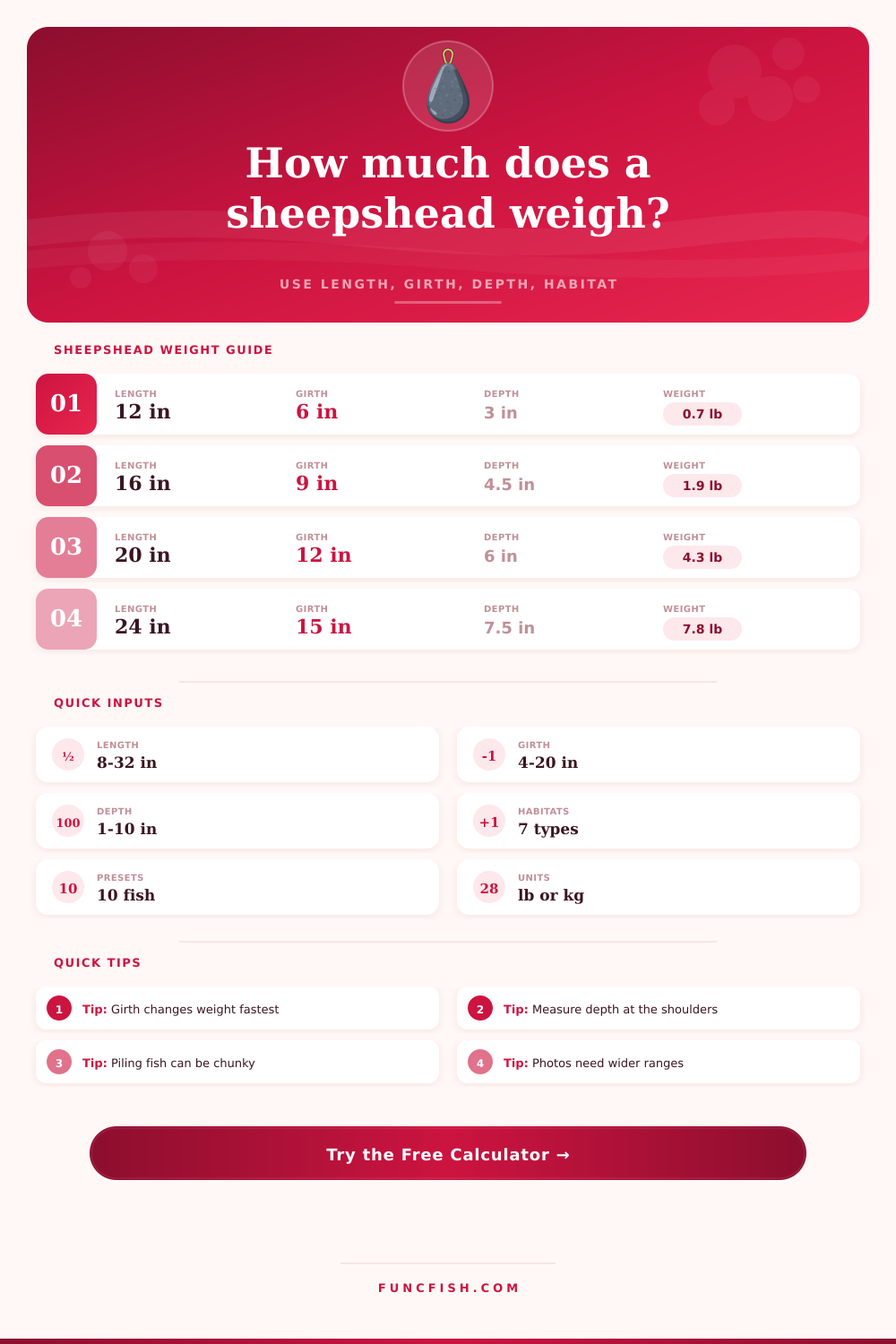
| Total length | Lean girth | Full girth | Typical weight window |
|---|---|---|---|
| 10 in / 25 cm | 4.8 to 5.4 in / 12 to 14 cm | 5.5 to 6.1 in / 14 to 15 cm | 0.4 to 0.8 lb / 0.2 to 0.4 kg |
| 14 in / 36 cm | 7.0 to 7.8 in / 18 to 20 cm | 8.0 to 9.0 in / 20 to 23 cm | 1.1 to 2.0 lb / 0.5 to 0.9 kg |
| 18 in / 46 cm | 9.5 to 10.6 in / 24 to 27 cm | 11.0 to 12.5 in / 28 to 32 cm | 2.7 to 4.6 lb / 1.2 to 2.1 kg |
| 22 in / 56 cm | 12.0 to 13.2 in / 30 to 34 cm | 13.8 to 15.5 in / 35 to 39 cm | 5.2 to 8.2 lb / 2.4 to 3.7 kg |
| 26 in / 66 cm | 14.4 to 15.6 in / 37 to 40 cm | 16.0 to 18.0 in / 41 to 46 cm | 8.3 to 13.5 lb / 3.8 to 6.1 kg |
| Habitat profile | Multiplier | Shape cue | Use when |
|---|---|---|---|
| Dock piling cluster | 1.03 x | Deep shoulder and square belly | Fish fed tight to vertical cover |
| Bridge fender or pier piling | 1.06 x | Thick body and strong shoulders | Piling fish looks blocky |
| Rock jetty wash | 1.00 x | Balanced current-shaped profile | Default jetty estimate |
| Oyster bar edge | 0.98 x | Often trim but hard-bodied | Shallow shell and bar edges |
| Artificial reef rubble | 1.01 x | Mixed reef body | Nearshore rubble or wreck pieces |
| Natural reef ledge | 1.02 x | Steady reef forage body | Ledge or patch reef fish |
| Season and forage | Body effect | Calculator factor | Best shape check |
|---|---|---|---|
| Winter fiddler crab focus | Compact but often solid | 1.01 x | Widest girth |
| Spring spawn transition | Variable belly mass | 0.97 x | Condition selection |
| Summer barnacle grazer | Baseline piling condition | 1.00 x | Depth and girth |
| Fall crab and shrimp mix | Full feeding condition | 1.05 x | Shoulder depth |
| Oyster spat and shell edge | Good shell-edge fullness | 1.03 x | Girth ratio |
| Post-spawn lower reserve | Lean recovery body | 0.90 x | Belly line |
| Body class | Length marker | Weight marker | Calculator label |
|---|---|---|---|
| Juvenile compact fish | Under 12 in / 30 cm | Usually under 1 lb / 0.5 kg | Small fish |
| Keeper-class adult | 12 to 17 in / 30 to 43 cm | 1 to 3 lb / 0.5 to 1.4 kg | Keeper |
| Chunky reef adult | 18 to 21 in / 46 to 53 cm | 3 to 6 lb / 1.4 to 2.7 kg | Chunky adult |
| Trophy piling ram | 22 in plus / 56 cm plus | 6 lb plus / 2.7 kg plus | Trophy |
| Spawned-down adult | Any adult length | Lower for frame | Lean adult |
Weight estimates are field calculations. Use a calibrated scale when exact sheepshead weight matters.
💡Measurement tips
Girth is squared in the main formula. For sheepshead, take the tape around the deepest shoulder and belly without compressing the fish.
Body depth helps catch false estimates. A piling fish with the same length and girth as a lean jetty fish often carries more shoulder mass.
When you catch a sheepshead from a pilings or jetty ledge, you have to determine the weight of the sheepshead that you caught. Determining the weight of the sheepshead is important to know whether or not the sheepshead meet the size limits for that particular area and whether or not you should keep or release the sheepshead that you caught. The length of the sheepshead alone is not a reliable measurement of the weight of the sheepshead due to the deep shoulders that the sheepshead can have and the bellies of the sheepshead changing with the season and the type of food that the sheepshead eat.
For these reasons, a calculator that considers more than length as a means of calculating the weight of the sheepshead can be of benefit to anglers. The calculator located on this page calculate the weight of the sheepshead in three different ways. The first estimate use a formula that is based upon the length of the sheepshead multiplied by the girth of the sheepshead, squared, which biologists have used for many years to calculate the weight of sheepshead.
How to Estimate Sheepshead Weight
The second estimate calculates the depth of the body of the sheepshead since sheepshead may be slab sided rather than round. The third estimate calculates the Fulton-style condition index of the sheepshead which takes into account the weight of the sheepshead when lean versus when it is full of fat and energy. Each of these three calculations is then adjusted according to the habitat, body class, season forage, and the confidence in the measurements of the sheepshead to determine the total weight of the sheepshead.
The calculator outputs the weight of the sheepshead, the weight of the sheepshead in a likely range, the condition score, and the category of the sheepshead. The habitat in which the sheepshead was spotted will impact the weight of the sheepshead; sheepshead in docks or bridge areas will have more fat than sheepshead in areas with rock and oyster bars. The calculator applies a multiplier to each habitat to calculate the effect that the habitat may have upon the weight of the sheepshead.
While the calculator does not claim that every sheepshead caught from a piling is fat, the habitat does impact the girth of the sheepshead. The body class and condition of the sheepshead will also impact the weight of the sheepshead. For instance, a juvenile sheepshead or a sheepshead that has recently spawned will weigh less than an adult sheepshead with the same length since adult sheepshead have eaten more crabs and barnacles.
The sheepshead season and the type of forage that they eat will impact the weight of the sheepshead; for instance, crabs are available during the winter months while crabs and shrimp is available in the fall, so a sheepshead that has been eating crabs during the winter will weigh more then a sheepshead that has just spawned and depleted it’s fat reserves for the year. The girth of the sheepshead is important since the girth has the most leverage within the formula; thus, if the sheepshead girth is measured incorrectly, the calculator will calculate the weight of the sheepshead incorrectly. Thus, it is important to measure the girth around the shoulders and belly rather than the middle of the sheepshead.
The depth of the sheepshead is similarly important since two sheepshead of the same length and girth may have different weights if one sheepshead has deeper shoulders than the other sheepshead. Thus, the calculator will blend the depth that is entered into it with the depth that is expected in the habitat where the sheepshead is spotted. The way in which the sheepshead is measured will also impact the weight of the sheepshead; for instance, if the sheepshead is measured on a board with a tape measure around its body, the weight will be relatively tight; however, if the sheepshead is estimated from a boat or from a photograph, the calculator will calculate the weight of the sheepshead to an inaccurate number.
The confidence that the angler have in the measurement of the sheepshead will also impact the weight of the sheepshead; if the angler measured the sheepshead from a boat with a photograph, the weight range of the sheepshead will be wider than if the angler is more confident in the accuracy of the estimation. The tables on this page are reference tables that list the weight of sheepshead of each length, the habitat multipliers according to type, and the factors according to the season in which the sheepshead was spotted. Additionally, there is a table that compares the sheepshead to other reef fish of similar length; for instance, a 16-inch sheepshead will typically weigh more than a 16-inch mangrove snapper but will weigh the same as a 16-inch tautog.
These comparisons provide an indication of whether the calculated weight of the sheepshead is within the expected parameters of the fish. The weight of the sheepshead can never be exact unless you place the sheepshead on a scale; however, the calculator will give an estimate of the weight of the sheepshead that was calculated according to each of the mentioned variable. An estimate of the length of the sheepshead alone is not enough since it does not account for the mass of the shoulders of the sheepshead.
An estimate of the girth of the sheepshead alone is not enough since it does not account for the depth of the sheepshead. An estimate of the habitat and the season in which the sheepshead was spotted is necessary to account for the fact that not all sheepshead are the same; thus, an estimation of the weight using these variables will allow you to know both the weight of the sheepshead that you will either keep or release and the range of the weight of the sheepshead if it had different measurements or were spotted in a different habitat. Thus, both the weight and the weight range will allow anglers to decide if the sheepshead meets the requirement for that area while understanding the uncertainty of that estimate; however, the smaller the range of the estimated weight, the more accurate the estimate is to the true weight of the sheepshead.
You should of used this tool to get a better idea of the weight. Its alot more helpful than just guessing.