Shooting Line Diameter Calculator
Estimate a practical fly shooting line or running line diameter from head grains, head length, cast distance, water, wind, and line handling preference.
📌Scenario presets
⚙Shooting line settings
Shooting line recommendation
Full breakdown
📋Running line material reference
Round Mono
Flat Mono
Coated Trout
Coated Spey
Braided Core
Slick Braid
Stiff Mono
Integrated
📊Diameter and setup tables
| Setup | Typical head | Mono diameter | Coated diameter | Backing class |
|---|---|---|---|---|
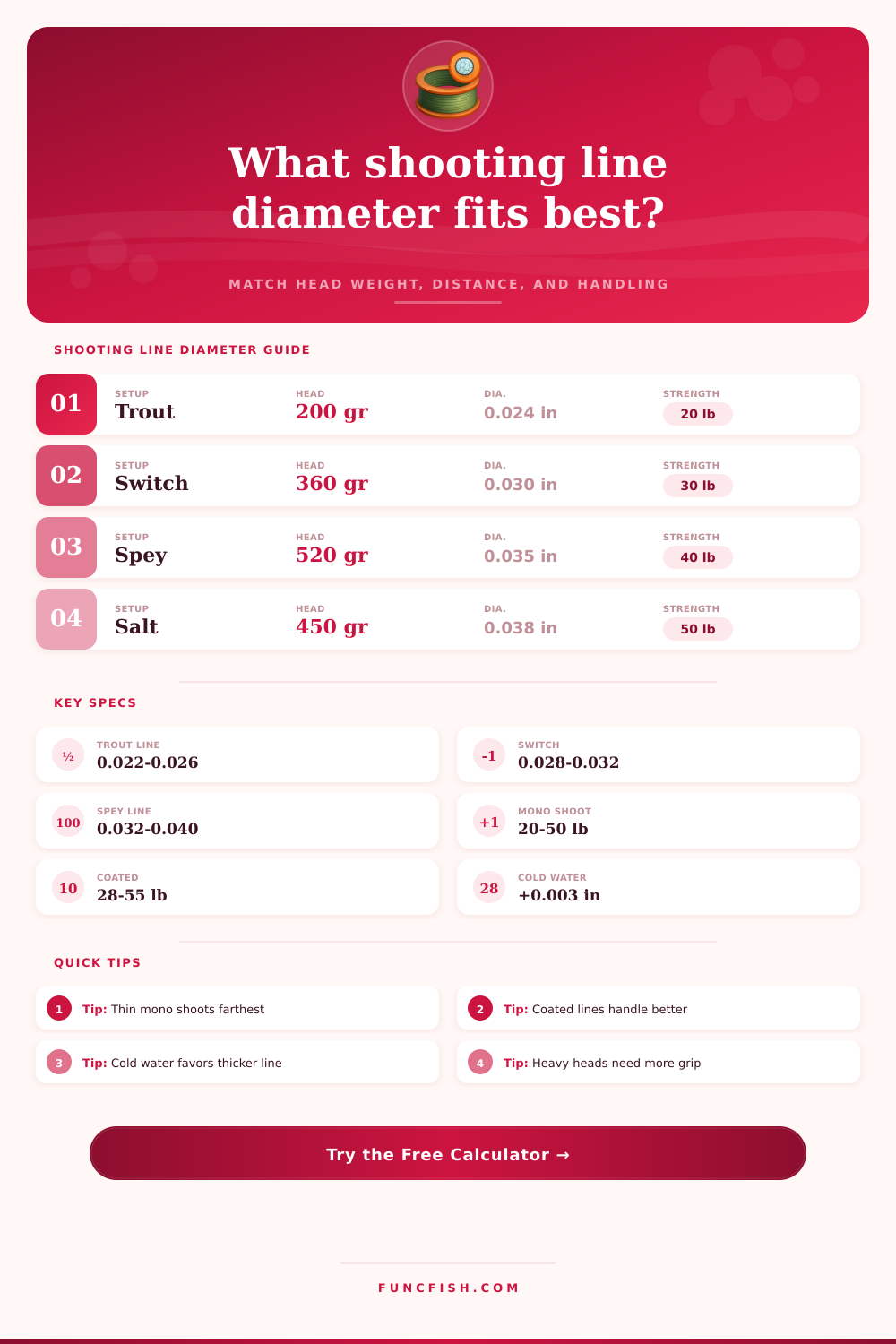
| 4-5 wt trout shooting head | 150-220 gr | 0.020-0.024 in | 0.028-0.032 in | 20 lb |
| 6-7 wt stillwater | 230-320 gr | 0.024-0.028 in | 0.030-0.035 in | 25-30 lb |
| Switch rod Skagit | 330-450 gr | 0.028-0.032 in | 0.034-0.040 in | 30-40 lb |
| Two-hand Scandi | 360-520 gr | 0.030-0.035 in | 0.036-0.042 in | 35-45 lb |
| Winter Spey Skagit | 480-650 gr | 0.035-0.040 in | 0.040-0.050 in | 40-50 lb |
| Saltwater shooting head | 330-550 gr | 0.032-0.038 in | 0.037-0.050 in | 40-60 lb |
| Line style | Best trait | Watch item | Diameter shift | Typical use |
|---|---|---|---|---|
| Round mono | Low friction | Slippery grip | -0.002 in | Distance and warm hands |
| Flat mono | Better hand feel | Memory coils | +0.001 in | Switch and surf work |
| Coated running line | Easy handling | More guide drag | +0.006 in | Cold water and beginners |
| Slick braid | Maximum shoot | Finger cuts | -0.006 in | Competition and backup rigs |
| Integrated running line | No loop hinge | Fixed match | +0.008 in | Saltwater and stripping baskets |
| Condition | Diameter move | Handling move | Reason |
|---|---|---|---|
| Cold water | +0.002 to +0.004 in | Increase grip | Stiff fingers and coil memory |
| Warm stillwater | -0.001 to -0.003 in | Favor shoot | Soft line handles easier |
| Windy beach | +0.002 in | Reduce tangles | Loops blow into slack line |
| Competition casting | -0.004 in | Low friction | Grip matters less than speed |
| Heavy sink tip | +0.002 to +0.006 in | More pull strength | Head mass loads the running line |
💡Practical calculation checks
Tip: If two diameters score close, pick the thinner one for warm open water and the thicker one for cold hands, surf wash, or repeated stripping.
Tip: A very thin shooting line can cast farther but may be harder to grip safely with heavy heads, sink tips, and strong fish.
The shooting line gets overlooked when people think about fly selection and rod action, but realy it is the line that brings the whole package together. Does the shooting line’s diameter determine if your presentation lands softly or whips back into your face? Too small a diameter will send it farther but render it un-grippable in any breeze. Too large a diameter cause friction and kills your cast well short of half-distance.
This tool handles the tricky physics for you. It balance tactile control with energy transfer to determine how your line performs with your set-up. The key is that ratio of head weight to running line diameter stay the same. That weight coming off the rod should of be equal to what you’re putting in terms of resistance. So if you have a three-hundred grain shooting head, a big, heavy coated line will really impede its progress due to both surface area and guide drag. By prompting for your head length and head weight, the tool recommend a diameter that still keeps up with momentum but won’t lose so much speed. It’s not simply about casting farther then; it’s about conserving energy across transition.
How to Choose the Right Shooting Line
But even if two lines has the same nominal diameter, the type of material can make all the difference. For instance, round monofilament has far less surface area than other lines of comparable pound test; like coated or flat mono. So it’s going to slip through your guides with much less friction. That’s why you’ll notice competitive casters using very thin, slick materials to get most distance possible. But that slickness makes it next to impossible to hold under heavy load. If you don’t have any grip on the line, a fish will fight it right out of your hand. A heavier sink tip will pull it right out of your hand too.
The material differences is illustrated in the tables on this page where we show how coated lines provides more gripping power but at the expense of more drag.
The environment is often overlooked until it wrecks a cast. It is not just what’s in the water but what’s on your hands. Mono stiffens in cold water and keeps its coiled shape, which will either tangle it up or make it shoot unevenly. Cold fingers are less dexterous too so fine motor control are compromised. When grip fails due to cold, a bit of extra leverage comes from using a little more thickness which give your thumb something bigger for surface contact. The calculator takes those thermal conditions into account with a slight safety margin for thickness in extreme cases.
Pure physics alone don’t account for what happens when there’s any kind of wind. A narrow line offer very little surface area. This makes it very vulnerable to air resistance, particularly across greater distances, which means it stay in the air longer. A crosswind will also make a finicky target of your otherwise-straight shot, causing it to veer erratically off course. Thickening its diameter slightly increases both mass and aerodynamic stability, allowing the line to cut through the air with greater predictability. The tool takes wind severity into account to recommend a balance between stability and shootability.
The last stop on the checklist that most people fail to use is safety. Shooting lines under tension are dangerous. If you lose grip on something, like a broken line or when a big fish surges and whips back, you can get hurt. Using a diameter that allows you to handle the weight will keep you in control of what you’re doing. You can adjust how much extra margin the calculator gives you by using the safety margin option. This option accounts for the possibility of catching a big fish and needing a line strong enough to land it.
Choosing the proper line for your shooting needs is all about expectations. Infinite grip or no friction; pick your poison. Finding the sweet spot comes from getting the shooting line to go far enough to get on the fish but not so far that you can’t control it if something goes awry. Let experience be your guide on how to decide after you’ve narrowed it down with the tool. It’s a little thing that can make all the difference between a successful outing and a frustrating one.