Fishing Sinker Pyramid Weight Calculator
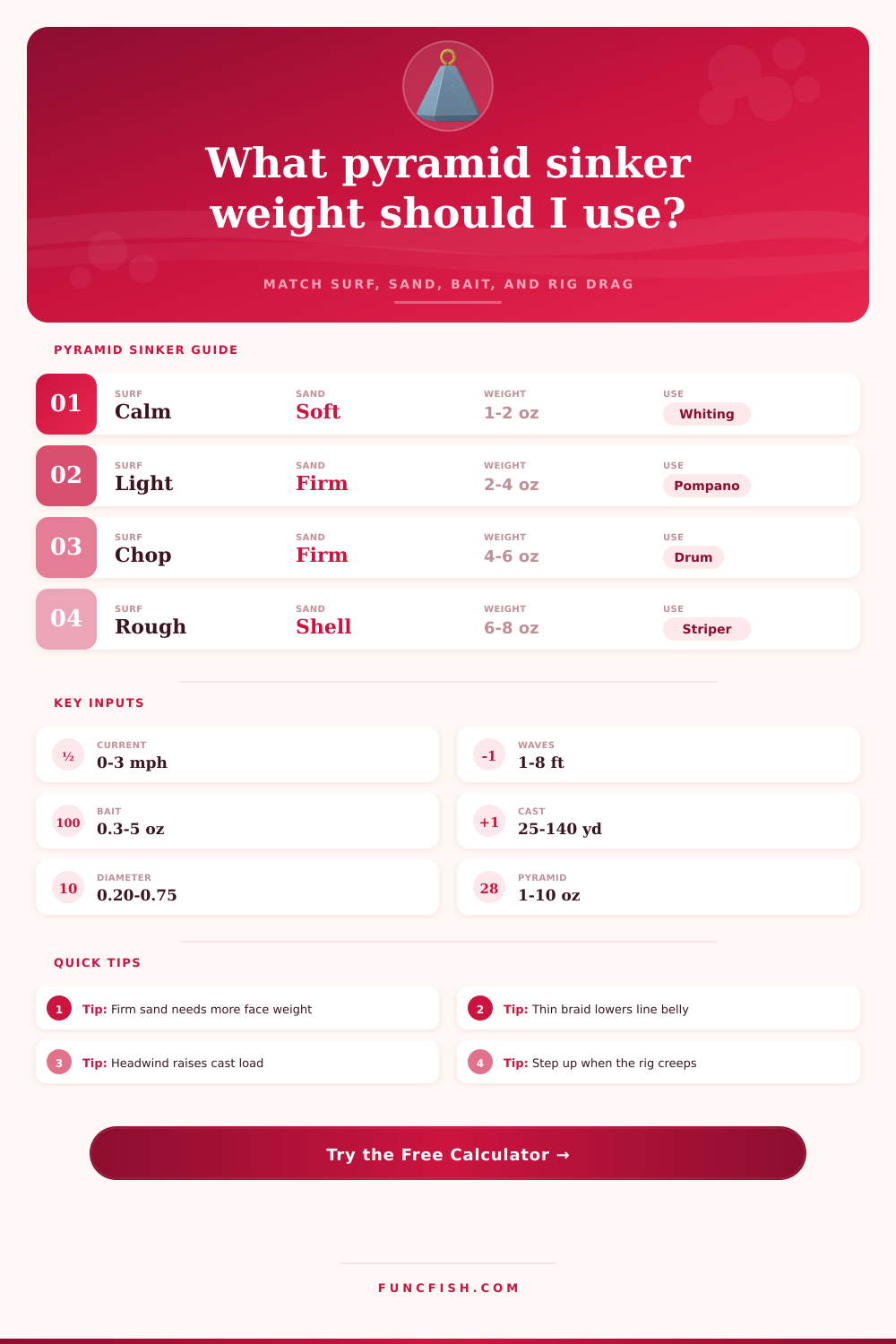
Estimate the pyramid sinker size that will hold in the surf by balancing current, waves, sand firmness, bait bulk, rig drag, line belly, cast distance, wind, and target species.
📌Pyramid sinker presets
⚙Pyramid weight inputs
Pyramid sinker match
Choose a pyramid sinker that holds without overloading the cast.
Full breakdown
📊Pyramid sinker comparison grid
Finesse Pyramid
Beach Pyramid
Drum Pyramid
Heavy Pyramid
📋Reference tables
| Pyramid size | Typical surf | Best sand | Common target |
|---|---|---|---|
| 1 oz / 28 g | Calm troughs | Soft sand | Whiting, small trout |
| 2 oz / 57 g | Light sweep | Soft to packed sand | Pompano, whiting |
| 3 oz / 85 g | Moderate current | Firm beach sand | Pompano, bluefish |
| 4 oz / 113 g | Steady sweep | Firm sand bar | Red drum, black drum |
| 5 oz / 142 g | Crosswind chop | Firm or shell mix | Red drum, striped bass |
| 6 oz / 170 g | Rough surf | Hard bar or shell | Striped bass, drum |
| 8 oz / 227 g | Heavy sweep | Shell or rolling trough | Big drum, shark bait |
| 10 oz / 283 g | Extreme holding | Firm cuts only | Slide rigs, large bait |
| Sand firmness | Pyramid bite | Weight shift | Holding note |
|---|---|---|---|
| Soft fluffy sand | Fast nose bury | -0.5 oz | Often holds light weights well |
| Soft packed sand | Balanced grip | 0 oz | Good baseline for pyramid faces |
| Firm beach sand | Needs face pressure | +0.4 oz | Step up when the sinker skates |
| Hard outer bar | Limited penetration | +0.8 oz | Heavier pyramid improves bite |
| Shell mixed sand | Patchy contact | +1.0 oz | Watch for slide and snag changes |
| Rolling trough sand | Breaks loose | +1.3 oz | Use extra margin or a grip sinker |
| Target species | Normal pyramid | Line diameter band | Rig match |
|---|---|---|---|
| Whiting / kingfish | 1-2 oz | 0.20-0.30 mm | Single drop, high-low |
| Pompano | 2-4 oz | 0.25-0.38 mm | Pompano float, clipped rig |
| Bluefish | 3-5 oz | 0.30-0.45 mm | Fish finder, high-low |
| Red drum | 4-6 oz | 0.35-0.55 mm | Fish finder, chunk bait |
| Black drum | 4-7 oz | 0.40-0.60 mm | Chunk bait fish finder |
| Striped bass | 5-8 oz | 0.40-0.65 mm | Fish finder, clipped rig |
| Small shark / ray | 6-10 oz | 0.55-0.80 mm | Slide leader, heavy bait |
| Surf condition | Current / waves | Pyramid adjustment | Cast impact |
|---|---|---|---|
| Clean trough | 0-0.6 mph / 1-2 ft | Hold near minimum | Lightest payload casts far |
| Side sweep | 0.7-1.4 mph / 2-4 ft | Add 1-2 oz | Thin line helps distance |
| Choppy bar | 1.5-2.1 mph / 4-6 ft | Add 2-3 oz | Headwind reduces load margin |
| Rough cut | 2.2-3.0 mph / 6-8 ft | Use heavy pyramid | Match rod rating before casting |
💡Pyramid sinker checks
Tip: If a pyramid sinker creeps but does not tumble, add one ounce before changing rig style. Creep usually means the face is almost biting.
Tip: Big bait, thick mono, and crosswind compound quickly. Reduce line belly or clip the rig before jumping several sizes heavier.
Pyramid sinkers is fishing weights used to ensure that fishing rigs remains in a specific location on the ocean floor. Pyramid sinkers take advantage of the fact that pyramid sinkers have flat faces and a pointed nose. The flat faces of the pyramid sinker will catch the movement of the water, while the pointed nose of the pyramid sinker will settle into the ocean floor sediment like sand.
Because the pyramid sinker has a pointed nose that sets into the ocean floor, it will resist the tendency of the pyramid sinker to roll. If the fisherman chooses the size of the pyramid sinker correctly, it will allow the fishing rig to remain in the same location. However, if the fisherman incorrectly chooses the size of the pyramid sinker, the fishing rig may either not be able to maintain its distance from the fishing spot or the bait will drift with the ocean current.
How to Choose the Right Pyramid Sinker
There are many factors that will determine the correct weight of the pyramid sinker. The speed of the ocean current will be one of those factors as the current may move the fishing line. The angle of the fishing line from the tip of the fishing rod will also have an impact on the weight of the pyramid sinker.
The ocean’s waves will impact the pyramid sinker as the height of the waves will create lifting forces on the bait. The firmness of the sand on the ocean floor will also create an impact on the weight of the pyramid sinker. Bigger bait will also require more drag, which the pyramid sinker must overcome.
The diameter of the fishing line will also have an impact on the correct weight of the pyramid sinker. Finally, the distance at which the fisher can cast the fishing rod will have an impact on the size of the pyramid sinker because it will impact the amount of weight the fishing rod can cast. The calculator will estimate the drag that the pyramid sinker will experience from the water and the fishing line.
It will also take into account the firmness of the ocean floor in relation to how well the pyramid sinker will grip the floor. Additionally, it will calculate the profile that the fishing rig will create. The calculator will not provide a specific number for the weight of the pyramid sinker, but rather will provide information that will allow the individual to calculate the size of the pyramid sinker.
This information will be presented in a table on the calculator that displays the weights of pyramid sinkers for species of fish like whiting, pompano, drum, or striped bass. Many people learn how to properly use pyramid sinkers through making mistakes. Using the same pyramid sinker on every fishing trip that works on previous trips may not work when the ocean floor is firm or when there are larger ocean waves.
When the ocean floor is soft, the nose of the pyramid sinker will sink in deeply into the ocean floor sediment, allowing a lighter pyramid sinker to maintain position against the current. However, if the ocean floor is firm or contains shells, deeper penetration will be more difficult. The calculator was created to help fishers understand these impacts without having to make guesses about the size of pyramid sinkers that they should of used on the ocean floor.
The direction of the wind will also impact the way that the pyramid sinker will function. A headwind will limit the distance at which the fisher can cast the fishing line and will lift the fishing line higher into the ocean water. A tailwind will allow the fisher to cast the fishing line further, but may also flatten the angle of the fishing line so that the pyramid sinker will not have a firm grip on the ocean floor sediment.
Crosswind will bow the fishing line in the direction of the wind and create a sideways movement that the pyramid sinker will have to fight against. These impacts of the wind are more noticeable when the ocean surf is moving in the same direction as the wind. The size of the bait that is to be used in fishing will also have an impact on the size of the pyramid sinker.
For instance, a single drop of bait with small shrimp will create less drag for the pyramid sinker to fight against than a high-low fishing rig with larger bait. The calculator takes into account these variables in its calculations of the necessary weight of the pyramid sinkers. The size of the pyramid sinkers can also impact how well the fisherman can cast the fishing line with the light rod that is used when fishing with pyramid sinkers.
Too much weight may make it difficult to effectively cast the fishing line with a light rod, but not enough weight may prevent the fishing rig from maintaining its position on the ocean floor. Different species of fish require pyramid sinkers of different weights. For instance, species like whiting and trout often live in areas where the water is light in strength, and using a one or two ounce pyramid sinker is often enough.
Pompano live in areas with medium ocean surf strength and therefore do not require pyramid sinkers that will embed too deeply into the ocean floor sediment. Fish like red drum and black drum live in areas with strong ocean currents. Therefore, fishermen use pyramid sinkers of four to seven ounces when pursuing these fish species.
Striped bass and sharks require larger pyramid sinkers because of the size of the bait that is used and because the ocean water is often more rough in these areas. However, these fish species are not rules for pyramid sinkers, but they are starting points from which fishers can select the appropriate size for pyramid sinkers. It is common for individuals to develop the idea that a specific size of pyramid sinker works for a specific beach.
However, the specific pyramid sinker size may not work for the same beach on two different days. The conditions may have changed in the period between fishing trips. Therefore, checking the conditions of the ocean at the beach before going to fish will save the fisherman time when choosing pyramid sinkers.
The calculator for pyramid sinkers was created to help those fisherman quickly calculate the size of the pyramid sinkers that will work best for them while they are standing on the beach. Additionally, the calculator allows the fisherman to understand the trade-offs of pyramid sinkers of different weights. For instance, if the calculator outputs a weight for a pyramid sinker that is heavier than the fisherman is used to, the fisherman can review the factors that went into calculating that weight.
Strong ocean currents will require heavier pyramid sinkers than areas with lighter currents of the ocean floor. The size of the bait will also impact the weight of the pyramid sinker. In each of these situations, if the fisherman understands the factors that contribute to the calculated weight of the pyramid sinkers, the fisherman can make adjustments to the fishing rig.
For instance, using thinner fishing line will reduce the amount of drag created by the line and the fisherman can use a lighter pyramid sinker to fight against the ocean currents. The goal is not to have every size of pyramid sinker. The goal is to understand why a specific size of pyramid sinker will work for a specific day while fishing.
The calculator will perform the mathematical calculations for the fisherman, but it is up to the fisherman’s observations of the ocean floor and ocean conditions to provide the feeling for when the mathematical calculations of the calculator should be adjusted. Thus, using the pyramid sinker calculator in conjunction with the fisherman’s observation skills will allow the fisherman to make a decision based off information about the ocean and fishing conditions.