Sinker Weight by Casting Distance Calculator
Estimate a practical sinker weight from target casting distance, rod load, line drag, wind angle, rig profile, and bait drag.
📌Scenario presets
⚙Casting setup
Sinker and casting forecast
Full breakdown
📋Rod and sinker data grid
Ultralight
Medium
Heavy
Surf Heavy
📊Distance reference tables
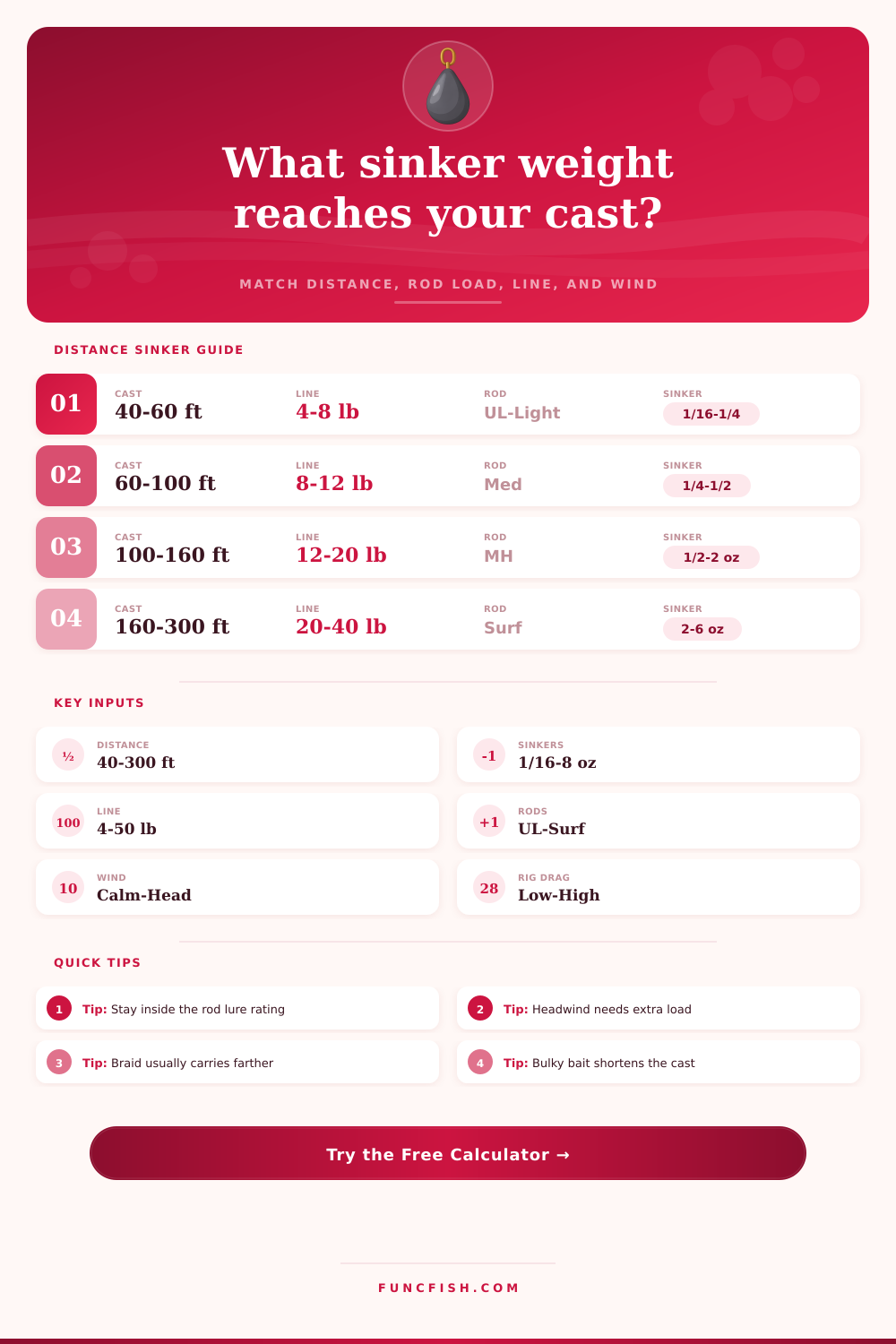
| Target distance | Typical sinker range | Common rod class | Notes |
|---|---|---|---|
| 30-50 ft / 9-15 m | 1/32-1/8 oz / 1-3.5 g | Ultralight or light | Split shot, tiny jig, float trim |
| 50-80 ft / 15-24 m | 1/8-1/4 oz / 3.5-7 g | Light to medium-light | Trout, panfish, finesse bank work |
| 80-120 ft / 24-37 m | 1/4-3/4 oz / 7-21 g | Medium to medium-heavy | Bass rigs, walleye, inshore jigs |
| 120-180 ft / 37-55 m | 3/4-2 oz / 21-57 g | Medium-heavy to heavy | Catfish, pier bait, long bank casts |
| 180-250 ft / 55-76 m | 2-5 oz / 57-142 g | Surf medium to surf heavy | Surf rigs and large bottom baits |
| 250-330 ft / 76-101 m | 4-8 oz / 113-227 g | Surf heavy | Distance surf work with shock leader |
| Condition | Distance effect | Sinker adjustment | Calculator treatment |
|---|---|---|---|
| Braid running line | Less air drag | Can go lighter | Lower diameter factor |
| Fluorocarbon main line | More stiffness drag | May need more weight | Higher line factor |
| Headwind | Shorter carry | Add load if rod allows | Wind penalty applied |
| Bulky bait rig | More tumbling | Step up or streamline | Rig drag multiplier applied |
| Rod overloaded | Lower release speed | Use lighter sinker | Load warning in results |
| Max accuracy | Shorter controlled cast | Lower load favored | Accuracy factor applied |
💡Practical checks
Tip: Treat the result as a starting sinker, then keep the total terminal weight inside the rod rating. If the calculator flags overload, shorten the target distance or move to a heavier rod class.
Tip: When two nearby sinker sizes both fit, choose the lighter one for accuracy and the heavier one for wind, current, surf grip, or bulky bait.
To determine the correct sinker weight for a cast, a person must take a few steps. If a person selects a sinker weight that is too light for the distance that they want to cast, the bait will not reaches the strike zone. If a person uses a sinker weight that is too heavy for the rods that they are using, the rod will feel sluggishly when cast, and the cast will fall short of the target.
Additionally, if the sinker weight is too heavy, the sinker may bury itself in the bottom of the water where the fish isnt located. In order to avoid these problem, a person must select the proper sinker weight based off the distance, rod, and environmental condition of the fishing spot. The first factor that a person should consider when selecting the sinker weight is the distance to which they wish to cast.
How to Choose the Right Sinker Weight
The distance that they desire to cast will affect the sinker weight that they use because of how a long cast require a heavier sinker to overcome air resistance. Additionally, the weight of the sinker must remain within the rating of the rod that are being used. Any weight that exceeds the upper limit of the rod will cause the rod to not load proper, resulting in the loss of distance with each cast.
The calculator considers this variable by allowing a person to input the class of their rod and the distance that they wish to cast to determine the mathematical result that will help to remove the guesswork involved in determining the proper sinker weight for that rod. The second factor is the type of line material that is being used. The line material will impact the distance that the sinker weight will travel due to the drag that each type of line create.
For instance, braided line will allow the sinker to travel further then lines that contains fluorocarbon. The calculator accounts for this variable by allowing the angler to choose the type of line that is being used. However, the calculator cannot account for how the line will behave when it is cast into the water, or the stretch and memory of the line.
The third factor is the wind. If the wind is working against the angler (headwind), then a heavier sinker weight will be required to reach the target. If the wind is working in the angler’s favor (tailwind), then a lighter sinker weight will be required to reach the target.
The calculator determines the sinker weight that is recommended based on whether the wind is a headwind or tailwind. However, the angler can also adjust for the wind by changing the stroke that is used when casting. The fourth factor is the profile of the fishing rig and the size of the bait that is being used.
Any fishing rig that contains multiple hook or uses large sized bait will create more drag than a single, slim profile hook. The drag that is created will act as a multiplier on the sinker weight that is used. Additionally, the calculator includes a variable for this factor.
However, the angler could also adjust for the drag by streamlining the fishing rig. The fifth factor is the skill of the person that is casting and the priority that they place on accuracy with their casts. A skilled angler will be able to reach the fishing spot with a lighter sinker weight than an inexperienced angler due to the ability of the skilled angler to load the rod proper.
Additionally, if accuracy is the angler’s top priority, the calculator will recommend a lighter sinker weight because casts that are targeted at specific locations will be shorter than those that are used to reach maximum distance. Thus, the calculator provides a recommendation for sinker weight, but the angler must use this weight as a guide to determine the proper sinker weight for their fishing spot. Reference tables are provided on the page that list the weights for different distance and rod classes.
These tables is a helpful starting point for anglers to understand the possible sinker weights. However, the reference tables only provide average weight. Because there are never average conditions when fishing for bait, the angler should use the calculator to determine the proper sinker weight for those conditions.
Additionally, using the calculator will allow the angler to account for each of these variable in one place instead of having to manually adjust the sinker weight for each variable. The result of the calculator is a test weight that should be used to test the distance that can be cast with the given rod, line, and environmental conditions. Using the test weight once will allow the angler to observe whether the rod loaded cleanly and whether the sinker weight fell short of the target distance.
If the weight fell short of the target distance, the angler could increase the sinker weight by a small amount or change the profile of the fishing rig. If the rod felt overloaded with the test weight, the sinker weight should of been one size lighter. The calculator provides a narrow range in which to select the sinker weight because each angler may have different preference or skills in casting with these weights.
As an angler casts weights with the calculators recommendations, they will eventually learn which variable are the most important to adjust when changing the sinker weight. On some occasions, the wind will be the only factor that is adjusted. On other occasions, the size of the bait will require more adjustment to the sinker weight than the distance variable requires.
Thus, the calculator is an efficient tool that saves time for anglers who otherwise would of had to guess at the proper sinker weight.