Hot Smoke vs Cold Smoke Time Calculator
Compare fish hot-smoking cook time against cold-smoking exposure time using species, cut thickness, cure style, drying time, chamber temperature, smoke strength, and finishing temperature targets.
📌Fish smoking presets
⚙Smoking time inputs
Hot smoke vs cold smoke timing estimate
Calculation breakdown
🧪Species and smoke material grid
Salmon
Trout
Mackerel
Whitefish
Alder
Apple
Oak
Hickory
📊Reference tables
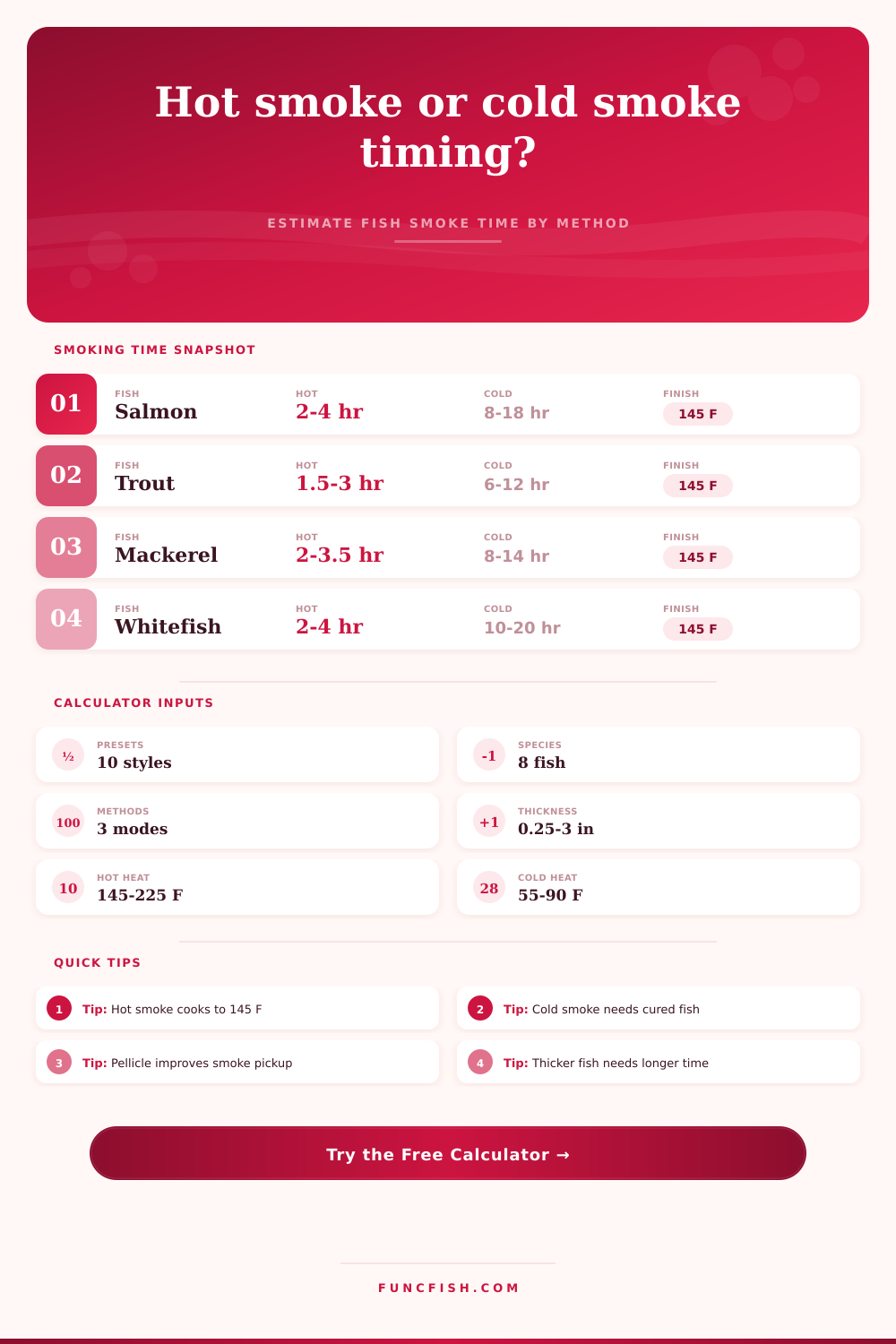
| Species | Typical cut | Hot smoke range | Cold smoke range | Timing note |
|---|---|---|---|---|
| Salmon | Side, fillet, belly | 2 to 4 hours | 8 to 18 hours | Fat content slows heat but takes smoke well |
| Trout | Whole fish, fillet | 1.5 to 3 hours | 6 to 12 hours | Small trout can finish quickly in hot smoke |
| Mackerel | Fillet, portion | 2 to 3.5 hours | 8 to 14 hours | Oily flesh handles stronger wood |
| Whitefish | Slab, whole fish | 2 to 4 hours | 10 to 20 hours | Dense flesh benefits from longer smoke exposure |
| Tuna | Loin, steak | 1.5 to 3 hours | 6 to 14 hours | Lean loin dries quickly if overheated |
| Catfish | Fillet, strip | 1.5 to 3 hours | 8 to 16 hours | Moderate oil and soft flesh suit hot smoke |
| Cod | Loin, portion | 1.5 to 2.75 hours | 6 to 12 hours | Lean flakes need careful drying control |
| Sardine | Whole small fish | 1 to 2 hours | 4 to 10 hours | Small fish absorb smoke rapidly |
| Method | Chamber range | Main output | Food safety check | Best planning use |
|---|---|---|---|---|
| Hot smoke | 145 to 225°F / 63 to 107°C | Cooked smoked fish | Confirm internal finish temperature | Dinner portions, cooked flakes, same-day service |
| Cold smoke | 55 to 90°F / 13 to 32°C | Smoked cured fish | Requires cure, cold chain, and process control | Lox-style slices and long smoke flavoring |
| Warm transition | 90 to 145°F / 32 to 63°C | Partial drying and smoke | Do not treat as fully cooked by time alone | Step-up schedules before hot finishing |
| Rest and chill | Refrigerated hold | Smoke equalization | Cool promptly after smoking | Texture setting and slice quality |
| Wood material | Intensity factor | Best fish match | Hot smoke effect | Cold smoke effect |
|---|---|---|---|---|
| Alder | 1.00 | Salmon, trout | Classic mild color | Clean long exposure |
| Apple | 0.90 | Trout, cod | Gentle sweetness | Longer exposure tolerated |
| Cherry | 0.98 | Salmon, whitefish | Rosy color and round smoke | Balanced fruit note |
| Maple | 0.95 | Catfish, trout | Mellow sweet finish | Soft smoke profile |
| Oak | 1.12 | Mackerel, tuna | Medium robust smoke | Shorten if fish is lean |
| Hickory | 1.25 | Oily fish, robust cuts | Strong smoke quickly | Use shorter sessions |
| Beech | 1.02 | Whitefish, cod | Clean savory smoke | Steady cold-smoke profile |
| Pellet blend | 0.88 | Mixed racks | Predictable light smoke | Stable generator output |
| Thickness band | Imperial | Metric | Hot smoke effect | Cold smoke effect |
|---|---|---|---|---|
| Thin strip | 0.25 to 0.5 in | 0.6 to 1.3 cm | Very fast finish | Smoke quickly penetrates |
| Small fillet | 0.5 to 1 in | 1.3 to 2.5 cm | Moderate cook time | Short to medium exposure |
| Standard fillet | 1 to 1.5 in | 2.5 to 3.8 cm | Common hot-smoke range | Often needs overnight timing |
| Thick loin | 1.5 to 2.25 in | 3.8 to 5.7 cm | Slow core heating | Long exposure and firm cure |
| Whole fish | Varies by cavity | Varies by cavity | Air cavity slows heating | Not ideal for cold smoke unless controlled |
💡Timing tips
Hot smoke check: Treat the calculator time as a planning estimate, then verify cooked fish with a probe at the thickest point.
Cold smoke check: Cold smoking adds flavor and drying time, but the fish still depends on proper curing, temperature control, and prompt chilling.
There are basicly two methods of smoking fish. First, cold smoking involve adding flavor to an already dried, cured fish. Second, hot smoking impart flavor to the fish as it cooks in the smoke.
One type of smoking is a quick process. The second is a slow process due to low heat and long exposure time.
How to Smoke Fish Properly
How long should I cook my cut? This is where calculator comes in. You don’t have to guess anymore; it do the math for you.
So what matters most? Fish thickness. The thinner the fish, the faster it will finishes. The thicker it is, the longer it will take. Protein doesn’t conduct heat well. Cook too fast and you’ll burn the outside while leaving middle raw. This tool use the size of the fish you’re cooking to figure out a safe estimate for you.
“Cold smoking is tricky. With cold smoking, the fish aren’t being cooked but just dried and flavored by the smoke.” The calculator then request your cure level (you must cure the fish if you are cold smoking). “Otherwise, bacteria will develop. Time will be changed according to how long it takes to develop a pellicle and strength of your brine. A pellicle is a dry, tacky covering on the fish’s surface that allows the smoke to adhere to the fish. Without it, the smoke will slide right off.”
There’s also a chart on page correlating fish with wood. For example: Salmon, try mild alder. Lean fish such as cod can be overpowered with hickory. The type of wood matter. So does taste. Fatty fish such as mackerel goes well with hard woods (those that impart a strong), savory flavor (think hickory and oak). Oily fish such as trout pair nicely with fruitwood such as cherry or apple. These wood bring out the sweetness.
The calculator also take into account airflow through your chamber as well as strength of smoke. If your chamber has humidity, that will slow things down. Dry air, on the other hand, increase the speed. Why? The tool need that information to calculate correctly. Temperature isn’t everything. Moisture leaving the fish make all the difference.
Let the fish rest after smoking. There’s a bit of time for this in calculator. When the heat shuts off, smoke continues to entering the meat. It takes some time for flavors to settle in. Cut into the fish too soon and all the smoke sits atop the flesh. Allow it to chill. That allow the smoke to spread through. With cold-smoked fish, this is extremely important. You want the fish to firm up enough that you can cleanly slice it.
And one last thing: patience. Since heat does most of the work for you, hot smoking are more forgiving. Cold smoking? It require attention. Curing can’t be rushed. You could of force a pellicle to form. Trust the process. Your senses, and your thermometer, will tell you it’s ready.
The plan is in the calculator. However, you should still use your sense of smell, your sense of sight, and your sense of touch. They’ll guide you to the right answer.
The time is yours, use the tool to plan what you have to do. And then just let it smoke. Time is on your side, whether you’re looking for something fast for dinner or something to keep forever. You own the wood and the heat. You should control time as well.