Snakehead Weight Calculator
Estimate Channa snakehead weight from total length, girth, body depth, head width, habitat, condition, and measurement confidence.
📌Snakehead presets
⚙Channa measurement inputs
Snakehead weight estimate
Detailed breakdown
📋Gear and species comparison grid
Northern
Giant
Striped
Bullseye
📐Snakehead reference tables
| Channa type | Formula factor | Shape cue | Typical adult window |
|---|---|---|---|
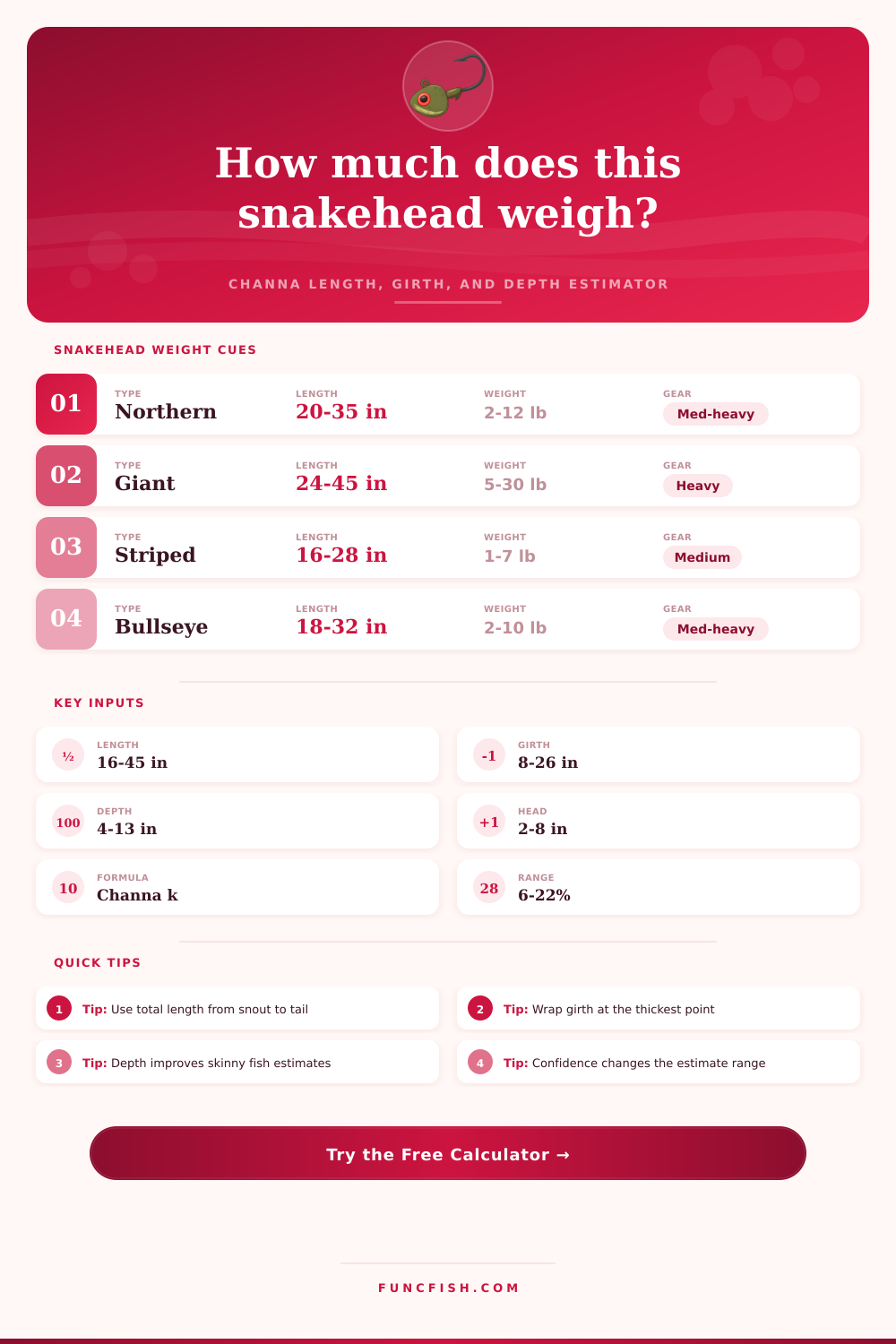
| Northern snakehead | 1.03 | Thick cylinder, broad head | 20-35 in / 2-12 lb |
| Giant snakehead | 1.12 | Long body with heavy shoulders | 24-45 in / 5-30 lb |
| Striped snakehead | 0.96 | Slimmer canal and pond profile | 16-28 in / 1-7 lb |
| Bullseye snakehead | 1.01 | Compact body, strong head width | 18-32 in / 2-10 lb |
| Forest snakehead | 0.92 | Lean swamp fish profile | 14-24 in / 1-5 lb |
| Dwarf / ornate snakehead | 0.78 | Shorter ornamental Channa build | 6-14 in / 0.1-1.5 lb |
| Condition setting | Multiplier | Body clue | Best use in calculator |
|---|---|---|---|
| Lean / post-spawn | 0.90 | Flat belly, narrow shoulders | After stress or sparse forage |
| Normal | 1.00 | Round body and normal head | Default field estimate |
| Thick / feeding well | 1.08 | Full belly, dense back | Healthy feeding periods |
| Ripe / deep-bodied | 1.15 | Deep abdomen and wide flank | Very full-bodied fish |
| Habitat type | Adjustment | Shape expectation | Measurement note |
|---|---|---|---|
| Canal / ditch | 0.98 | Often leaner and longer | Girth is the key check |
| Pond / lake edge | 1.02 | Balanced forage body | Use normal condition first |
| Reservoir / open water | 1.04 | Strong shoulders on larger fish | Check head width carefully |
| Swamp / vegetated slough | 1.06 | Deep body from ambush cover | Depth modifier matters |
| River / flowing water | 0.95 | Longer and more streamlined | Do not overstate girth |
| Floodplain / backwater | 1.03 | Seasonally thick fish | Confidence range helps |
| Estimated weight | Rod power | Braid main line | Leader / bite guard |
|---|---|---|---|
| Under 2 lb / under 0.9 kg | Medium-light | 10-20 lb | 15-25 lb abrasion leader |
| 2-6 lb / 0.9-2.7 kg | Medium | 20-30 lb | 25-40 lb abrasion leader |
| 6-12 lb / 2.7-5.4 kg | Medium-heavy | 30-50 lb | 40-60 lb bite leader |
| 12-25 lb / 5.4-11.3 kg | Heavy | 50-65 lb | 60-90 lb bite leader |
| Over 25 lb / over 11.3 kg | Extra-heavy | 65-80 lb | 90-120 lb bite leader |
💡Measurement checks
Tip: Snakeheads are tube-shaped but not perfectly round. The calculator starts with a Channa length and girth formula, then corrects for body depth and head width.
Tip: Use the widest girth behind the head. A small girth error changes the estimate quickly because girth is squared in the formula.
Estimating the weight of an snakehead involve taking various measurements of the fish to calculate a numerical value that represent the weight of the fish. If you dont have access to a scale to measure the weight of the fish, use a length tape to take the various measurement of the fish that will allow you to estimate the weight of the snakehead. To measure the weight of a snakehead, you must take the length of the fish from the snout of the snakehead to the tip of the tail of the snakehead.
Additionally, you must measure the girth of the snakehead by measuring the diameter of the snakehead at its thickest point. You will need to take the body depth and head width measurement to obtain the most accurate estimate of the weight of the snakehead. The body depth is the distance from the snout to the dorsal fin, and the head width is the distance from one side of the head to the other.
How to Estimate a Snakehead’s Weight
These measurements will helps in distinguishing the body shape of the snakehead. The weight estimate will change depending on the species of snakehead that are being measured. For instance, the Northern snakehead has a different body shape then the striped canal snakehead.
The Northern snakehead is thicker, and it has more mass per inch of length than the striped canal snakehead. The weight formula account for this by calculating the volume of a cylinder and adjusting it based on the specific shape of the snakehead species that is being measured. The condition of the fish will also impact the weight of the snakehead.
If the snakehead is preparing to spawn, it will have more mass in its belly. Additionally, the habitat in which the snakehead live can also impact its body shape. Snakeheads that live in canals are typically longer and have leaner bodies then snakeheads that live in swamps with more mass in their bodies.
By using the information you gather from measuring your snakehead, you can make better decisions regarding the fishing gear that you use. If the weight of the snakehead is heavy, you should use a medium heavy fishing rod with a forty-pound fishing leader. If the fishing gear is too light for the weight of the snakehead that you are fishing for, your line or fishing gear may break.
Using the information from the weight estimate will allow you to choose the appropriate fishing gear for the snakehead that you are catching. Finally, there is various purpose for using the weight estimate of the snakehead that you are measuring. You can use the weight estimate to keep tournament fishing record.
You can use the weight estimate to determine how much the snakehead will weigh when cooked. If you are using the information to measure the snakehead to release it back into the water, the weight will provide proof of the size of the fish without having to kill it. Thus, using the length tape to measure the snakehead and using the formula to estimate its weight allow you to turn the guessing of the weight into an estimation process.