Spawning Size Threshold Calculator
Estimate whether a measured fish is likely near spawning size from species, sex, length, weight, age, temperature, climate band, and condition factor. These thresholds are planning estimates, not legal or regulatory advice.
📌Named species presets
⚙Fish maturity inputs
Spawning threshold estimate
Calculation breakdown
📋Species comparison grid
Largemouth bass
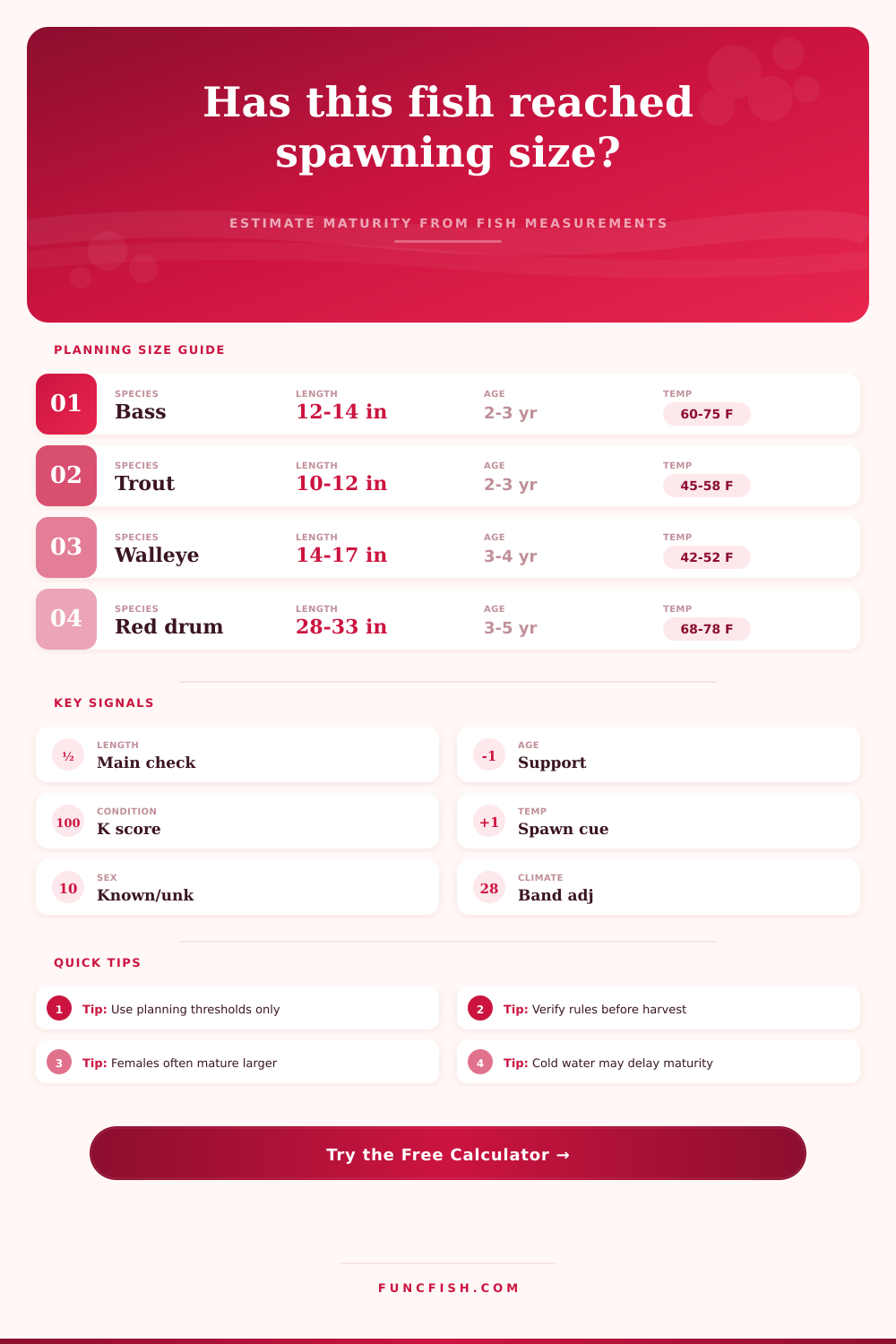
12-14Inches at maturityRainbow trout
10-12Inches at maturityWalleye
14-17Inches at maturityChannel catfish
13-16Inches at maturityNorthern pike
18-22Inches at maturityBluegill
3.5-5Inches at maturityAtlantic cod
18-26Inches at maturityRed drum
28-33Inches at maturityCommon carp
10-14Inches at maturityNile tilapia
4-6Inches at maturity📊Reference threshold tables
| Species | Male planning threshold | Female planning threshold | Typical maturity age |
|---|---|---|---|
| Largemouth bass | 11 in / 28 cm | 13 in / 33 cm | 2-3 years |
| Rainbow trout | 10 in / 25 cm | 12 in / 30 cm | 2-3 years |
| Walleye | 14 in / 36 cm | 17 in / 43 cm | 3-5 years |
| Channel catfish | 13 in / 33 cm | 16 in / 41 cm | 3-4 years |
| Northern pike | 18 in / 46 cm | 22 in / 56 cm | 2-4 years |
| Bluegill | 3.5 in / 9 cm | 5 in / 13 cm | 1-2 years |
| Atlantic cod | 18 in / 46 cm | 26 in / 66 cm | 3-6 years |
| Red drum | 28 in / 71 cm | 33 in / 84 cm | 3-5 years |
| Common carp | 10 in / 25 cm | 14 in / 36 cm | 2-4 years |
| Nile tilapia | 4 in / 10 cm | 6 in / 15 cm | 0.5-1.5 years |
| Temperature signal | Score effect | What it means | Use in estimate |
|---|---|---|---|
| Below spawn window | Low | Fish may be mature but not cued | Reduces readiness |
| Inside early window | Moderate | Seasonal movement may begin | Supports estimate |
| Inside core window | High | Water temperature matches spawning cue | Raises estimate |
| Above upper window | Mixed | Spawning may be late or past peak | Soft reduction |
| Climate band | Length adjustment | Age adjustment | Planning note |
|---|---|---|---|
| Tropical / low latitude | -6% | -0.4 yr | Warm growth and early cycling |
| Subtropical / warm temperate | -2% | -0.2 yr | Mild seasonal delay |
| Temperate / mid latitude | 0% | 0 yr | Baseline comparison |
| Cold temperate / high latitude | +5% | +0.5 yr | Later maturity is common |
| Cold marine shelf | +8% | +0.8 yr | Longer growth window |
| Condition factor K | Body signal | Score effect | Planning interpretation |
|---|---|---|---|
| Below 0.85 | Thin | Lower | Energy reserves may be limited |
| 0.85-1.05 | Lean | Neutral low | May still mature if length and age are high |
| 1.05-1.35 | Balanced | Strong | Typical healthy condition range |
| Above 1.35 | Heavy | Mixed | High weight can reflect feeding or gravidity |
💡Practical checks
Tip: Treat the result as a planning estimate for biological maturity. It is not a size limit, slot limit, season rule, or harvest recommendation.
Tip: If length and age disagree, give more weight to local growth patterns and repeated samples from the same water body.
Do you need to know if largemouth bass are pre-spawn? Does it matter whether they’re ready or not? That’s going to help understand their seasonal behavior as well as how you manage them in your fishery.
That’s where the spawning size threshold calculator come into play. It is a tool that takes a raw measurement and puts it into biological terms. It incorporate length, weight, age, condition, and temperature into one maturity likelihood. From there, you move from guesswork to making a structural estimate that takes into account your local environment and its unique pressures.
How to Tell if Fish Are Ready to Spawn
The most apparent one is length, but that’s hardly all of the answer. Sure, a fish can reaches technical maturity by being long enough, but what about having energy reserves to go ahead and spawn? This is where condition factor matter. When you input information into the tool, it then spits out the K value, which essentially determines if the fish has plumpness necessary to reproduce. If it is low on the K score and skinny, sure, it could be big and old but it will not have the lipid stores to produce eggs. It accounts for that in addition to its size to provide a more detailed perspective than just a ruler can do.
The other critical factor in this equation is temperature. Because fish are ectothermic, they relies on surrounding water to regulate their internal processes. A big, fat, perfectly proportioned fish won’t spawn when the water isn’t warm enough to stimulate the hormones. And so we have our tool adjust the confidence level based off the current water temperature being measured. Is it still cool out? Then it lowers the chance of maturity. Why? This is because the environmental cue hasn’t arrived yet, not because the fish isn’t mature. It’s a fine line but helps avoid false positives in your planning.
The other wrinkle beyond size that most folks miss is climate. A red drum will grow up quicker and reach sexual maturity at a smaller size if it’s in Florida different than Chesapeake Bay. To account for that, the calculator use temperature zones based on latitude. Fast-growing tropical species achieve reproductive size sooner, often during their first year of life, while cold-water species like walleye or cod takes longer to reach reproductive size. Slow-growing species in cold water reaches sexual maturity later. That variation in geographic difference gets you poor data if you ignore it. The page has a reference table that spells out the maturity age ranges that change from cold to warm waters so you can better calibrate what you expect in any particular place.
Another factor that affects the threshold, and one especially important in species where males and females look very different, is sex. In many predator species, such as bass or pike, females reaches maturity at larger sizes then males do prior to their initial spawns. You can indicate sex, if known, and the calculator will further refine the threshold. Otherwise it assumes mixed (unknown) sex and errs on side of caution, which is helpful when you’re using this out in the field where you may not be sure of the sex visually until you see them spawning.
It provides a breakdown on how the factors contribute to the likelihood (percentage) and doesn’t give you a directive as to what to do with that fish. Rather, it’s based off the probability that the fish is doing something. It’s a planning tool, not a regulatory tool. Biological averages don’t necessarily align with local slot limits or fishing seasons; they exists for a reason. Always check your local regulations when you’re trying to make harvest decisions. This tool should of help you better understand how the population changes but not replace your legal guidelines.
This way of thinking makes what you caught more than a number on a piece of tape. Instead of merely catching a certain size, you begin to see a fish that has been affected by genetics, temperature, and food and see its biological state as well. It becomes not only a number but a conversation with the environment around them.
When you go out next and measure your next fish, notice the temperature of the water, examine the condition of the fish and think about where you’re located on the map. If it is in spawning shape, the numbers will tell you it is time to go; if not, it is still waiting.