🤿 Spearfishing Weight Belt Calculator
Calculate your ideal weight belt load for neutral buoyancy — based on body weight, wetsuit, and water type
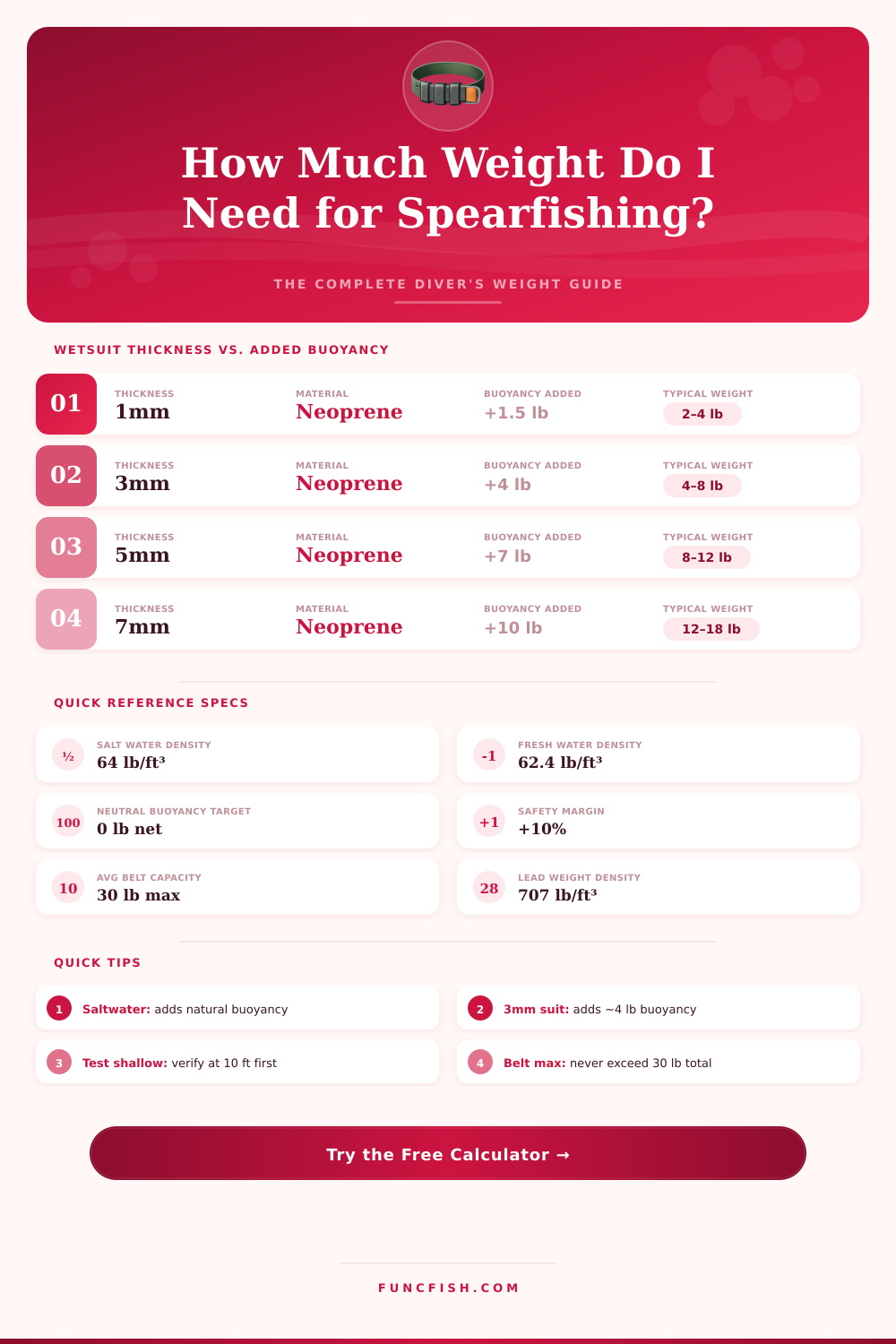
| Thickness | Buoyancy Added (lb) | Buoyancy Added (kg) | Typical Belt Weight (lb) | Typical Belt Weight (kg) |
|---|---|---|---|---|
| No Suit / Swimwear | 0 | 0 | 2–5 lb | 1–2.3 kg |
| 1mm Skin Suit | ~1.5 lb | ~0.7 kg | 3–6 lb | 1.4–2.7 kg |
| 2mm Shorty | ~2.5 lb | ~1.1 kg | 4–8 lb | 1.8–3.6 kg |
| 3mm Standard | ~4 lb | ~1.8 kg | 6–10 lb | 2.7–4.5 kg |
| 5mm Cold Water | ~7 lb | ~3.2 kg | 10–16 lb | 4.5–7.3 kg |
| 7mm Very Cold | ~10 lb | ~4.5 kg | 14–22 lb | 6.4–10 kg |
| Species | Typical Depth (ft) | Typical Depth (m) | Recommended Wetsuit | Notes |
|---|---|---|---|---|
| Mahi-Mahi | Surface–30 ft | 0–9 m | 1–3mm | Bluewater pelagic |
| Yellowtail / Amberjack | 20–60 ft | 6–18 m | 3mm | Reef & kelp edges |
| Grouper | 30–80 ft | 9–24 m | 3–5mm | Rocky reef structure |
| Wahoo | Surface–40 ft | 0–12 m | 1–3mm | Open water offshore |
| Snapper (Various) | 15–60 ft | 5–18 m | 3mm | Warm tropical reefs |
| Halibut | 10–50 ft | 3–15 m | 5–7mm | Sandy bottom, cold |
| Spiny Lobster | 5–40 ft | 1.5–12 m | 3–5mm | Reef crevices |
| Cobia | Surface–30 ft | 0–9 m | 1–3mm | Warm coastal |
| Tuna (Bluefin) | Surface–50 ft | 0–15 m | 3mm | Offshore bluewater |
| Bass (Freshwater) | 5–20 ft | 1.5–6 m | 3mm | Lake, river |
| Belt Type | Max Capacity (lb) | Max Capacity (kg) | Best Use | Weight of Belt Itself |
|---|---|---|---|---|
| Rubber Weight Belt | 30 lb | 13.6 kg | All-around spearfishing | ~0.5 lb / 0.2 kg |
| Nylon Web Belt | 25 lb | 11.3 kg | Budget, casual diving | ~0.3 lb / 0.1 kg |
| Integrated BCD Pockets | 20 lb | 9 kg | Scuba-style freediving | Varies |
| Backplate & Wing | 35 lb | 15.9 kg | Technical / deep dives | ~5 lb / 2.3 kg |
| Vest / Power Belt | 28 lb | 12.7 kg | Cold water, thick suit | ~1 lb / 0.45 kg |
| Soft Pocket Belt | 22 lb | 10 kg | Comfort, streamlined | ~0.4 lb / 0.18 kg |
A spearfishing weight belt is simply a belt around the waist with weights. You make it from nylon or rubber to help spearfishers have neutral buoyancy underwater With wetsuits, diving down is almost impossible without a belt. Divers put weight on it to fight the natural buoyancy and reach the hunting zone.
The secret is to choose the right amount of weight.
How to Choose a Spearfishing Weight Belt
Rubber or silicone weight belts are needed for neutral buoyancy during spearfishing and freediving. They give divers better control and energy saving underwater. Rubber belts make freediving and spearfishing easer because they stay on the body or wetsuit better than nylon.
Also they stretch a bit, which is a big advantage. Freedive belts from rubber are popular because they stretch, although they were made for freediving; now they please scuba divers because of the same features.
Spearfishers choose a rubber belt that stays set during the whole dive. Use a longer belt, good advice. Rubber compensates the compression of the wetsuit during deep dives, and it sticks, so it does not move.
In a good rubber weight belt, a good balance between flexibility and stiffness matters.
The right weight system is key for every dive. Kicking against natural buoyancy wastes breath and energy. Weight belts help you stay under with less effort, which extends the breath hold.
You can easily lay on the bottom and wait for fish in shallow water. Less weight makes shallow dives easier, but for deep ones it helps more on the way heir.
It is possible to choose between Marseille-style buckles and friction or clamp buckles. A Marseille buckle with a strong but flexible rubber belt forms an excellent combination. The buckle of a Marseille belt is heavy duty and has no quick release.
If you search for weight vests instead, mind the safe release.
Dive weights add quickly to the belt and last for years of use. A knife, lights, belt reel or D-ring attaches to it to free hands for catching fish, lobsters and abalone. Weight placement also matters, some divers put weight on both sides and one in the center back.
A thicker wetsuit requires more weight. About colors, some choose camo, green or black belts so that they blend in, rather than bright colors.