Speed Jigging Retrieve Rate Calculator
Estimate handle cadence, effective inches per turn, vertical jig speed, retrieve time through the strike zone, and whether the setup matches the target species and depth.
📌Speed Jigging Presets
⚙Retrieve Inputs
Retrieve Breakdown
📊Retrieve Rate Reference Cards
📐Species and Cadence Table
| Target | Useful Vertical Speed | Common Cadence | Retrieve Note |
|---|---|---|---|
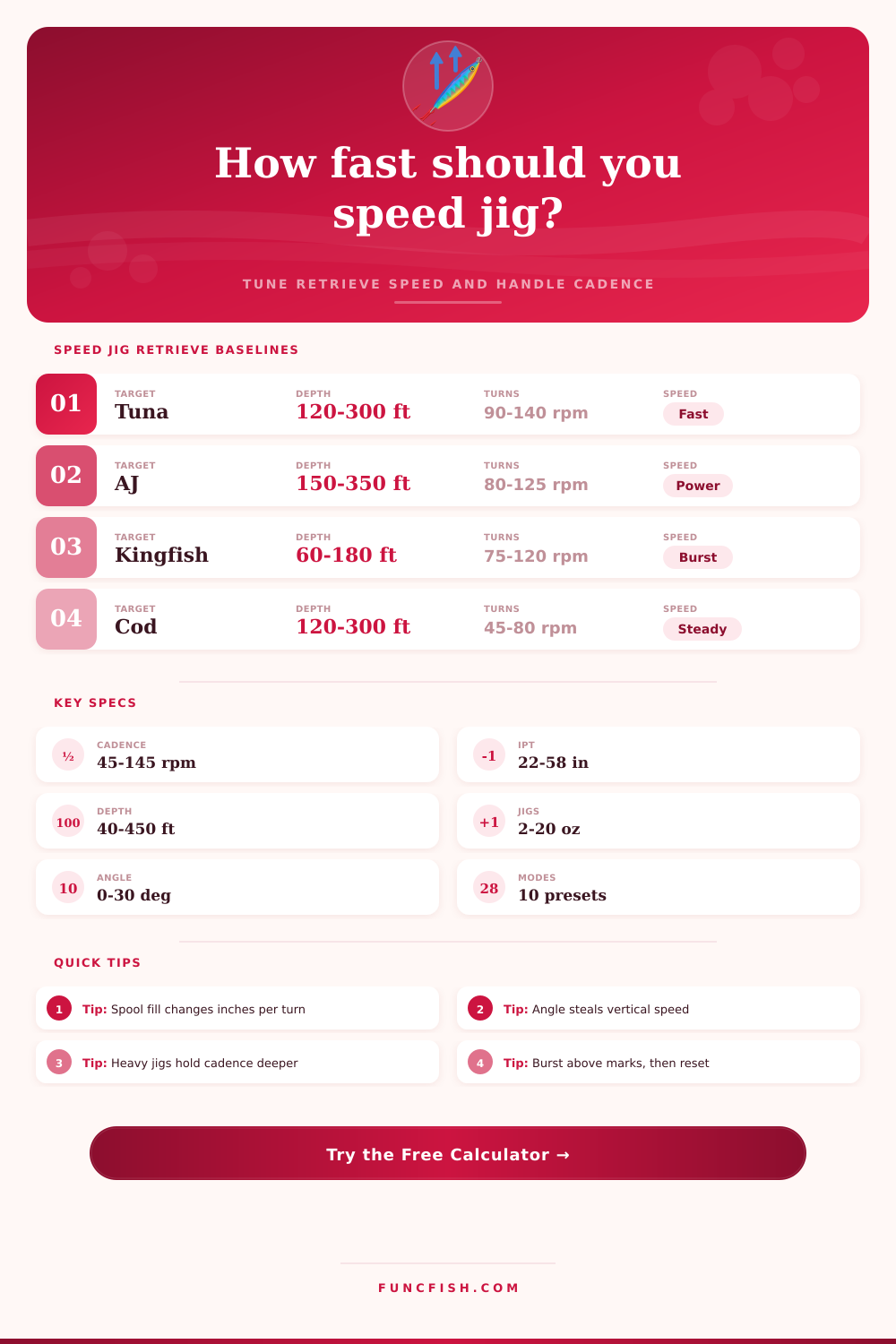
| Tuna and pelagics | 3.0-6.0 ft/s (0.9-1.8 m/s) | 90-145 turns/min | Slim jigs, high gear reels, minimal pause above marks. |
| Amberjack and seriola | 2.4-5.0 ft/s (0.7-1.5 m/s) | 75-125 turns/min | Strong rod pump helps when the reel is under load. |
| Kingfish and mackerel | 2.2-4.5 ft/s (0.7-1.4 m/s) | 75-120 turns/min | Bursts trigger chases; wire trace adds drag penalty. |
| Grouper and reef fish | 1.6-3.4 ft/s (0.5-1.0 m/s) | 65-105 turns/min | Fast escape for first 20-40 ft above structure. |
| Cod and bottom fish | 1.1-2.5 ft/s (0.3-0.8 m/s) | 45-80 turns/min | Steady wind keeps contact without over-speeding the jig. |
⚓Reel and Jig Matching Table
| Setup | Typical IPT | Best Depth | Retrieve Use |
|---|---|---|---|
| Compact 5000 spinner | 31-37 in (79-94 cm) | 40-160 ft | Light vertical speed jigging and shore metal work. |
| Offshore 10000 spinner | 38-45 in (97-114 cm) | 80-300 ft | Balanced tuna, kingfish, and amberjack pace. |
| High gear 14000 spinner | 48-55 in (122-140 cm) | 120-400 ft | Fast chase retrieves when the angler can sustain load. |
| Narrow lever drag | 34-46 in (86-117 cm) | 120-450 ft | Mechanical jigging with consistent spool pickup. |
| Low gear power reel | 22-32 in (56-81 cm) | 180-600 ft | Heavy jigs, deep current, and fatigue control. |
✅Retrieve Check Notes
Correct the published IPT. Reel specs are usually measured with a full spool and light load. A deep drop, partly empty spool, and tight drag can reduce actual pickup by 8-25%.
Watch vertical speed, not just handle speed. A fast crank with a 25 degree line angle may move the jig sideways and upward more slowly than a controlled cadence with better vertical alignment.
Deep water physics is against you. You are cranking hard, but the jig does not move up much. The delay between how fast you turn the handle and how much the jig rise ruins many offshore fishing trips. Line angle and water density inhibits vertical movement.
The way you move the handle along with your depth makes the calculator do all that math for you. So you know if your speed gets bit or not… no more guessing while burning calories.
Calculate Your Jig Speed to Catch More Fish
Anglers miss something simple: line angle robs vertical speed. At a 20 degree line angle, you’re hauling more sideways than upwards. The calculator include this lost geometry in the calculation and displays true rise rate versus line pulled in feet. Although slight on paper, it’s enough to keep you ahead of a school before they fall out of reach.
Pure crank calculations ignore rod lift. To get more inches per cycle, mechanical jigging combine rod pumps and reel turns. That erratic burst trigger a predator response, but each lift creates slack during the rod drop. Unless you factor in lost pickup efficiency, your effective speed tanks.
To help match species to best cadence, the page’s reference table pairs species to their optimal cadence. Cod like a steady wind to maintain constant contact, but you must avoid scaring them. Tuna need a frantic go-to-work approach to keep slim jigs breathing. Half the battle is matching the retrieve to the target’s instinct.
Current acts as an invisible brake on your jig. The harder the current flow, the more line it creates a belly in and the more drag there is. So you have to reel even faster to stay neutrally buoyant. When it hit hard against you, the jig will stall out easy on the pause.
Knowing how many inches per turn your reel actualy picks up under load is important, as published specs are normally taken at a full spool. A partially filled spool has less effective leverage which reduces pickup distance per revolution. The calculator corrects for those variances and provides a baseline based off real-world conditions different than what brochures promise.
The last component to the puzzle is fatigue management. While you might be able to crank out 100 turns per minute for five minutes in pursuit of a school on flash, there’s no way you can maintain that speed for an hour. By establishing a sustainable pace you’re still able to cover water efficienty throughout a long day without torching your arms. This also reveals whether your setup favor short bursts or endurance.
If your match rating suggests you need fatigue management, you know your current combo require too much effort to get consistent vertical gain. Modifying reel gear ratio and jig weight can change this balance.
The jig speed isn’t necessarily about how fast you work it but more about how you control the bait’s vertical presentation. You need to synchronize your own physical rhythm with the hydrodynamics of current, depth, etc. To give yourself precision on where you bring fish and bait together, treat the rate of retrieve as a calculated factor.
If you’re feeling like you’re spinning your wheels, check the angle and the lift loss first. Often, it’s about working smarter not harder when the numbers is behind you. You should of checked the line angle before.