Spey Line Head Length Calculator
Estimate a practical Spey head length from rod length, line rating, casting style, sink tip length, leader, target distance, and available casting room.
📌Scenario presets
⚙Spey setup inputs
Spey head length result
Full breakdown
📋Spey head family grid
Skagit compact
Scandi compact
Short Spey
Long belly
📐Reference tables
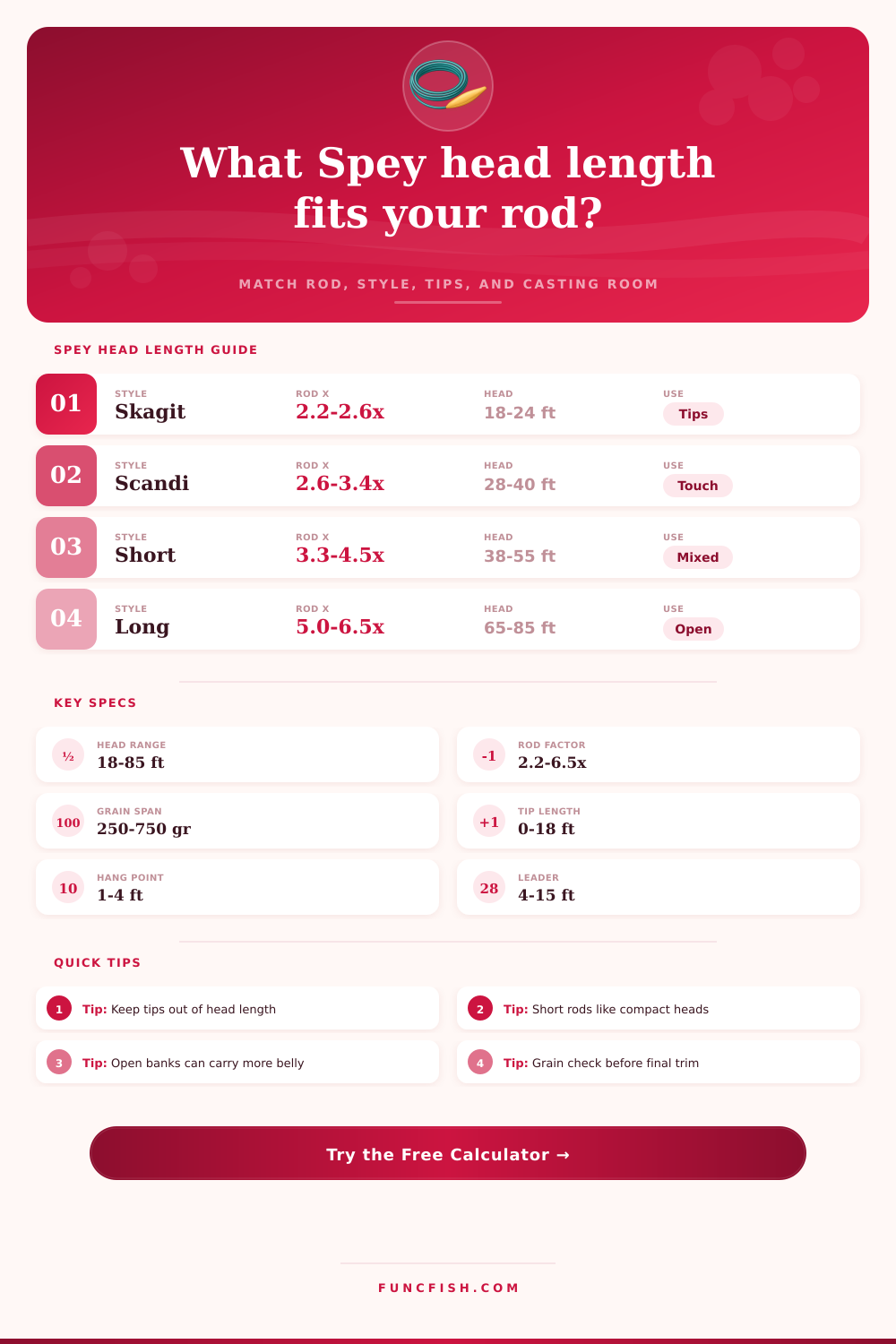
| Head family | Typical length | Rod multiple | Best match |
|---|---|---|---|
| Trout Spey head | 18-24 ft / 5.5-7.3 m | 2.0-2.5x | Light tips, small streamers |
| Skagit compact | 20-25 ft / 6.1-7.6 m | 2.1-2.7x | Sustained anchors, heavy tips |
| Scandi compact | 28-36 ft / 8.5-11.0 m | 2.5-3.1x | Touch and go, poly leaders |
| Short Spey belly | 38-55 ft / 11.6-16.8 m | 3.2-4.5x | Mixed casts, moderate room |
| Mid belly Spey | 52-68 ft / 15.8-20.7 m | 4.2-5.4x | Open banks, line control |
| Long belly Spey | 65-85 ft / 19.8-25.9 m | 5.0-6.5x | Classic long casts, open water |
| Rod rating | Scandi window | Skagit window | Common use |
|---|---|---|---|
| 3 wt Trout Spey | 220-270 gr / 14-17 g | 250-300 gr / 16-19 g | Soft hackles, small trout streamers |
| 4 wt Trout Spey | 260-320 gr / 17-21 g | 300-360 gr / 19-23 g | Trout streamers, light sink tips |
| 5 wt Spey | 330-390 gr / 21-25 g | 390-450 gr / 25-29 g | Large trout, summer steelhead |
| 6 wt Spey | 390-450 gr / 25-29 g | 450-510 gr / 29-33 g | Grilse, light steelhead |
| 7 wt Spey | 450-520 gr / 29-34 g | 510-570 gr / 33-37 g | Steelhead, medium salmon |
| 8 wt Spey | 510-570 gr / 33-37 g | 570-630 gr / 37-41 g | Winter steelhead, salmon |
| 9 wt Spey | 570-650 gr / 37-42 g | 630-700 gr / 41-45 g | Large salmon, heavy tips |
| 10 wt Spey | 650-720 gr / 42-47 g | 700-780 gr / 45-51 g | Big rivers and heavy flies |
| Setup | Tip or leader | Hang-back | Length adjustment |
|---|---|---|---|
| Heavy sink tip | 10-15 ft / 3.0-4.6 m | 1-2 ft / 0.3-0.6 m | Shorten head 1-3 ft if the anchor sticks |
| Floating poly leader | 8-12 ft / 2.4-3.7 m | 2-3 ft / 0.6-0.9 m | Keep head near the style midpoint |
| Long mono leader | 12-15 ft / 3.7-4.6 m | 2-4 ft / 0.6-1.2 m | Use longer heads only with clean anchors |
| Open long belly | 4-8 ft / 1.2-2.4 m | 3-5 ft / 0.9-1.5 m | Lengthen with room and line control |
| Species / water | Rod range | Head family | Typical target |
|---|---|---|---|
| Trout tailwater | 3-4 wt, 10.5-11.5 ft | Trout Spey or compact Scandi | 35-70 ft / 10.7-21.3 m |
| Summer steelhead | 5-7 wt, 12-13.5 ft | Scandi compact or short Spey | 60-90 ft / 18.3-27.4 m |
| Winter steelhead | 7-8 wt, 12.5-13.5 ft | Skagit compact or Skagit long | 55-85 ft / 16.8-25.9 m |
| Atlantic salmon | 8-10 wt, 13-15 ft | Short Spey, mid belly, long belly | 70-120 ft / 21.3-36.6 m |
💡Calculation checks
Head length check: Spey heads are usually measured as the belly or shooting head. Sink tips, poly leaders, and mono leaders are calculated separately for anchor and total system length.
Room check: If the D-loop depth is longer than your available back space, shorten the head family before changing grain weight. Grain changes load the rod; length changes line control.
A Spey setup begin with the selection of the head length. The head length is a critical component of the Spey rod because the head length determine how the rod will perform during a lift or a sweep of the rod. If an individual select the incorrect head length for the rod that they are casting, the rod may feel overloaded during a lift of the rod or the rod may feel starved during a sweep of the rod.
Each of the head length’s component will determine how much line the angler can control and how long the D-loop can form. Furthermore, the head length will determine if the designated anchor will hold long enough to load the rod before the current move the line. Many individuals attempt to test the lines by feel alone.
Choose the Right Head Length for Your Spey Rod
However, testing the lines by feel alone will likely be unsuccessful if the angler change rods or if the angler moves to a different river. The head length is the measurement from the tip to the running line of the fly. Furthermore, this measurement carry the grain weight that the rod is design to cast.
A shorter head length will allow the angler to turn the line over more quickly if the angler utilize heavy tips to the line. A longer head length will allow the line to travel further from the angler’s rod when the anchor is set in place. Additionally, longer head length require more space to be created behind the angler that is casting the line.
The calculator calculate the head length of the Spey rod based off the length of the rod, the head family of the rod, and the amount of room available on the bank where the angler plan to cast. Furthermore, the calculator considers the length of the tip of the rod and the leader in the calculation of the head length even though they is not considered part of the head length that is calculated. The casting style that are utilized with the Spey rod will affect the math of the head length.
For instance, sustained anchor casts allow the line to remain on the water for extended periods of time which allow for shorter heads to load the rod. By contrast, touch and go casts will require more length of the line to allow for the angler’s line to maintain its momentum when changing the direction of the line. Thus, touch and go casts will require a longer head length than sustained anchor casts.
Snap casts will fall somewhere in the middle of touch and go and sustained anchor casts. Furthermore, the tempo of the angler will also play a key role in the decision of head length. For instance, a shorter head length will be easier to learn and utilize for a novice angler than an experienced one who can cast longer distances of line.
Thus, the calculator will adjust for the different casting tempo, but the angler must make a decision of what they feel is the correct head length. The amount of room behind the angler that is casting the Spey line is another component that will influence the head length of the Spey rod. For instance, if the angler is casting along the bank with overhead brush, there is less room for the D-loop created when the line is cast.
Thus, a tight bank will force the angler to use a shorter head length to allow for the D-loop to not extend too far into the area that is available. The amount of space behind the angler is considered in the calculator for head length but the best test of that space is to make the first cast of the day. If the line begin to hit any vegetation during the lift, the head length is likely too long for that area that is being target by the angler.
The speed of the water in which the Spey rod will be used and the weight of the spey line will also impact the head length. For instance, if the water is moving rapidly along the riverbed or banks, the current will sweep the anchor downstream which will cause the line to be difficult to control. Thus, shorter head length with more grain along the line will be able to recover better from these fast currents.
Additionally, if the spey line has heavier flies or if the flies has heavy sink tips, the line will add to the load on the tip of the spey rod. Thus, compact heads will be the favorite for these flies. By contrast, lines that has light, floating tips will allow for the angler to use a longer head length because the faster the line turns over the tip the less of an issue it will be to utilize a longer head length to cast the spey line.
These factor will impact the type of heads that can be used with each spey rod so that the same rod can have two different heads depending upon the time of year and the river that is being fished. An additional component to consider in the Spey casting setup is the grain window of the Spey rod. The head length should have enough weight to load the rod but should not have so much weight that the tip of the rod begins to dive with each cast of the line.
The Spey rod calculator will indicate the center grain weight and the grain window. Furthermore, any lines that is purchased for Spey rods come in different weights. Thus, the grain window indicate the length to which the line should be trimmed.
The head length should be allowed to start near the middle of the grain window if the angler plan to trim the Spey line to its preferred length. The reference table indicate the multiples of the length of the rod for each of the head families of the rod. Additionally, each of the reference tables also indicate the ranges of grain that each rod weight can handle.
These reference tables provide a starting point for the head length of the Spey rod. For instance, the tables may state that a 7 weight Spey rod has a grain length of between 510 and 570 grain for Skagit heads but may also state that the same 7 weight rod will utilize a lighter Scandi head if the water is slow and the angler has a smooth casting style. Thus, the reference tables provides a general range for each type of rod but the head length calculator provides the fine tuning of that range to account for the length of the rod and the conditions in which the rod will be used.
The numbers in the calculator cannot account for the individual caster. For instance, if the angler utilizes long tapers of line that extend to the rod tip, a shorter head length will be required to allow the line to turn over properly. A slightly shorter head length may be preferred by the angler that has good timing with the Spey rod.
Thus, the turnover score that the Spey rod head length calculator calculates is only a guide. It indicate whether or not the angler’s inputs are working together or against one another. An approach to selecting the head length for a Spey rod is to first select the head family.
Following the selection of the head family, the angler can use the head length calculator to fine tune the head length to account for the amount of room behind the angler, the water speed, and the experience level of the angler. The calculations can be run for two different casting styles. The head lengths and grain windows recommended for each casting style can be compared to each other.
Following the comparison of the head lengths and grain windows, the angler can take the shorter head length to the river and test it for one day of fishing. If the anchor hold and the turnover of the line is to the angler’s satisfaction, the head length that is selected is workable. However, if the Spey line feels short when cast with the tested head length, the angler must lengthen the head or change the head family of the rod.
Thus, the Spey rod head length calculator provides a great starting point for the angler but the river will provide the final decision to the angler as to what the best head length is for the Spey rod that they own.