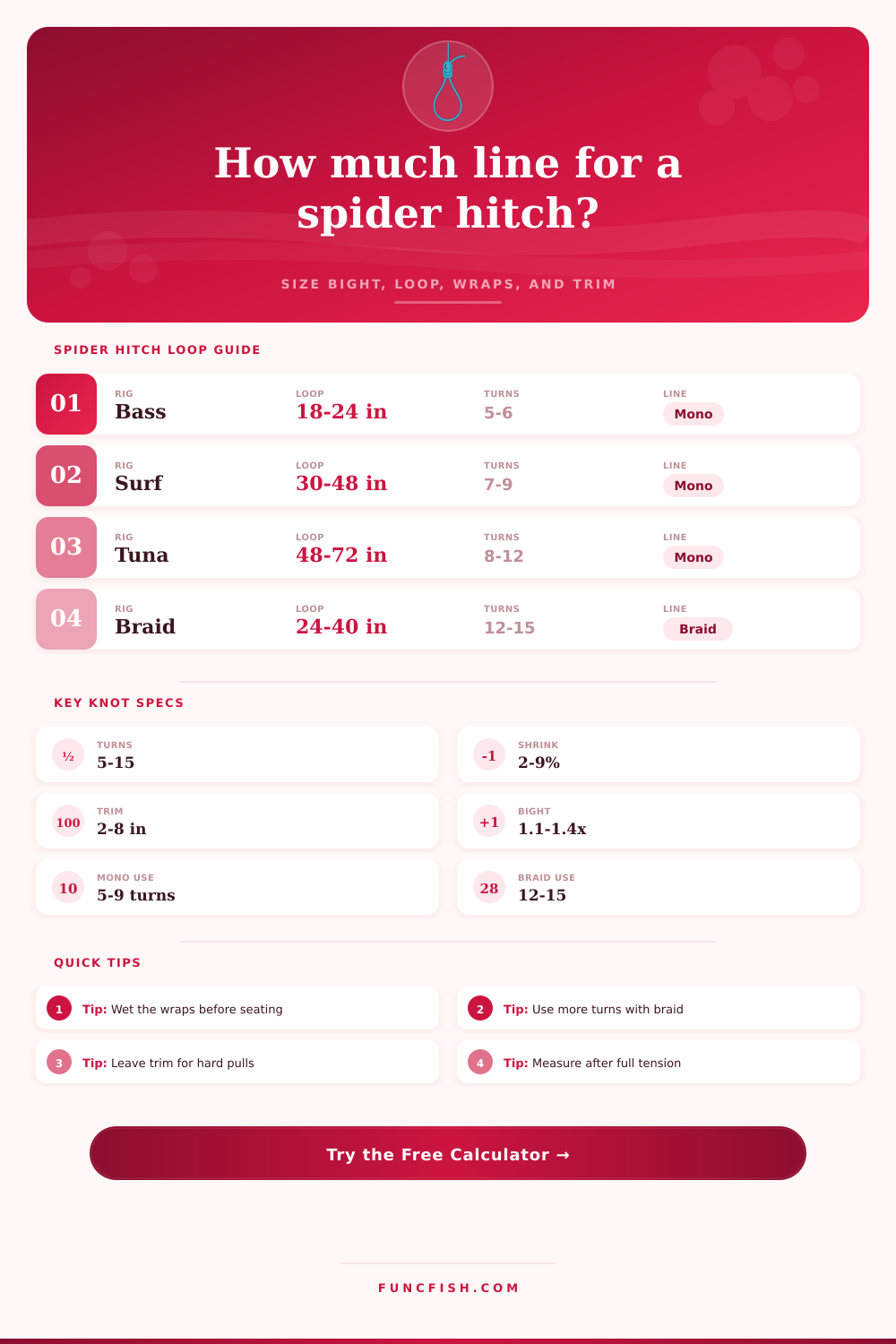
Spider Hitch Length Calculator
Estimate the starting bight, finished double-line loop, wrap take-up, seating shrink, and usable leader reach for spider hitch rigs used with mono, fluorocarbon, copolymer, and braid.
📌Spider hitch rig presets
⚙Spider hitch measurements
Use the actual main line rating, not the leader rating.
Measure from the tip of the doubled loop to the seated spider hitch barrel.
Typical ranges: 5-7 in mono, 8-10 in heavy mono, 12-15 in braid.
The calculator can auto-fill this from line type and test when a preset is used.
Extra line to hold, tighten, and trim after the knot is fully seated.
Add reach for an Albright, Bristol, snap, swivel, sinker clip, or loop-to-loop join.
Use higher values for dry mono, stiff fluorocarbon, or hurried rigging.
Spider hitch length forecast
Calculation breakdown
🧵Line material comparison grid
Nylon mono
Fluorocarbon
Thin braid
Dacron braid
📏Spider hitch turn and length reference
| Line class | Common turns | Finished loop range | Starting bight rule | Best use |
|---|---|---|---|---|
| 6-12 lb mono / 3-6 kg | 5-6 turns | 12-24 in / 30-61 cm | target + 3-5 in | trout, panfish, finesse leaders |
| 15-30 lb mono / 7-14 kg | 6-8 turns | 18-36 in / 46-91 cm | target + 4-7 in | bass, inshore, light surf |
| 40-80 lb mono / 18-36 kg | 8-10 turns | 30-60 in / 76-152 cm | target + 7-12 in | catfish, reef, heavy surf |
| 100-150 lb mono / 45-68 kg | 10-12 turns | 48-84 in / 122-213 cm | target + 12-20 in | tuna, trolling, wind-on prep |
| 10-50 lb braid / 5-23 kg | 12-15 turns | 18-40 in / 46-102 cm | target + 4-8 in | compact double lines and lure joins |
🐠Species and rig matching table
| Species group | Typical line | Loop length | Turns | Comparison note |
|---|---|---|---|---|
| Bass and walleye | 10-20 lb mono or braid | 16-26 in / 41-66 cm | 5-7 mono, 12 braid | Shorter loops cast cleaner through small guides. |
| Redfish, snook, stripers | 20-40 lb braid or mono | 24-40 in / 61-102 cm | 7-9 mono, 12-14 braid | Leave reach for leader knots and boat-side pressure. |
| Surf rays and drum | 30-60 lb mono shock line | 36-60 in / 91-152 cm | 7-10 turns | Longer doubled section helps casting shock and abrasion. |
| Catfish and reef fish | 40-80 lb mono | 24-48 in / 61-122 cm | 8-10 turns | Hard seating matters more than a tiny knot barrel. |
| Tuna and kingfish | 80-150 lb mono or Dacron | 48-84 in / 122-213 cm | 10-14 turns | Plan extra bight for gloves, drag scale, and trimming. |
🔢Line diameter and shrink reference
| Material | Approx diameter examples | Wrap factor | Base shrink | Calculator treatment |
|---|---|---|---|---|
| Nylon monofilament | 20 lb 0.40 mm, 50 lb 0.70 mm | 1.00 | 4.5% | Balanced default for most spider hitch lengths. |
| Hard mono | 30 lb 0.55 mm, 80 lb 0.90 mm | 1.08 | 5.5% | Adds take-up because stiff line makes a larger barrel. |
| Fluorocarbon | 25 lb 0.45 mm, 60 lb 0.75 mm | 1.12 | 6.5% | Higher shrink allowance for dense, springy material. |
| Thin PE braid | 20 lb 0.23 mm, 50 lb 0.36 mm | 0.88 | 2.8% | Uses more turns, less diameter take-up per wrap. |
| Dacron trolling braid | 50 lb 0.70 mm, 100 lb 1.05 mm | 1.18 | 3.6% | Bulky braid needs a longer bight even with modest shrink. |
🔗Double-line knot comparison
| Double-line knot | Length planning | Strength tendency | Rigging speed | When to compare it |
|---|---|---|---|---|
| Spider hitch | Moderate bight waste | Good when evenly seated | Fast | Quick surf, inshore, and boat rigs. |
| Bimini twist | Longer working area | Excellent with correct turns | Slow | Maximum double-line strength matters more than speed. |
| Surgeon loop | Low bight waste | Fair to good | Very fast | Short loops, light line, and simple terminal rigs. |
| Figure-eight loop | Compact but bulky | Good in heavier mono | Fast | Dropper, sinker, and swivel loops. |
Length tip: Mark the desired finished loop on a damp towel before tying. The knot barrel normally creeps toward the loop as it seats, so the starting bight should be longer than the finished target.
Seating tip: Pull both standing legs and the loop legs evenly. Uneven tension can shorten one side of the doubled line and make leader knots track off-center under load.
The knot was tied right, all the turns were snug. You pulled it so tight that your knuckles turned white, but after all that work, it’s just an inch too short to make a nice finished loop on the towel. And no, it wasn’t your technique, it was your arithmetic. In fact, there are three unseen reasons why the spider hitch take some of your line: 1) Wrap take-up, 2) Seating shrinkage and 3) Physical size of the barrel. So if you don’t allow for these losses in advance of starting the knot, your casting stroke will be cramped and your leader will end up being short.
Why does most folks miss this? Because they think about strength and not geometry. This is where our calculator above come in and adjusts to give you an exact start point for your bight based on how long you want your loop to be. Just put in the number of loops you want to make, what fish you are fishing for, and what kind of line you’re using. Then it adds back the inches that will vanish into the knot structure. In effect it reverse engineers the final setup so you can start with enough line.
How to Measure Line for Spider Hitch Loops
And that’s important since nylon mono shrinks different than fluorocarbon, which in turn behaves nothing like thin braid. Using a one size fits all allowance results in trouble at the dock or on the bank.
How about the turn? Turns provide security; the more turns, the tighter the knot grips your load and holds it in place. But the more turns, the more line is held within the barrel. This chart on the page spell that out by material. Generally speaking, nylon should require five to eight turns, fluorocarbon’s density and stiffness tend to make it want seven to ten turns and braid. Being as slick as it is, typicaly takes a dozen or even fifteen turns before you see any friction. Attempt to do a braid spider hitch with just six turns and it’ll slip off when it gets a good hard tug. Simply put, it wants more line fed into the knot to compensate for all those extra wraps.
Your most important measurement is the beginning bight, the length of double line that you hold in hand prior to wrapping around your finger for the initial turn. Depending upon your final goal, the calculator will provide precise guidance as to how much line must initially be held. For instance, if I wanted a thirty-inch loop for a surf rig, perhaps the tool would indicate I should begin with thirty-six inches. This additional six inches accounts for the five inches eaten up by the wraps, plus an inch for shrinkage as the knot cinches down tightly on itself. It also allows plenty of space to cleanly trim the leftover ends. If left too long, these ends can weaken the knot and cause tangles in your guides.
These numbers are also influenced by species choice, more than you might expect. For instance, a tight little loop is good for throwing a bass topwater rig. It helps you cast tighter with small lures and keep them off of vegetation while setting the hook in a fit of frantic stripping. But then again, a long double is better for something like a tuna or catfish rig where you want to distribute the load across the knot barrel so less of it is felt by any single fiber. The knot will be squeezed hard when you start pulling on a lot of heavy monofilament line. That line gets so compressed under all that force that there’s a large jump in how much it shrinks. If you don’t account for this, your shock leader becomes shorter than you planned and therefore much less effective at absorbing those big fish surges.
Another common trip up for anglers are variables of hardware allowances. There’s typically something like a swivel, a sinker clip, some other knot connecting your main line to your terminal tackle, and rarely do you ever see someone tying a spider hitch straight to their hook. This tool allows you to account for inches of hardware reach so when you come back to your snap or leader knot, you’ll have enough distance from your main line to your bait as you intended. If not, your bait will be closer to the weight than you expected, which changes how it moves in the current.
But you have to wet the wraps first. As the line slides along itself, any friction causes heat, which melts nylon or weakens the fibers of braid in no time at all. Saliva (or water) serves as a lubricant and lets the knot cinch down evenly without any heat-damaging friction. Only when properly wetted does the knot take its proper shape; otherwise, the knots won’t work like you expect if you are too quick with dry hands.
Don’t rush it; preparation is key to tying consistent loops; measure twice, tie once. Let the tool do the math for you while you concentrate on pulling and feeling the line. You’ll save yourself some time in the long run because you would of had to cut off short rigs and start over.