Spinnerbait Blade RPM Calculator
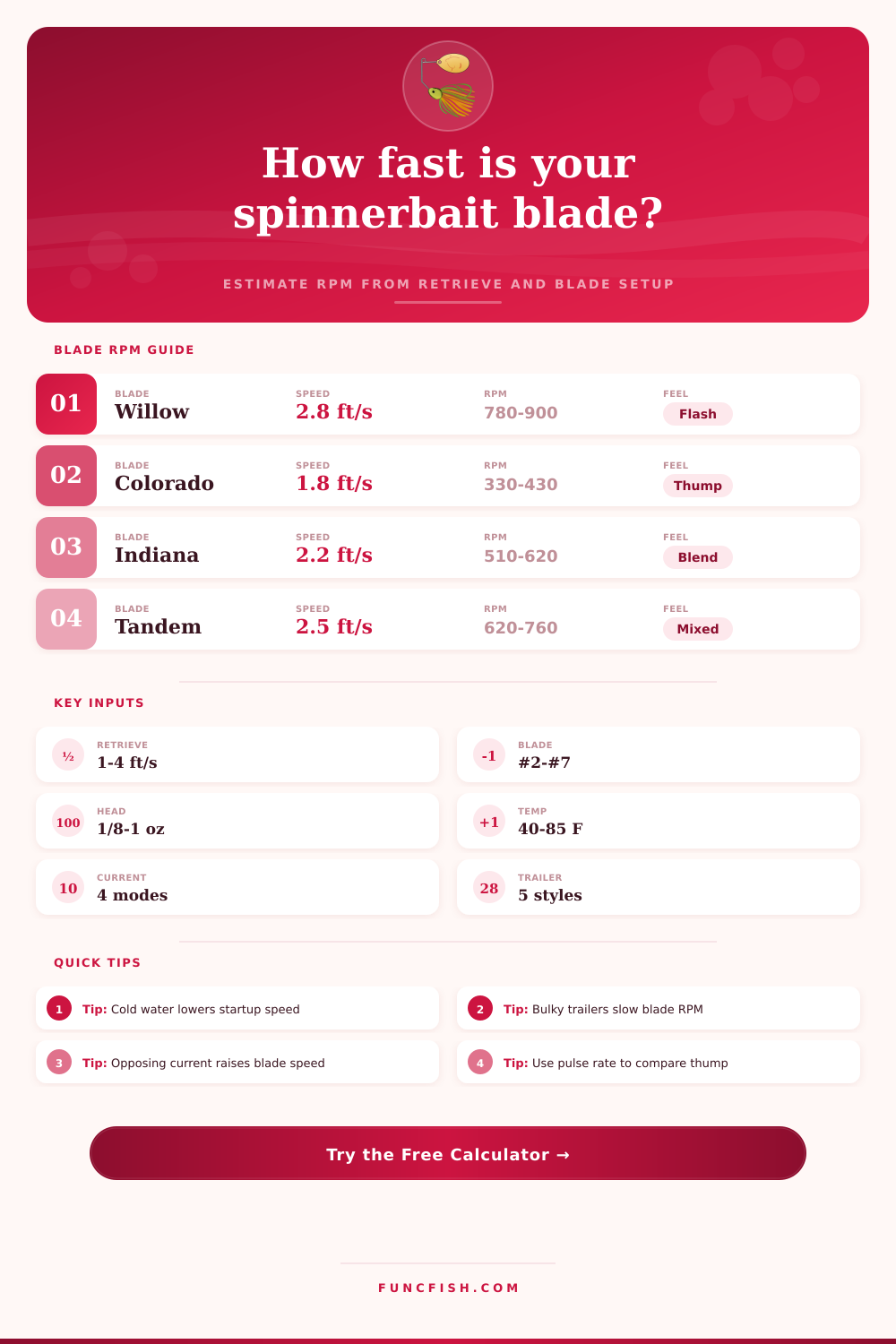
Estimate blade revolutions per minute, pulse rate, and total rotations per retrieve from blade family, retrieve speed, spinnerbait weight, water load, and trailer drag.
📌Scenario presets
⚙Blade and retrieve settings
Use lure travel through water, not reel handle turns.
Spinnerbait blade speed forecast
Full calculation breakdown
🛠Blade family comparison grid
Willowleaf
Colorado
Indiana
Tandem
📊Retrieve speed to RPM reference
| Retrieve pace | Approx speed | Willow #4 RPM | Colorado #4 RPM | Indiana #4 RPM |
|---|---|---|---|---|
| Crawl | 1.0 ft/s (0.30 m/s) | 260 to 320 | 175 to 225 | 215 to 270 |
| Slow roll | 1.6 ft/s (0.49 m/s) | 440 to 510 | 290 to 360 | 360 to 430 |
| Steady search | 2.3 ft/s (0.70 m/s) | 650 to 750 | 420 to 510 | 530 to 620 |
| Burn | 3.2 ft/s (0.98 m/s) | 920 to 1080 | 610 to 730 | 770 to 910 |
| High-speed wake | 4.0 ft/s (1.22 m/s) | 1160 to 1350 | 760 to 910 | 970 to 1140 |
📏Blade size and head matching table
| Main blade size | Common head weight | Approx metric head | RPM tendency | Typical use |
|---|---|---|---|---|
| #2 to #3 | 1/8 to 1/4 oz | 3.5 to 7 g | Fast startup, high revs | Finesse, shallow clear water |
| #3.5 to #4 | 1/4 to 1/2 oz | 7 to 14 g | Balanced rotation | Standard bass spinnerbait |
| #4.5 to #5 | 3/8 to 3/4 oz | 10.5 to 21 g | More torque, lower revs | Stained water, slow rolling |
| #6 | 3/4 to 1 oz | 21 to 28 g | Heavy load, strong lift | Pike, deep ledges, big profile |
| #7 oversized | 1 oz plus | 28 g plus | Slowest cadence | Specialty thump or wake bait |
🐟Species and water condition reference
| Target / condition | Useful blade style | Practical RPM band | Pulse target | Adjustment note |
|---|---|---|---|---|
| Clear largemouth | Willow or double willow | 700 to 1150 RPM | Bright fast flash | Trim trailer drag if lure rolls |
| Stained pond bass | Indiana or tandem | 520 to 820 RPM | Blend of flash and thump | Use steady retrieve speed |
| Muddy water / night | Colorado or double Colorado | 300 to 620 RPM | Strong low pulse | Slow down and keep blade loaded |
| Smallmouth flats | Willow or Indiana | 650 to 1000 RPM | Crisp flash | Favor smaller #3 to #4 blades |
| Pike and heavy cover | Oklahoma or #5 Colorado | 420 to 720 RPM | Heavy vibration | Expect bulky trailers to slow RPM |
⚖Hardware and drag comparison table
| Adjustment | RPM impact | Thump impact | When to use | Calculator factor |
|---|---|---|---|---|
| Premium swivel | Raises RPM slightly | Smoother pulse | Fast retrieves and large blades | 1.06 |
| Worn clevis | Can reduce RPM sharply | Erratic start-stop feel | Only if cleaned or replaced | 0.88 |
| Bulky trailer | Lowers RPM | Adds body roll and drag | Cold, dirty, or shallow water | 0.88 |
| Retrieve into current | Raises effective water speed | Stronger blade load | River seams and drains | 1.12 |
| Wide wire arm | Lowers RPM slightly | More lift and presence | Slow rolling big blades | 0.94 |
💡Calculation tips
Reading the RPM: Spinnerbait blade RPM is an estimate of water-driven blade rotation. Real lures vary with cup depth, blade bend, clevis friction, skirt flare, and how straight the bait tracks.
Comparing setups: Use the pulse rate and rotations per retrieve together. Two spinnerbaits can show similar RPM, but tandem blades create more visible flashes and more repeated pressure pulses.
Till then, it’s a game of spinners. You pick up some bling, throw it in there and hope it bites. And it does. But then you realize it is all about science. It is not about hoping; it is about physics.
For a bass, a spinning blade emit a pair of signals: Visual flash. Hydrodynamic vibration. To get those two right, you have to know how fast the metal revolves compared than the surrounding water. For instance, there’s an RPM calculator that lets you model this rate of rotation. Based off what you have rigged up, it lets you see if you’re retrieving too slow or too fast. And it takes into account things most angler overlook.
The Science of Fishing Spinners
One example is drag from bulkier craw trailers. An opposite current also increases water velocity over the blade without making you reel any faster. This stuff makes a difference; especially when a Colorado blade thump heavily at low speeds in dirty water and a willowleaf blade flashes frantically at high speeds in clear water. If you mix up those roles, you send the wrong message to bass waiting for a bite in the weeds.
When you enter retrieval speed, size and blade family into the page inputs it does the math for you. No need to estimate coefficients in your head, saves time. Fish metabolism and reaction time are influenced by water temperature. Viscosity of the water will increase in cold water a little bit. A blade spinning at 900 RPM in seventy-five degree water might be too frantic for a lethargic bass in fifty-degree water. The calculator accounts for this with its environmental adjustments. Not only does it tell you about hardware but also what it is doing based on the environment.
You learn to think different about speed with a trailer on. A skinny split-tail provide little resistance, allowing the blade to spin at high RPMs. When you replace it with a big twin-tail swimbait, you’ve added major load. The trailer pushing back on the water slows the blade, not your reel speed. That slowness further increases thump per rotation. It also causes bait to create a wider displacement wave that fishes well in stained water. Understanding this trade-off help you choose between vibration or flash based off the day’s conditions.
Rotation efficiency is also affected by equipment condition. Sticky swivels and worn clevises increase system friction. Reel speed may be constant, but mechanical drag lower RPMs into an ineffective range. Different combinations of equipment states is reflected in these reference tables. A premium quality ball-bearing swivel maintain momentum. Even when under load, the blade remains true to its designed specs.
The trick is to match your blade speed to the circumstance. A fast burn over top of a grass edge maintains the bait out of the weeds. Willowleaf blades can handles high speeds without stalling. Slower heavier pulses work a slow rolling presentation along a deep ridge line. Here is where Colorado or tandem rigs shine. The math comes from the calculator and translating that into what it means for a specific fish are the art.
You join machine power to biological expectation. The presentation becomes purposeful rather than lucky. The RPM thought process put purpose into how you present to them. The fish respond to the motion in the water, not the motion you feel on rod.