Spreader Bar Length Calculator
Estimate offshore trolling spreader bar length from lure count, drop spacing, bar material, target species, sea state, trolling speed, and outside-rod clearance.
📌Scenario presets
⚙Spreader bar inputs
Calculated spreader bar setup
Calculation breakdown
🔧Bar material comparison grid
Light Fiberglass
Heavy Fiberglass
Spring Titanium
Hybrid Tuna Bar
📊Bar length sizing table
| Bar class | Tip-to-tip length | Typical drops | Teaser spacing | Best use |
|---|---|---|---|---|
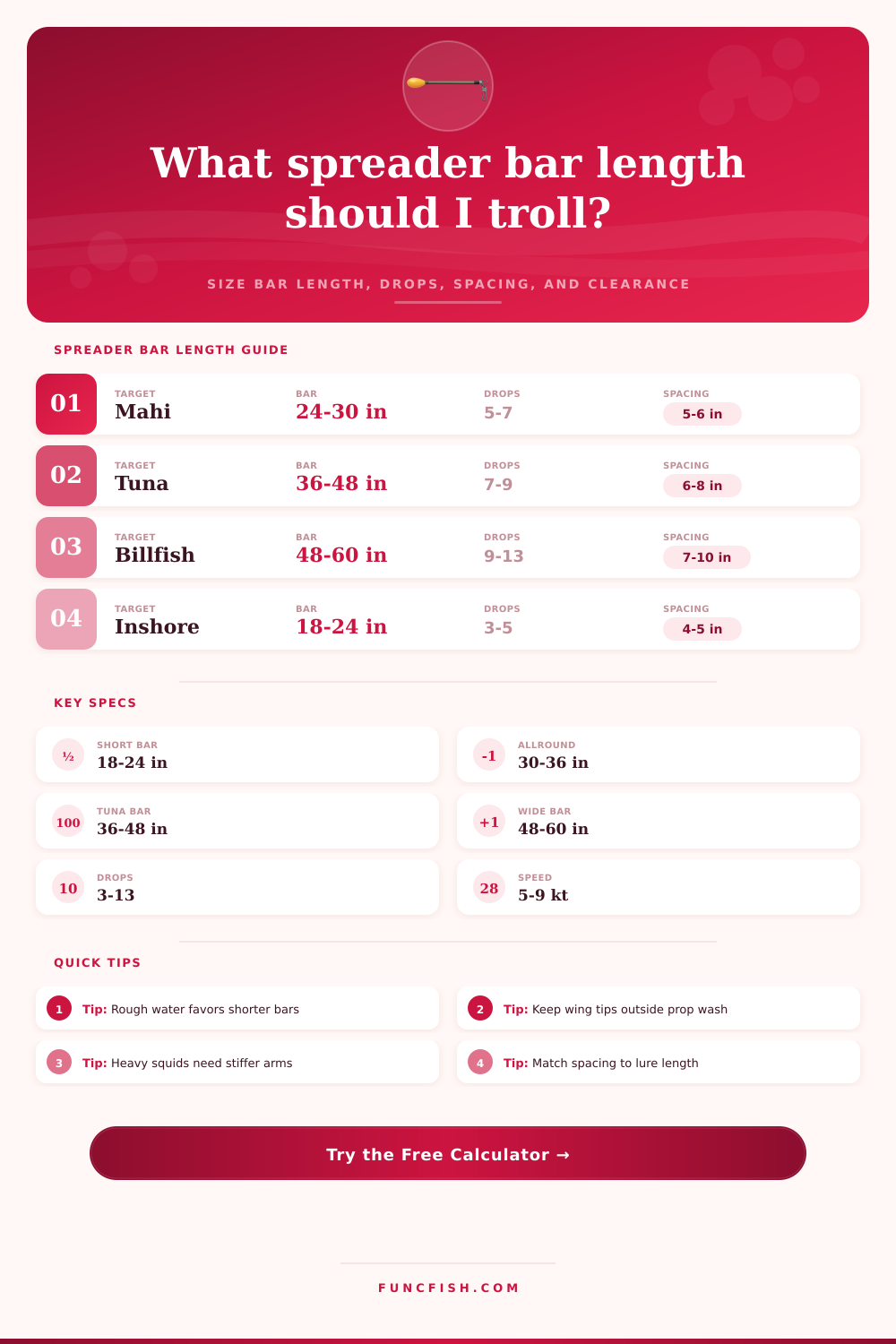
| Mini inshore | 18-24 in / 46-61 cm | 3-5 | 4-5 in / 10-13 cm | Bonito, albies, striped bass |
| Mahi bar | 24-30 in / 61-76 cm | 5-7 | 5-6 in / 13-15 cm | Mahi, small yellowfin, skipjack |
| Standard tuna | 36-42 in / 91-107 cm | 7-9 | 6-8 in / 15-20 cm | Yellowfin, school bluefin, albacore |
| Heavy tuna | 42-48 in / 107-122 cm | 9-11 | 7-9 in / 18-23 cm | Bluefin, big yellowfin, rougher troll |
| Billfish teaser | 48-60 in / 122-152 cm | 9-13 | 8-10 in / 20-25 cm | Sailfish, white marlin, blue marlin tease |
🐟Species and gear matching table
| Species group | Common lure size | Bar length range | Trolling speed | Rig note |
|---|---|---|---|---|
| Bonito / false albacore | 2-3.5 in / 5-9 cm | 18-24 in / 46-61 cm | 5.5-7.5 kt | Small profile, tight V, light tow load |
| Striped bass / bluefish | 4-6 in / 10-15 cm | 24-36 in / 61-91 cm | 3.5-5.5 kt | Heavier bunker or shad teasers pull more |
| Mahi / dorado | 4-6 in / 10-15 cm | 24-36 in / 61-91 cm | 6-8 kt | Bright squid chains can run wider |
| Yellowfin tuna | 5-8 in / 13-20 cm | 36-48 in / 91-122 cm | 6.5-8.5 kt | Use stiffer bar when birds are added |
| Bluefin tuna | 6-10 in / 15-25 cm | 42-60 in / 107-152 cm | 5.5-7.5 kt | Keep heavy splash bars inside rod capacity |
| Sailfish / marlin teaser | 7-10 in / 18-25 cm | 48-60 in / 122-152 cm | 6.5-8.5 kt | Wide teaser face, often hookless |
| Wahoo high speed | 4-7 in / 10-18 cm | 24-36 in / 61-91 cm | 9-14 kt | Compact, stiff, and low-drag rigging |
📐Spacing and drag reference table
| Teaser body | Body length | Minimum spacing | Clean spacing | Drag tendency |
|---|---|---|---|---|
| Small squid | 2-4 in / 5-10 cm | 3.5 in / 9 cm | 4.5-5.5 in / 11-14 cm | Low |
| Medium squid | 5-7 in / 13-18 cm | 5.5 in / 14 cm | 6.5-8 in / 17-20 cm | Moderate |
| Large shell squid | 8-10 in / 20-25 cm | 8 in / 20 cm | 9-11 in / 23-28 cm | High |
| Bird teaser | 4-8 in / 10-20 cm | 6 in / 15 cm | 8-12 in / 20-30 cm | High splash |
| Baitfish softbait | 4-7 in / 10-18 cm | 5 in / 13 cm | 6-8 in / 15-20 cm | Medium |
⚓Tow position reference table
| Tow position | Usual bar length | Wake clearance | Sea-state fit | Adjustment |
|---|---|---|---|---|
| Flatline clip | 18-36 in / 46-91 cm | 1-3 ft / 0.3-0.9 m | Calm to moderate | Shorter leader, tighter V |
| Short outrigger | 30-48 in / 76-122 cm | 2-5 ft / 0.6-1.5 m | Calm to rough | Standard offshore setting |
| Long outrigger | 36-60 in / 91-152 cm | 4-8 ft / 1.2-2.4 m | Calm to moderate | Wider bars and teaser face |
| Down-sea corner | 24-42 in / 61-107 cm | 2-4 ft / 0.6-1.2 m | Rough and quartering sea | Add stiffness, shorten bar |
🛠Target comparison grid
Mahi Spread
24-36 inBright 5-7 drop bars with moderate spacing raise fish without excessive pull on small outriggers.
Tuna Spread
36-48 inSeven to eleven drops create a larger bait ball profile for yellowfin and school bluefin trolling.
Billfish Teaser
48-60 inWide bars and large squids build a visible commotion when used as hookless dredge-style teasers.
Rough Water
24-42 inShorter stiff bars track cleaner and reduce wing slap when the boat rolls through quartering seas.
💡Calculator notes
Spacing tip: If the spacing-to-lure ratio falls below 1.05, the outer teasers can overlap during turns. Increase spacing or drop count only after the calculated bar length still fits your tow position.
Load tip: The pull estimate rises with speed squared, so a bar that trolls clean at 6 knots can overload clips or fold soft arms at 9 knots with the same teaser count.
I’m sure you’ve witnessed this scenario on any chartered fishing trip where they believe they know more than the laws of physics. A giant six-foot long bar goes flying into the water, filled to the brim with a dozen large bird teasers. As the vessel crests a wave, the entire contraption fold like an overfilled beach umbrella. Hooks intertwine, the spread disintegrates and the fish flee in terror. This wasn’t bad luck. This was simple math. The fish were never the issue; rather, it was the math involved based off the rigging.
Spreader bars is kind of a give and take. On one side, you’d like some width for a good visual profile and to get your teasers well away from prop wash. But on the other, you need enough stiffness so they don’t slap against the hull when boat rolls. With the above calculator, you can plug-in your specific set of conditions and let someone else do the math. That way you’re not guessing at drag estimates and coefficients; you’re forced to think through actual constraints of your rigging instead of choosing by how something might look cool in shop.
How to Pick the Right Spreader Bar
First thing: What are you targeting? Mahi will come up to the bait and respond better to moderate speeds and bright colors. The area covered isn’t so much that it creates too much drag. Five to seven drops on a bar in the twenty-four to thirty-inch range is typicaly sufficient.
Conversely, tuna swim fast and deeper. They want more of a display in front of them. Often this mean a wide bar that is thirty-six to forty-eight inches. This gives them multiple options all at one time. For those of us fishing for billfish, we’re basically constructing a distraction factory. Marlin and sailfish is curious critters. They’ll check out big commotion from afar, and those bars can grow as long as sixty inches.
As important as the bar’s length is what it’s made from. You can get away with light fiberglass if you’re using small lures on calm water, but put a heavy bird on there at high speed and it will buckle. Bars made from titanium or some sort of mixed material (hybrid) has more spring resistance and can take heavier loads before bending permanently. The bar is like the suspension system that holds your lures in place. You want it to be rigid enough to stand up to the wake and current. It should of be flexible enough to absorb shock, but not too much.
The variable least considered by most folks, until it’s too late, is sea state. A long bar turns the boat’s roll into a lever action. This increase the force on the outside wings, forcing them to either smack against the hull or transom. The fish spook from your line. As you’ll see in the reference tables, a shorter bar is always recommended in rough water. Why? There’s a tradeoff here. You sacrifice some spread width for stability but maintain a tighter setup with less movement of the center of mass from the tow point.
Another common mistake is amount of space between the drop-backs. When a fish bites, or they turn around, all those teasers gets fouled up on top of each other if they’re too closely spaced. Leave enough room that each drop back can wiggle free from the others. About one and a half times length of the lure in between hooks is a good rule of thumb. That way it’s a clean presentation with each teaser swinging its own tail. The calculator will do that check for you and let you know if spacing is too close for the lure size you’ve chosen.
The speed is the difference. The velocity squared equals drag. In other words, if you bump up the number of knots by one increment, it exponentially increases the tension on your clips and tow lines. What might have been a perfect run on a bar at six knots will be a nightmare at nine knots pulling as hard as it does on the same count of teasers. That’s why some bars is so rigid and small while others are so wide and flexible. On high-speed trolling like yellowfin or wahoo, you’re sacrificing visual spread for mechanical strength.
Finally it’s all about having the proper set up. It is not necessarily about having the most lures or the longest string, but about what will last in the conditions and put a good lookin’ face on the bait for the fish. You need to find the magic number of what you can have out there without losing any form and yet still make enough commotion to draw strikes. When everything swims free and your bar runs true, then it gets good. Then it’s time to go fishing.