Swimfeeder Weight Calculator
Estimate empty feeder size, loaded casting weight, bottom holding margin, and rod compatibility from distance, flow, bait load, feeder pattern, line, and bed grip.
🎯Fast Swimfeeder Presets
⚙️Feeder Setup Inputs
Swimfeeder Weight Result
Calculation Breakdown
📏Feeder Style Data Used
Open Plastic
Wire Cage
Blockend
Gripper River
📊Weight Range Reference
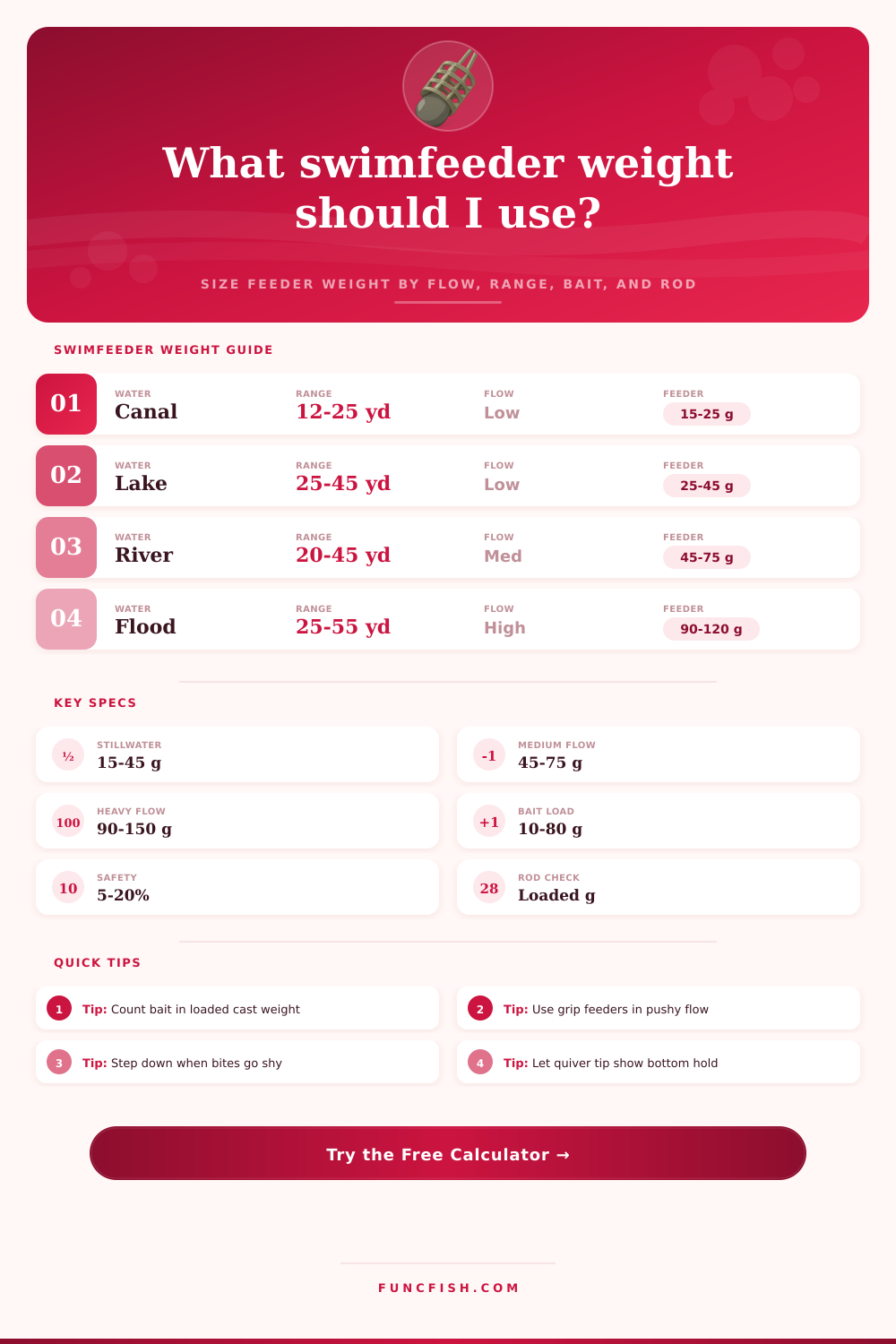
| Condition | Flow / Range | Common Empty Feeder | Loaded Weight Check | Best Feeder Style |
|---|---|---|---|---|
| Short canal swim | 0-0.15 m/s, 10-25 m | 15-25 g / 0.5-0.9 oz | 25-50 g loaded | Blockend or small open-end |
| Commercial carp lake | Stillwater, 20-45 m | 25-45 g / 0.9-1.6 oz | 55-100 g loaded | Flat method or inline method |
| Natural lake bream | Light tow, 30-55 m | 35-60 g / 1.2-2.1 oz | 70-125 g loaded | Wire cage or bullet cage |
| Medium river glide | 0.35-0.65 m/s, 20-45 m | 45-80 g / 1.6-2.8 oz | 80-145 g loaded | Open-end or gripper |
| Barbel pace | 0.65-0.95 m/s, 25-55 m | 75-120 g / 2.6-4.2 oz | 120-190 g loaded | Gripper river feeder |
| Floodwater crease | 0.95-1.35 m/s, 25-60 m | 110-180 g / 3.9-6.3 oz | 170-260 g loaded | Large gripper or heavy cage |
🐟Species And Rig Matching Grid
| Target | Typical Feeder Size | Line Strength | Rod / Tip Range | Payload Style |
|---|---|---|---|---|
| Roach and dace | 15-30 g / 0.5-1.1 oz | 1.4-2.7 kg / 3-6 lb | Light feeder, 0.75-1.5 oz tip | Small maggot or crumb load |
| Skimmers | 20-40 g / 0.7-1.4 oz | 1.8-3.2 kg / 4-7 lb | Light-medium feeder, 1-2 oz tip | Fine groundbait and pinkies |
| Bream | 35-70 g / 1.2-2.5 oz | 2.7-4.5 kg / 6-10 lb | Medium feeder, 1.5-3 oz tip | Groundbait, pellet, caster |
| Tench | 30-60 g / 1.1-2.1 oz | 3.2-5.4 kg / 7-12 lb | Medium feeder, 2-3 oz tip | Method mix or chopped worm |
| Commercial carp | 30-80 g / 1.1-2.8 oz | 3.6-6.8 kg / 8-15 lb | Method feeder, 2-4 oz tip | Pellet method or wafters |
| Chub | 35-90 g / 1.2-3.2 oz | 3.6-6.8 kg / 8-15 lb | Avon feeder, 2-4 oz tip | Bread, pellet, meat crumb |
| Barbel | 70-150 g / 2.5-5.3 oz | 4.5-8.2 kg / 10-18 lb | Heavy feeder, 3-6 oz tip | Dense pellets and hemp |
🧰Feeder Type Comparison
Blockend
Neat loadBest for maggots, casters, and small feed where bait release matters more than range.
Wire Cage
Fast washGood for groundbait release, but flow can push the open mesh more than a compact feeder.
Flat Method
Stable bedCompact profile helps stillwater accuracy and keeps hookbait tight to the feed pile.
Gripper
River holdRaised ribs and mass improve grip when a normal cage rolls or taps downstream.
📝Rod Rating And Line Drag Reference
| Rod Class | Feeder Rating | Comfortable Loaded Range | Typical Mainline | Use Case |
|---|---|---|---|---|
| Light quiver | 30-45 g / 1-1.6 oz | 20-40 g loaded | 1.4-2.7 kg / 3-6 lb | Canals, drains, short silverfish work |
| Medium feeder | 60-90 g / 2.1-3.2 oz | 45-80 g loaded | 2.7-4.5 kg / 6-10 lb | Lakes, skimmers, bream, light rivers |
| Method feeder | 80-120 g / 2.8-4.2 oz | 70-110 g loaded | 3.6-6.8 kg / 8-15 lb | Commercial carp and tench method rigs |
| Heavy feeder | 120-180 g / 4.2-6.3 oz | 100-165 g loaded | 4.5-8.2 kg / 10-18 lb | Barbel, big chub, strong river flow |
| Extra-heavy river | 180-250 g / 6.3-8.8 oz | 150-230 g loaded | 6.8-9.1 kg / 15-20 lb | Floodwater, large grippers, meat feeders |
💡Calculation Notes
Loaded weight matters: a 45 g method feeder carrying 45 g of damp pellet is a 90 g casting load before water pickup, so compare loaded weight with the rod rating.
Flow changes fast: if the tip slowly pulls round or the feeder bumps downstream after settling, recalculate with the next flow band or add more safety margin.
Grip beats mass: on gravel or stone, a shaped gripper can hold better than a heavier smooth cage because it resists rolling.
Presentation check: when bites become delicate, reduce payload first, then feeder mass, while keeping enough hold margin to leave the rig still.
When swim feeder fishing, there’s a certain type of silence that follows a perfect cast. When you make the cast, you let it sit until line gets tight and tip settles down and the fish will either take it or leave it.
Understanding how heavy to rig your bait so that you hold your ground begins before you even pick up your rod. There are three things you need to hold your ground against: the wind, the current, and the pull of riverbed. Once you enter your details, the page does the math for you. That way you don’t have to do any guesswork with converting and coefficients. Now you just concentrate on fish instead of physics of lead.
How to Choose the Right Feeder Weight
Many anglers will consider only blank weight of feeder. This is wrong. A cage that weigh sixty grams may sound reasonable, but it adds forty grams of moist groundbait, maggots and pellets. You now have a one-hundred-gram loaded casting weight. This can bends rods not meant for such task, make accurate casts difficult, or cause an aching arm after extended use. By adding the weight of the unloaded feeder and the bait, it show the full picture and allows you to plan for what hits the water instead of simply what stays in the box. It also provides a safety margin for unexpected changes in flow or wind direction.
The variable that will ruin more swims than bad bait choices ever will is flow. In stillwater, you can get away with smaller feeders as gravity hold them in place. But a river adds drag, which fights each and every gram of lead you want to plant there. So when you plug flow speed into the calculator, it factor in the additional force required to keep your rig in place without letting it drift out of the swim.
Sometimes grip is more important than mass. Shape matters more then weight when it comes to staying put. You may need a gripper feeder with raised ribs to stay firm on stony bottom even at fifty grams; whereas a smooth wire cage of the same weight may roll downstream like a wheel. The bed type reference table tells you exactly how to choose a feeder style based off the conditions.
Similarly with action and weight, the farther out you want to cast, the greater the power demand. Throwing 40 yards take more momentum than 10 feet over your head. This momentum means stiffer actions at the top of rod or heavier leads. For instance if you’re trying to catch some deep-water bream, you want enough weight to penetrate the water column fast and have a hookbait that doesn’t float off while falling to bottom. The calculator consider your distance and depth to make sure you’ll have a large enough feeder to make the journey. And it compares against your rod’s casting rating so you don’t go too light and fail to cover the ground effectivly, or go too heavy for your rig.
The other factor here is seasonality. If it’s winter, those fish are going to be shy and slow. They’ll get spooked if an oversized feeder drop down and splashes too loud or kicks up enough silt over their heads. You may have to use much lighter line and weight than you would when it was warm out. You should of present your bait more lightly. And the tool has presets for scenarios like small river dace or winter skimming, which will automatically dial back the expected weights. It serves as a reminder that angling is an exercise in adaptation rather than stubborn persistence with whatever worked last month.
Feeder fishing is a delicate balance between subtlety and control. Too little weight and you lose control; too much weight and you override the bite signal or intimidate the fish. This tool provides a foundation of physics for your given conditions, a starting place for you to get out on the water. Then you go from there, tweaking as the tip responds.
Steady movement in one direction typically means you’re probably not holding them well enough. It is stiff and non-responsive even when things are happening around it. Maybe you’re over-feeding or too heavy of a lead for the fishs comfort zone.
So the key to all this is really in the knowledge of what you’re measuring. Yes, use some weight, but more importantly, get the bait planted exactly where the fish want it and hold it there long enough for them to make up their minds. Whether you are on a running river or even a flat, calm canal, that combination makes the difference between a fun day out and a day filled with frustration. A well weighted feeder anchors your approach, letting you dial down to the bites while staying rooted enough to put the fish in the boat with conviction. This level of control is the difference between the occasional caster and the reliable angler. Making careful considerations on the bank pays dividends with a fully loaded keepnet.