
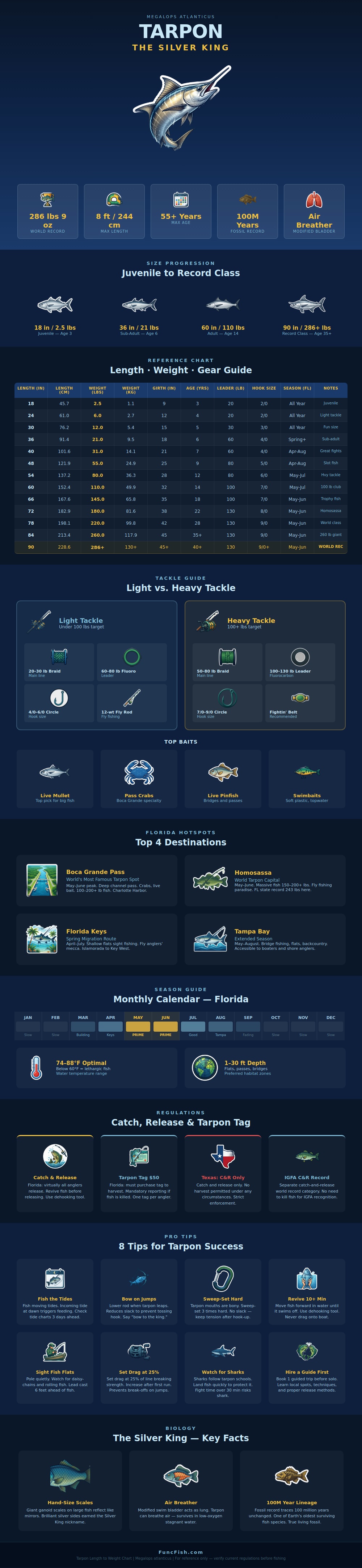
For tarpon anglers, we all has our own level of stress that accompanies every hook up. That’s not the part that causes anxiety. It’s when the rod flexes out, when the two-hundred pound monster takes off and starts reeling in a few thousand yards of line. Anglers is familiar with the chart numbers, yet most simply read them as a red flag for their tackle.
Understanding the correlation between length and weight are important for getting those measurements right. That data is what decide if you catch a fish or let one get away. But their growth doesn’t follow a straight line. It’s clear from this chart that they grows exponentially. Sure, a 36 inch tarpon is around 21 pounds and that sounds reasonable. But then double the size to 72 inches, and now you’re pushing triple the amount of weight than before. Once past sub-adult stage the fish bulk up rapidy and push into the two hundred pound class.
How to Catch and Release Tarpon
While you might be able to initially land a forty pounder on light tackle, sustained pressure against a two hundred pound bull require more then the same leader strength and drag setting. The physics simply won’t allow it. Anglers is split when it comes to gear options here in Florida, but as usual, it depends on your targeted size class. According to data, there seem to be a definitive cutoff at the hundred pound mark.
If it’s below a hundred pounds, you’re good. Go ahead and break out the thirty-pound braid or even a twelve-weight fly rod. It’ll have enough sensitivity to feel those subtle take while having strength needed for their first few runs. But above a hundred pounds? Everything change. You’ll want some big hooks capable of staying buried in those bone-jawed fish. You will also need abrasion resistant leader to endure the harsh teeth of the gills. Going after record-class tarpon on light tackle doesn’t necessarily mean you has what it takes; it just means you’ve got a boatload of money riding on the outcome and you’re willing to gamble on your expensive equipment.
Because they are ectothermic, tarpon behavior depend as much on timing as it does on tackle. As the water warms up from May through June the fish will seek out shallow water and start feeding aggressively. That’s why places such as Boca Grande Pass gets famous around that time period. Tidal flow combined with warm water make for a feeding frenzy that brings the fish off of the deeper offshore channels and into shallows where shore angler and flats skiff fishermen can reach them. Outside of that window, the fish stay either sluggish or move too deep to see them easy. Chasing the fish in cold water isn’t very fun because they just don’t want to eat.
Because of the slow reproductive rate of these species, catch-and-release is necessary for their survival. To match this, conservation ethics has changed the way you approach this battle. After a fight, reviving the fish require patience. Driving off while throwing the fish in the water wouldn’t of cut it. The fish need to be kept horizontal in the current and eased slowly forward as it regains function of its gills before swimming off on its own power. It can take a few minutes, even up to ten minutes, but that’s what separates a catch that benefits the ecosystem from one that hurts it.
You need to know when it’s time to go big. Catching a Tarpon is all about respecting their biology as well as the limitations of your equipment. These charts are your starting point; this is where your experience will teach you to adjust. It doesn’t matter if you’re after a world-record giant or a juvenile sub-adult; it’s still the same game. Hook up deep, fight smart, and release strong to make sure the king rules the flats another day. By doing this, you’ll know the next generation of anglers will be waiting there for that familiar flash of silver against the shore.