🐟 Tiger Musky Weight Calculator
Estimate tiger musky weight from length & girth — instant results in lb & kg
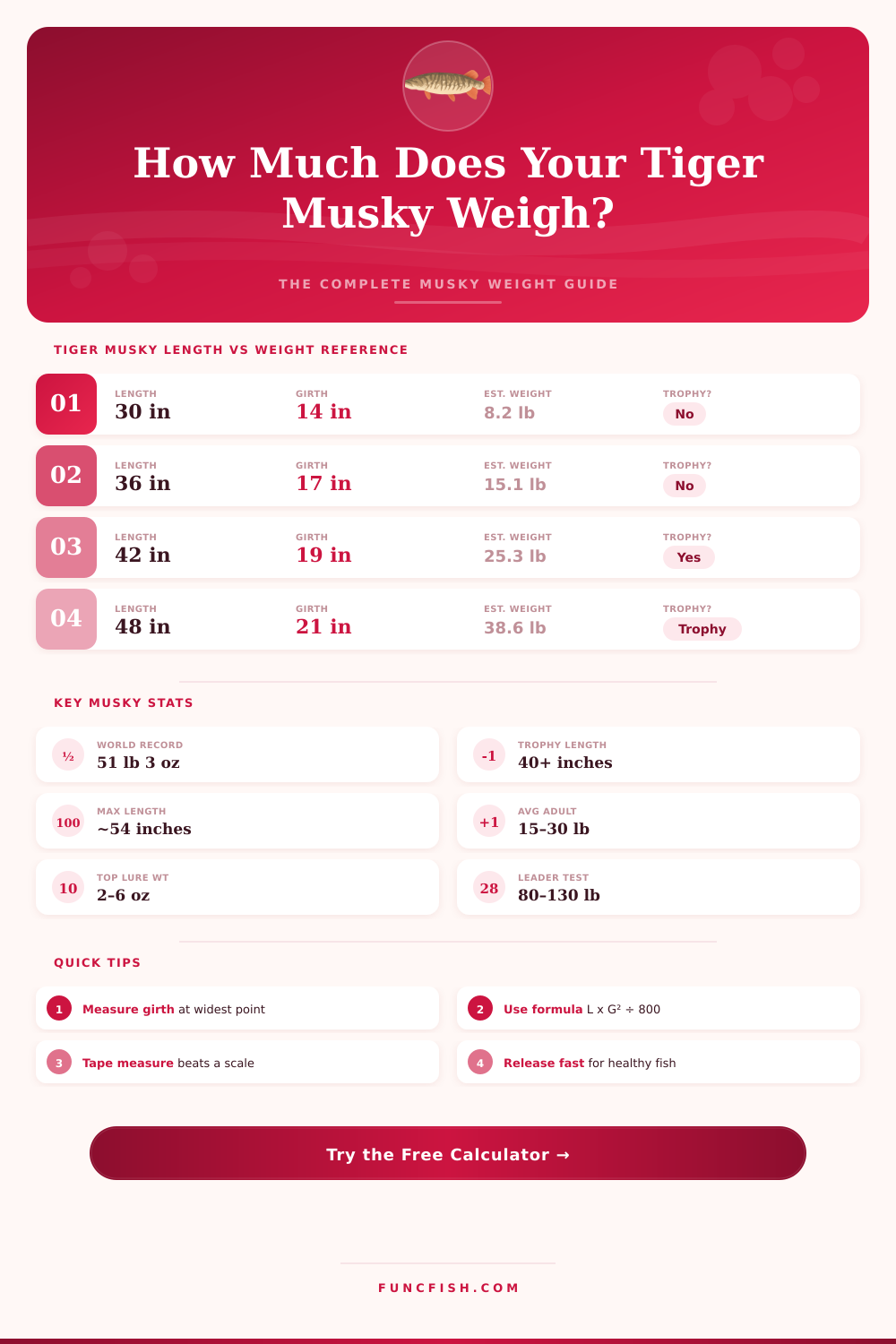
| Length (in) | Length (cm) | Avg Girth (in) | Est. Weight (lb) | Est. Weight (kg) | Classification |
|---|---|---|---|---|---|
| 24 | 61.0 | 11.5 | 3.8 | 1.72 | Sub-Legal |
| 28 | 71.1 | 13.0 | 5.9 | 2.68 | Sub-Legal |
| 30 | 76.2 | 13.8 | 7.1 | 3.22 | Legal (some states) |
| 34 | 86.4 | 15.5 | 10.2 | 4.63 | Keeper |
| 36 | 91.4 | 16.5 | 12.3 | 5.58 | Keeper |
| 38 | 96.5 | 17.0 | 13.7 | 6.21 | Keeper |
| 40 | 101.6 | 17.8 | 15.8 | 7.17 | Trophy |
| 42 | 106.7 | 18.5 | 17.9 | 8.12 | Trophy |
| 44 | 111.8 | 19.5 | 20.9 | 9.48 | Trophy |
| 46 | 116.8 | 20.0 | 23.0 | 10.43 | Trophy |
| 48 | 121.9 | 20.8 | 25.4 | 11.52 | Mega Trophy |
| 50 | 127.0 | 21.5 | 28.8 | 13.07 | Mega Trophy |
| 52 | 132.1 | 22.0 | 31.2 | 14.15 | Mega Trophy |
| Formula | Variables | Divisor | Best For | Accuracy |
|---|---|---|---|---|
| Standard Musky | L x G² | 800 | True Muskellunge | ±8% |
| Pike / Tiger | L x G² | 700 | Tiger Musky (chunkier) | ±7% |
| Esox Regression | Length only | Regression coeff. | Quick field estimate | ±12% |
| Simple Length Curve | Length only | Avg girth assumed | No girth tape available | ±15% |
| Species | Avg Adult (lb) | Trophy (lb) | Max Length (in) | Rec. Leader (lb) |
|---|---|---|---|---|
| Tiger Musky | 10–30 | 25+ | ~54 | 80–130 |
| Muskellunge | 15–36 | 30+ | ~60 | 80–130 |
| Northern Pike | 5–20 | 20+ | ~52 | 60–100 |
| Chain Pickerel | 1–4 | 6+ | ~30 | 20–40 |
| Redfin Pickerel | 0.2–1 | 1.5+ | ~16 | 10–20 |
| Fish Size | Rod | Reel / Line | Leader | Lure Wt. |
|---|---|---|---|---|
| Under 30" (<7 lb) | MH 7'0" | 3000 / 20lb braid | 30lb wire | 1/2–1 oz |
| 30–36" (7–13 lb) | H 7'6" | 4000 / 30lb braid | 50lb wire | 1–2 oz |
| 36–42" (13–20 lb) | XH 8'0" | 5000 / 65lb braid | 80lb wire | 2–4 oz |
| 42–48" (20–30 lb) | XXH 8'6" | 6000 / 80lb braid | 100lb wire | 3–6 oz |
| 48"+ (30+ lb) | XXH 9'0" | 8000 / 100lb braid | 130lb wire | 4–8 oz |
Determining the weights of a tiger musky can be a difficult task because of the way the fish’s body is composed of the features of two different species. Tiger muskys has the body shape of a pike and musky hybrids. The fish have the length and slim body of a northern pike, but possess the deep and muscular shoulders of a musky fish.
Due to these different features of a tiger musky, the length of the fish are not a good indicator of it’s weight. For instance, two tiger muskys may have the same length but one may weigh more considerabl than the other. A tiger musky that have eaten several servings of oily fish may weigh more than a fish that has eaten little food.
How to Estimate the Weight of a Tiger Musky
The most important measurement of a tiger musky is its girth, or the circumference of its belly. This measurement is important in calculating the weight of the fish because the girth is squared in the mathematical formula for the weight of the tiger musky. Additionally, another important measurement is the shoulder depth of the fish.
Measuring the depth at the fishs shoulder indicate whether the fish is a slim species or a deep-bodied species. This measurement is necessary for accounting for the body shape of the fish. There is also environmental factors that affect the weight of the tiger musky.
Two environmental factors that impact the weight are the temperature of the water in which the fish lives and the type of food that its diet contains. Tiger muskys that eat alot of food will be denser and heavier than those that eat little foods. Tiger muskys that have just spawned their eggs may be thinner than those that are at the peak of their weight for the year.
These factors must be consider to accurately estimate the weight of the fish. The forage type and the temperature band can be used to adjust the weight estimation. The way in which a tiger musky is measured can also lead to inaccuracies in the estimation of its weight.
For example, if the fish is curved, the measurement may not be accurate if you measure it while the fish are curved. The weight will be under estimated if the fish is curved rather than flat on the measuring board. Using a confidence setting for the measuring tool will provide an estimation of the weight of the tiger musky in the form of a range of weight rather than a single weight measurement.
Using this confidence setting will provide a more accurate estimation of the weight of the fish if the measurement were rushed. Accurately estimating the weight of the tiger musky can be of great help to the fisherman. For example, a tiger musky that weighs forty pounds will exert more pressure on the fishing leader than a tiger musky that weighs twenty pounds.
Thus, by knowing the weight of the fish, the angler can better determine whether the fishing gear will be strong enough to hold the fish. Many fisherman may use the standard formula for musky fish, but there is a different formula for tiger muskys because of the different rates at which tiger muskys grows. The formula that should of be use is the tiger musky formula.
By measuring the girth, the depth of the shoulder, and the diet of the tiger musky, it is possible to produce an estimation of its weight.