🚛 Trailer Weight Distribution Calculator
Calculate tongue weight, axle loads, and weight distribution hitch settings for safe towing
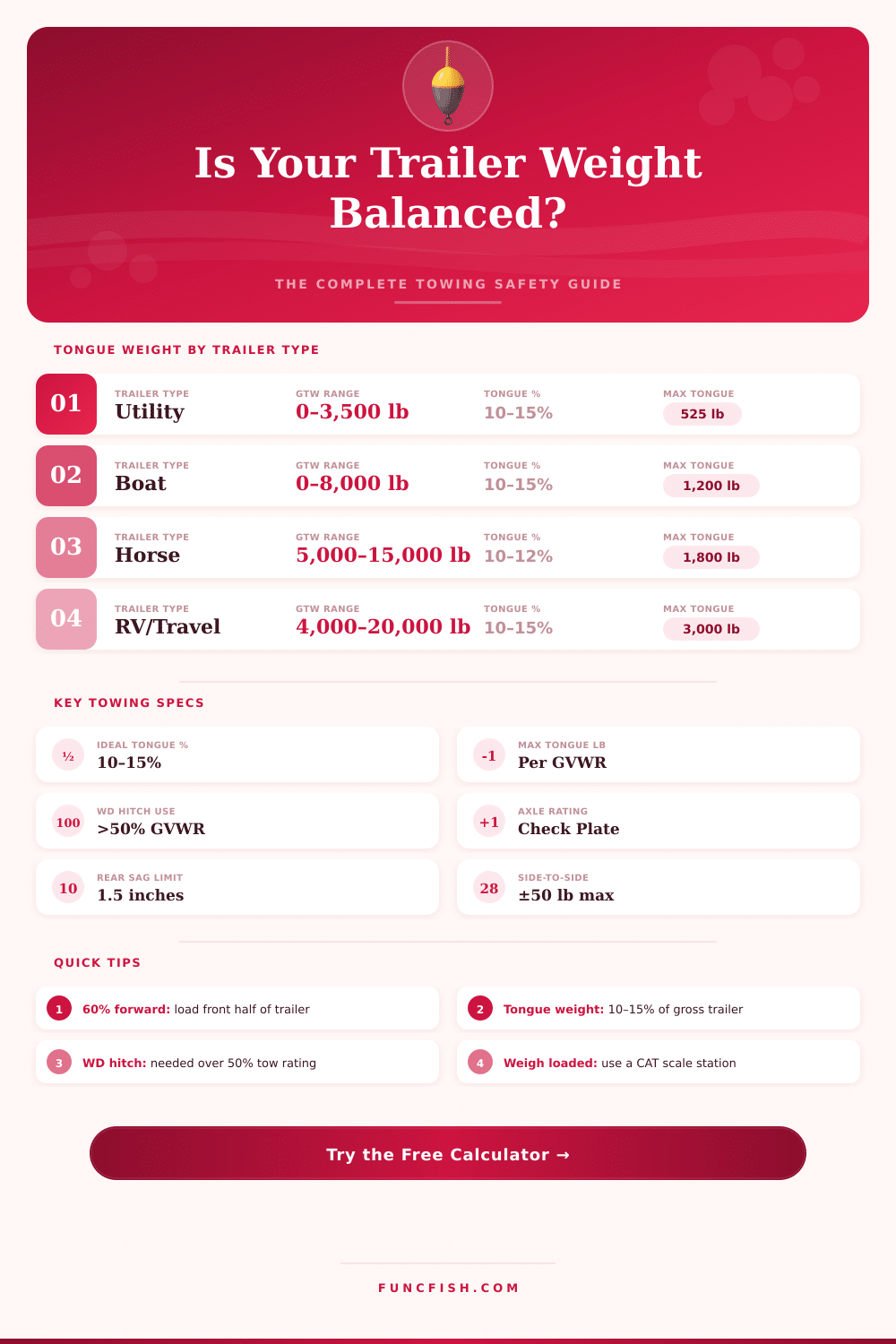
| Trailer Type | Typical GTW Range | Tongue Wt % | WD Hitch Needed? | Safety Factor |
|---|---|---|---|---|
| Utility / Open | 500 – 3,500 lb | 10–15% | Rarely | 1.25x |
| Boat Trailer | 1,000 – 8,000 lb | 10–15% | Above 5,000 lb | 1.3x |
| Travel Trailer | 3,000 – 15,000 lb | 10–15% | Above 6,000 lb | 1.35x |
| Fifth Wheel | 8,000 – 25,000 lb | 18–25% | N/A (integrated) | 1.4x |
| Horse Trailer | 4,000 – 16,000 lb | 10–12% | Above 8,000 lb | 1.5x |
| Enclosed Cargo | 2,000 – 10,000 lb | 10–15% | Above 6,000 lb | 1.3x |
| Car Hauler | 3,500 – 12,000 lb | 10–15% | Above 6,000 lb | 1.35x |
| Dump Trailer | 4,000 – 14,000 lb | 10–14% | Above 8,000 lb | 1.4x |
| Flatbed | 2,000 – 10,000 lb | 10–15% | Above 6,000 lb | 1.3x |
| Toy Hauler | 6,000 – 18,000 lb | 10–15% | Yes (typically) | 1.4x |
| Hitch Class | Max GTW (lb) | Max Tongue Wt (lb) | Receiver Size | Typical Use |
|---|---|---|---|---|
| Class I | 2,000 | 200 | 1.25 in | Compact cars, small loads |
| Class II | 3,500 | 350 | 1.25 in | Sedans, small SUVs |
| Class III | 8,000 | 800 | 2 in | Most trucks & SUVs |
| Class IV | 14,000 | 1,400 | 2 in | HD trucks, large trailers |
| Class V | 18,000+ | 2,700+ | 2.5 in | Commercial, heavy duty |
| Fifth Wheel | 25,000 | 6,250 | Bed-mounted | Large RVs, heavy trailers |
| Gooseneck | 30,000+ | 7,500+ | Bed ball | Commercial, livestock |
| Pintle Hook | 60,000+ | Varies | Lunette ring | Military, heavy commercial |
| GTW (lb) | Tongue Wt (lb) | WD Head Angle | Bar Tension | Recommended WD |
|---|---|---|---|---|
| 4,000 – 6,000 | 400 – 900 | 2–3° | Light | Optional |
| 6,000 – 9,000 | 600 – 1,350 | 3–5° | Medium | Strongly Recommended |
| 9,000 – 12,000 | 900 – 1,800 | 5–7° | Heavy | Required |
| 12,000 – 16,000 | 1,200 – 2,400 | 6–8° | Very Heavy | Required + Sway |
| 16,000+ | 1,600+ | 8–10° | Max | Fifth Wheel / GN |
Get the right weight of your trailer is absolutely critical when you tow anything. The gross trailer weight, or GTW, if you want to be precise, is made up of the trailer itself, your cargo, fuel, and everything else you filled. But here is the main point: it does not matter how heavy it is but where that weight actually sits on the trailer
Front loading alters everything. Want around 60% of your load before the trailer axle and the other 40% or less behind it. Heavy objects in the lead help for stability and strongly stop trailer sway.
How to Balance Your Trailer for Safe Towing
It is not always possible to center everything perfectly, so do not care about that, simply keep heavy stuff away from the two ends of the trailer. Weight in the lead differs from weight at the rear when dealing with handling. The hitch itself operates as a second pivot, that gives better control for heavy loads instead.
Usually simply spreading the objects equally works well and ends the task.
Moreover tongue weight deserves attention. Want around 10% of the total trailer weight on the tongue itself. Some use scales between 10 and 15 percent, that is the ideal.
Do not ignore side-to-side balance, because uneven loading can destroy tires and mess up steerinng.
If you omit good weight distribution, you risk problems. Fishtailing can start in low speeds, if the load is wrong. Overloading specific spots quickly exhaust bearings and make tires wear unevenly.
Here weight distribution with a hitch genuinely helps. Instead of focusing tongue weight at the hitch spot, the system spreads it across both trailer axles and the axles of the vehicle. The hitch pole up can raise the back end and move weight forward.
The whole system keeps the hitch parallel to the way. It is strange to understand that, but it is incredibly useful, and almost no one uses it.
Drive in highway speeds feel much more flat when the hitch works well. Some install it only for long journeys and leave it off for cities. For lightweight trailers, say, 3500 pounds…
Weight distribution maybe does not require. In little rigs sway control is most important. Fifth wheels do not require that, either.
A common mistake is pushing objects backwards on the trailer, thinking that helps weight distribution. That commonly fails and lightens the tongue, which causes sway back. The trailer should sit level when it is attached to the truck (that shows that balance is good).