⚡ Trolling Motor Charge Time Calculator
Calculate exactly how long to charge your trolling motor battery based on capacity, depth of discharge, and charger output.
| Motor Thrust | Voltage | Max Amp Draw | Approx. Watts | Est. Runtime (100Ah) |
|---|---|---|---|---|
| 30 lbs (133 N) | 12V | 30A | 360W | ~3.3 hrs @ 100% |
| 40 lbs (178 N) | 12V | 42A | 504W | ~2.4 hrs @ 100% |
| 55 lbs (245 N) | 12V | 52A | 624W | ~1.9 hrs @ 100% |
| 70 lbs (311 N) | 24V | 42A | 1008W | ~2.4 hrs @ 100% |
| 80 lbs (356 N) | 24V | 56A | 1344W | ~1.8 hrs @ 100% |
| 101 lbs (449 N) | 24V | 62A | 1488W | ~1.6 hrs @ 100% |
| 112 lbs (498 N) | 36V | 52A | 1872W | ~1.9 hrs @ 100% |
| 160 lbs (712 N) | 48V | 56A | 2688W | ~1.8 hrs @ 100% |
| Scenario / Species | Typical Motor | Avg Speed Used | Est. Battery Use/Day | Recommended Capacity |
|---|---|---|---|---|
| Bass Lake Tournament | 55–80 lb, 24V | 60–70% | 70–90% DoD | 2x 100Ah AGM |
| Walleye / Night Fishing | 45–70 lb, 12V | 40–60% | 50–60% DoD | 100–120Ah AGM |
| Crappie / Panfish Pond | 30–45 lb, 12V | 25–40% | 20–40% DoD | 50–75Ah AGM |
| Inshore Saltwater | 55–112 lb, 24V | 50–80% | 60–80% DoD | 100–200Ah Lithium |
| Kayak Fishing | 30–55 lb, 12V | 30–50% | 30–50% DoD | 50–100Ah Lithium |
| River Striper | 80–112 lb, 36V | 60–90% | 80–100% DoD | 3x 100Ah AGM |
| Musky / Pike Casting | 80–101 lb, 24V | 50–70% | 60–75% DoD | 2x 100Ah AGM |
| Trout Lake Drift | 30–55 lb, 12V | 20–40% | 20–35% DoD | 75–100Ah AGM |
| Charger Output | AGM (90% eff.) | Lithium (98% eff.) | Flooded (82% eff.) | Charger Type |
|---|---|---|---|---|
| 5A | ~11.1 hrs | ~10.2 hrs | ~12.2 hrs | Basic Trickle |
| 10A | ~5.6 hrs | ~5.1 hrs | ~6.1 hrs | Standard Marine |
| 15A | ~3.7 hrs | ~3.4 hrs | ~4.1 hrs | Fast Marine |
| 20A | ~2.8 hrs | ~2.6 hrs | ~3.0 hrs | High-Speed Marine |
| 25A | ~2.2 hrs | ~2.0 hrs | ~2.4 hrs | Pro Fast Charger |
| 30A | ~1.9 hrs | ~1.7 hrs | ~2.0 hrs | High-Output Pro |
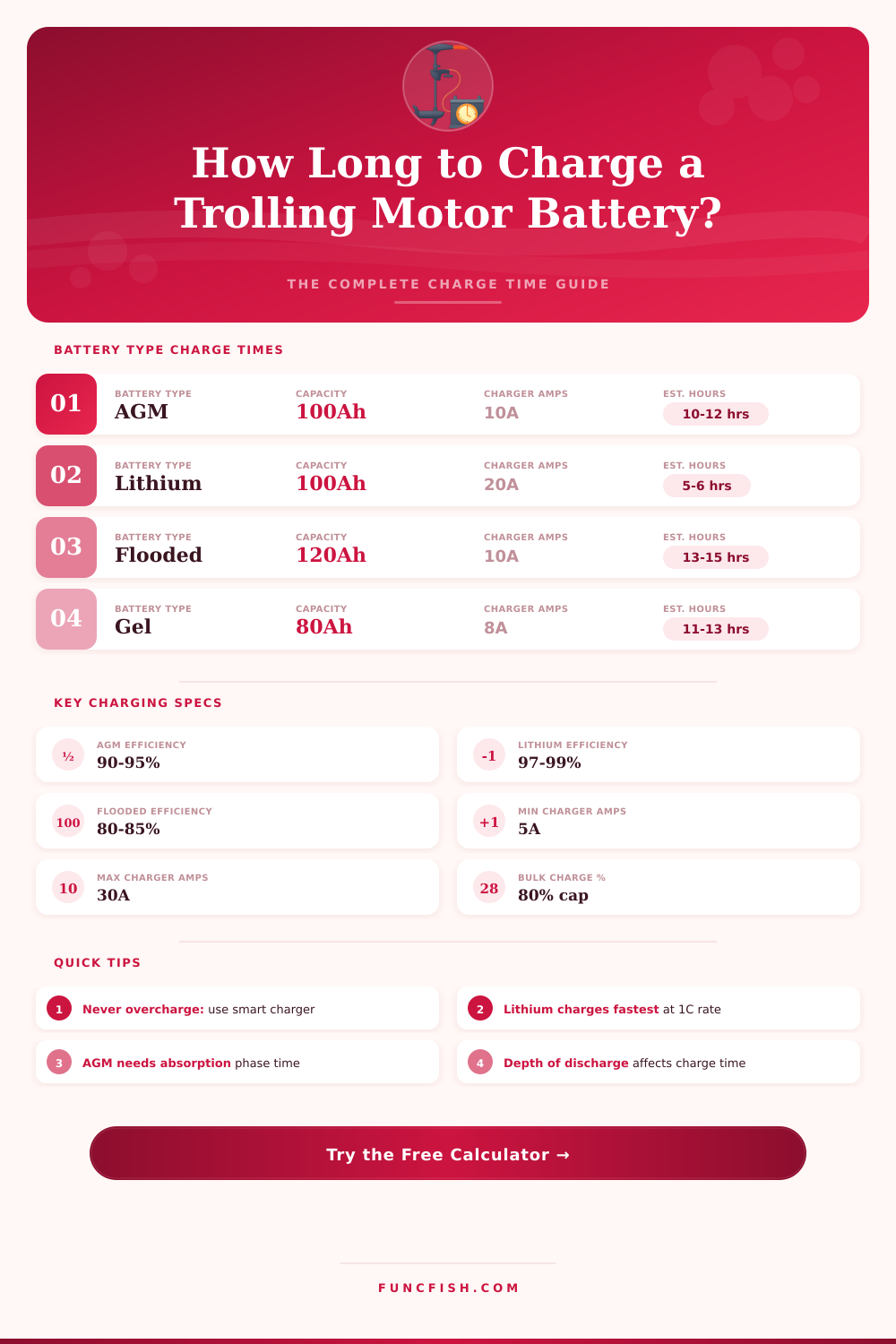
Calculating battery charge time require an understanding of many variable. The charge time for batteries cannot be calculated by dividing the battery amp hours by the charging amps of the battery charger. Many factor impact battery charge time, and if these factor are not accounted for, it is possible that you will calculate a battery charge time that dont reflect the actual charge time required to fully charge the batteries.
One of the major factor that affect battery charge time is the chemistry of the batteries. Lead acid batteries go through an absorption stage once they reaches approximately 85% charge. During this stage, the batteries accepts less current, which leads to a longer charge time for the batteries.
5 Things That Affect Battery Charge Time
In contrast, lithium batteries does not have this absorption stage and accept high charging current for a much longer period of time until they reaches approximately 96% charge. The temperature at which the batteries is charged also impact the charge time for both lead-acid and lithium batteries. At approximately 75 degrees Fahrenheit, batteries accept the charging current more smooth.
If the batteries are charge to temperatures below 45 degrees Fahrenheit, the lead-acid batteries accept the charging current at a much slower rate, which increase the battery charge time by 20% or more. If the temperatures rises to above 90 degrees Fahrenheit, lead-acid batteries begin to gas in the flooded battery cell. Lithium batteries are more forgiving of high temperatures but are still within a critical temperature range for optimal charge acceptance.
Another factor that impact battery charge time is battery age. New batteries will accept the charging current at a higher rate than older batteries. Due to the aging of the batteries, they may have lost some of their charging capacity.
A battery bank that has lost 15% of its charge capacity will have different charging considerations then a battery bank that is new. Additionally, if batteries is connected in series to create a battery bank, the battery bank will have to wait until the weakest battery reaches full charge before the battery bank will be considered fully charged. Another important variable to consider is the type of charger that will be use to charge the batteries.
If a true per-bank battery charger is used, each battery bank will receive the full amperage at the same time. A per-bank charger will reduce the charge time for the batteries. If a user uses a charger with a shared output charger, the amperage will be divided between the battery banks.
Using a 20A shared-output battery charger to charge two batteries will only provide 10A to each battery bank. This shared-output charger will take longer to charge the batteries than a per-bank charger. Portable battery chargers that provide 12V charges batteries in sequence, meaning that the batteries will take much longer to charge using a portable 12V battery charger than an onboard battery charger.
Another consideration for battery charge time is the depth of discharge of the batteries. Under normal use of the trolling motor, the batteries will typically discharge to between 40% and 50% charge. Under heavy use, the battery will discharge to a lower percentage of its state of charge.
Deep cycle lead-acid batteries should not be discharge to below 50% state of charge to avoid the formation of lead sulfate crystal on the plates of the batteries. Deep cycle lithium batteries can be discharged to 10% state of charge. However, the state of charge must be known to calculate the battery charge time.
Finally, the type of equipment used to connect the battery charger to the batteries can impact the charge time of the batteries. Using long extension cords to connect the battery charger to the batteries can create a voltage drop. The voltage drop will make the charging process less efficient and create a longer battery charge time.
Therefore, five factor must be accounted for when calculating battery charge time: battery chemistry, battery temperature, battery age, battery charger type, and length of charging cord.