⚡ Trolling Motor Wire Gauge Calculator
Find the correct wire gauge for your trolling motor — enter your amps, wire run length, and voltage system for a safe, code-compliant recommendation.
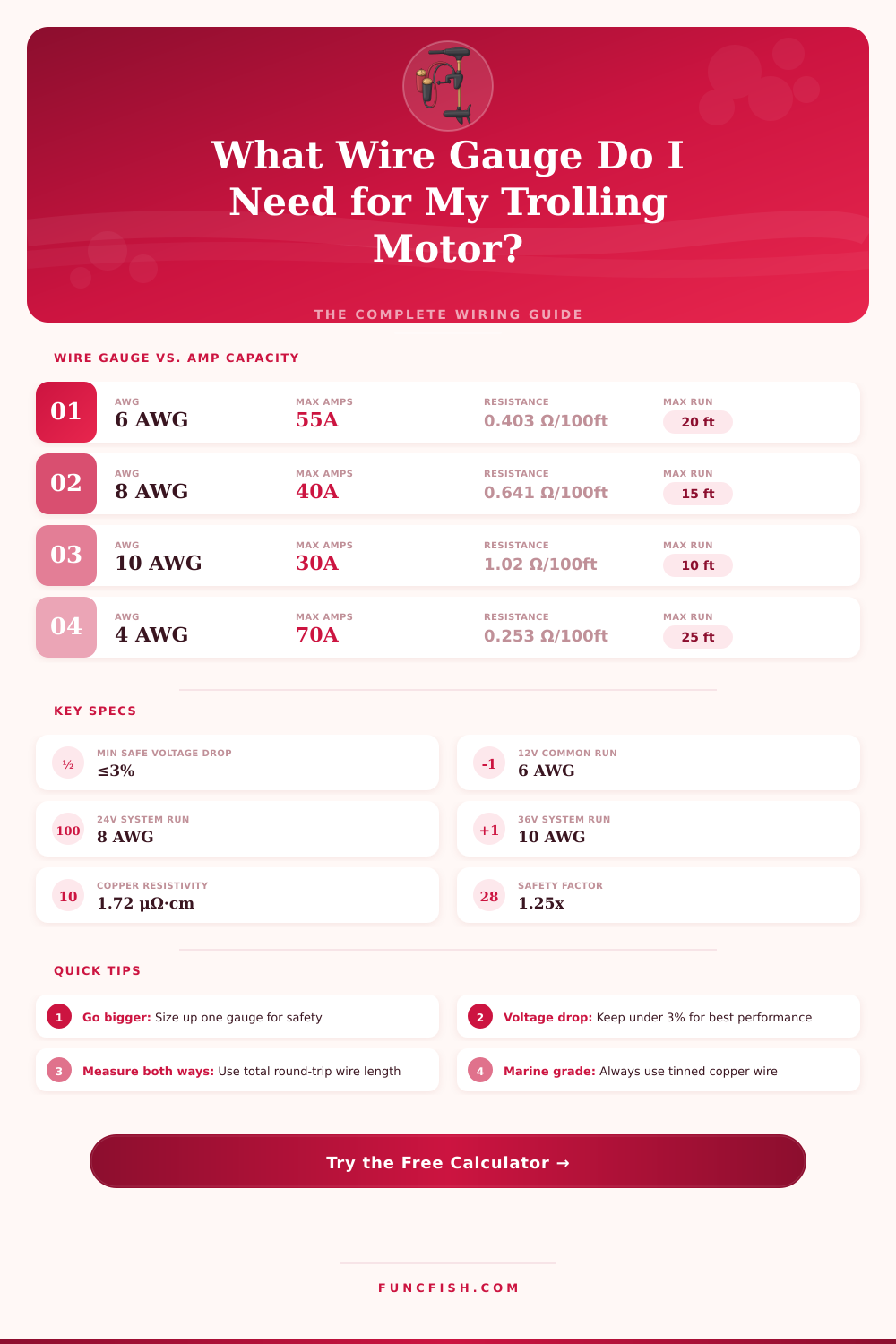
| AWG Gauge | Diameter (mm) | Area (mm²) | Resistance (Ω/100ft) | Max Amps (Open Air) | Max Amps (Conduit) | Typical Motor Thrust |
|---|---|---|---|---|---|---|
| 2 AWG | 6.54mm | 33.6mm² | 0.159 Ω | 95A | 85A | 112lb+ @12V |
| 4 AWG | 5.19mm | 21.2mm² | 0.253 Ω | 70A | 60A | 101–112lb |
| 6 AWG | 4.11mm | 13.3mm² | 0.403 Ω | 55A | 45A | 70–80lb |
| 8 AWG | 3.26mm | 8.37mm² | 0.641 Ω | 40A | 32A | 55–62lb |
| 10 AWG | 2.59mm | 5.26mm² | 1.02 Ω | 30A | 24A | 30–45lb |
| 12 AWG | 2.05mm | 3.31mm² | 1.62 Ω | 20A | 16A | Up to 25lb |
| Boat Type | Motor Thrust | Voltage | Typical Amps | Recommended AWG | Max Run Length (ft) |
|---|---|---|---|---|---|
| Kayak / Canoe | 30 lbs | 12V | 26A | 10 AWG | 12 ft |
| Small Jon Boat | 45 lbs | 12V | 34A | 8 AWG | 10 ft |
| Jon Boat / Aluminum | 55 lbs | 12V | 42A | 6 AWG | 15 ft |
| Bass Boat | 80 lbs | 24V | 56A | 6 AWG | 18 ft |
| Pontoon (Mid) | 101 lbs | 36V | 65A | 4 AWG | 22 ft |
| Pontoon (Large) | 112 lbs | 36V | 52A | 6 AWG | 20 ft |
| Offshore / Deep V | 112 lbs | 36V | 52A | 4 AWG | 25 ft |
| Wire Type | Resistivity Factor | Corrosion Resistance | Marine Rating | Notes |
|---|---|---|---|---|
| Tinned Copper (Marine) | 1.72 μΩ·cm | Excellent | ⭐ Best | ABYC standard – always use marine grade |
| Bare Copper | 1.72 μΩ·cm | Good | ⭐⭐ Good | Will corrode in saltwater over time |
| Oxygen-Free Copper (OFC) | 1.68 μΩ·cm | Excellent | ⭐ Excellent | Slightly better conductivity than standard |
| Aluminum | 2.82 μΩ·cm | Fair | ⚠️ Not Recommended | ~1.64x more resistance – size up 2 gauges |
Voltage drop are a technical problem that occurs with trolling motors whose electrical wires is either too thin or too long. When the wire is too thin or too long, voltage drop occur in the trolling motor because the resistance of the wire reduce the amount of electricity that reach the motor. As a result of the reduced electricity reaching the motor, the trolling motor lose thrust, the steering begin to lag, and the spot lock feature of the motor begin to drift.
Voltage drop isnt a problem with the battery or the motor, but a problem cause by the electrical wiring of the trolling motor. The math behind electrical resistance are important to understand in relation to trolling motors. The electricity have to travel from the battery to the motor, and from the motor back to the battery bank.
Why Voltage Drop Happens in Trolling Motors
Thus, the length of the wire have to be doubled in relation to the distance the electricity must travel. For instance, if the distance from the battery bank to the motor is 16 feet, the electricity will travel 16 feet to the motor, and 16 feet from the motor back to the battery bank for a total of 32 feet. Furthermore, 12-volt trolling motors are much more sensitive to voltage drop then 36-volt trolling motors because there is less headroom for the 12-volt system to compensate for the voltage loss from the wire resistance.
The length of the wire run need to be considered carefully when wiring a trolling motor. The length of the wire run will determine the gauge of the wire that are required for the trolling motor. The length of the boat does not necesarily have to be measured, but the length of the wiring run from the battery bank to the trolling motor do.
The wiring run may have to go around some trays or electrical breakers on the boat, which would add to the length of the wire. Additionally, each connector used in the wiring will create a small voltage drop. If many connector are used, the voltage drop will increase.
Thus, the more voltage drop that is created, the less power that will be delivered to the motor. The duty cycle of the motor should also be considered. Motors that are use for spot lock in areas that are exposed to the wind will draw more electricity than motors that are use for drifting in calm areas.
Thus, the wire should be thick enough to handle the electricity draw of the motor when in heavy use. Using a wire that is too thin for the trolling motor will cause the wire to become hot, and create a voltage drop. The material of the wire should also be considered.
Using tinned copper wire is one way to reduce the voltage drop in the trolling motor. Tinned copper wire resist corrosion caused by the spray from the water, and it remain flexible. Avoid using wires that are likely to corrode.
Additionally, the ambient temperature in the boat should be considered because high temperatures increase the resistance of the wire. If the ambient temperature in the boat is high, the wire will have to be thicker to compensate for the increased resistance that will result from the heat. There are calculation tools online that can calculate the gauge of wire that is need for a trolling motor of a certain size.
These calculations is based off the voltage drop that is targeted for the trolling motor, and the ampacity of the wire. Using this tool will allow the boat owner to determine the wire gauge that will prevent voltage drop from the motor, and prevent the wire from overheating. Additionally, you should measure the voltage to the motor to ensure that it recieve the correct voltage from the battery bank while under a load.
Finally, using the correct gauge of wire will allow the trolling motor to maintain its thrust and steering control.