
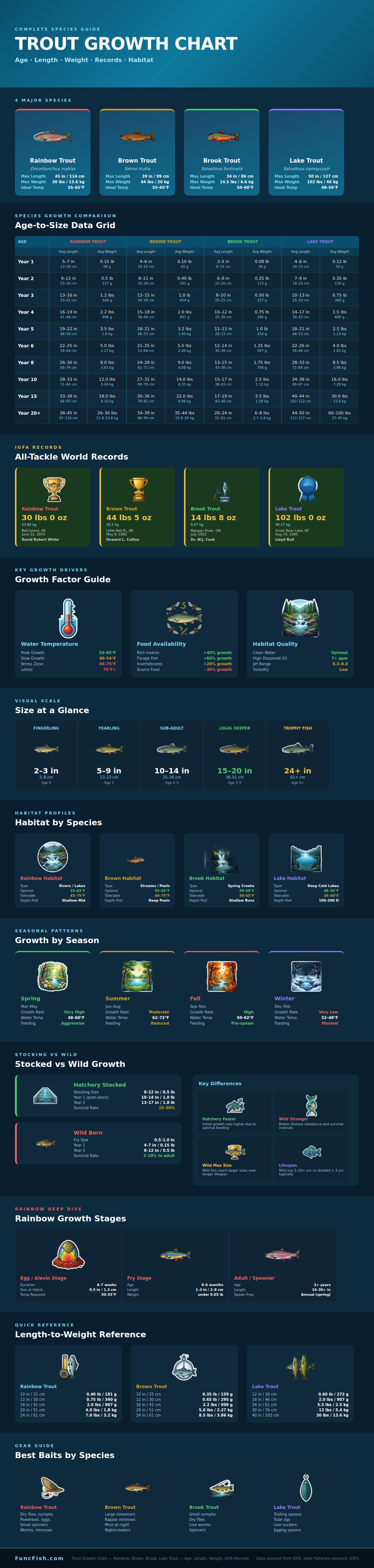
How big are the fish? Many anglers concentrate on where the fish live without considering the size fish should be for their age. So, many folks go fishing expecting something unreal while becoming frustrated because it doesn’t work out as hoped. After four hours on a mountain stream, you may have caught three doubles that resemble appetizers more then trophies.
Your lure-rod skills aren’t necessarily the issue; it’s typically just a lack of understanding what the trout can and cannot do based off their environment and their life timeline. Remember, the trout don’t grow according to your schedule. They grow according to a genetic-food-water temperature equation. Knowing that equation will change the choices you make in tackle and how you approaches each trip.
Why Fish Grow Different Sizes
Brown trout, brook trout, rainbow trout and lake trout is all very distinct species with different lifespans as well. Rainbow trout are sprinters; a sprinter among salmonids. If there is any opportunity at all, they hit the ground running and they’re often keepers by their third to fifth year of life.
Brown trout play a long game. They dawdle along and add inches well past their second decade of life, so they holds many world records for weight.
Then we have the brook trout that thrive in those spring-fed headwater streams with their cold water. Time just kind of slows down up there, and a 15-inch brook trout can be considered a monster among its peers even if it weigh only a few pounds.
Lake trout are an entirely different story. They’re deep-water predators and takes decades to get to their full potential. Don’t expect to apply the same standards to them as you would a stream rainbow.
This is all fueled by one master switch: temperature. When the water temperature reaches between fifty-five and sixty-five degrees Fahrenheit, metabolic rates skyrocket. Because fish are cold blooded animals, their digestive systems relies only on surrounding heat. When the water gets too cool, their bodies starts saving energy by shutting off metabolism. You might make the most perfect drift pass a trout’s nose, but at less than fifty-degree water, that fish doesn’t have the biological machinery to digest your offering. He’s not being picky; he’s just being efficient.
As the summer warms, this equation changes once more. Too many high elevation streams gets too warm for active trout. Instead of feeding aggressively, they hole up in deep pools or shade to loaf.
That’s another wrinkle in the puzzle, the nature of wild versus stocked fish. Hatchery raised trout leave the tank already heavily fed up from a diet of high-protein pellets and enter the water with a major leg-up on wild born fry. Immediately following stocking, they appear to be impressive specimens. But under natural conditions, including predation and having to compete with other natural forage, their growth rates soon level off.
The wild-born fish start out as little more than an inch long. It’s a cruel gauntlet they must of run during their first year of life, with only those who consume the most food surviving into the next spring. They gain stronger bodies and instincts, growing slower in the early years but frequently catching up and eventually exceeding their stocked counterparts by maturity due to their adaptation to the particular challenges of their native water.
The second half is choosing the correct species based on seasonality. Each time of year brings its own unique burst of activity. Insects hatch in spring, bringing renewed life, followed by fish prepping for their breeding duties. Then there’s fall, which sees another flurry of action as fish load up for winter. Summer sees them get lazy and winter finds them nearly comatose.
If you know they’re actively packing on weight you can target bigger ones with greater efficiency. The fish are more likely to be willing to work for it. You may throw a beefier bait or fish a different body of water during the times they’re most active.
To conclude. Finding these secret trout ponds has nothing to do with finding a big trout. It’s all about knowing the biology and sticking within those boundaries. If the habitat doesn’t allow them to get bigger, then they won’t. Targeting old water that gives the fish room and time to mature will pay off in catching trophy sized brown or lake trout. Knowing who lives in your body of water will help you read the environment and understand what livig there.