Vacuum Seal Fish Storage Life Calculator
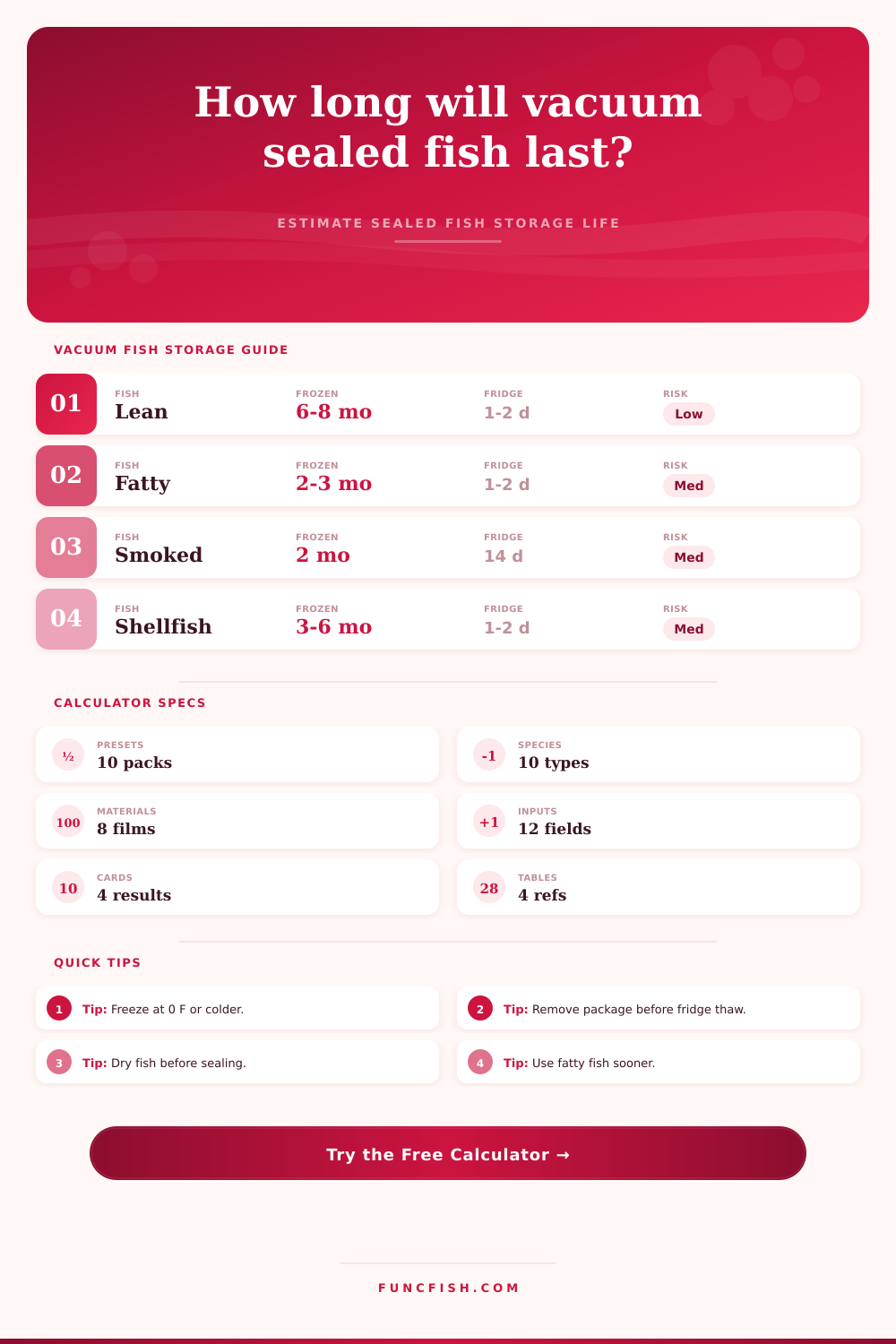
Estimate a practical quality window for vacuum sealed fish by species, package film, storage temperature, cut shape, seal condition, and days already stored.
For raw vacuum packed fish, this is a quality-life estimate. If fish is thawing in the refrigerator, remove it from the vacuum package first unless the processor label gives specific safe instructions.
Storage life estimate
Lean white fish
Cod, haddock, sole, pollock; low oil slows rancidity.
Fatty fish
Salmon, tuna, mackerel; flavor changes faster.
High barrier film
Best oxygen barrier for long frozen storage.
Weak seal risk
HighAir pockets, liquid in seal, or pinholes shorten life.
| Species group | Examples | Baseline freezer quality | Vacuum model range | Main limiter |
|---|---|---|---|---|
| Lean white fish | Cod, haddock, pollock | 6 to 8 months | 180 to 285 days | Freezer burn and dehydration |
| Flatfish | Halibut, sole, flounder | 6 to 8 months | 170 to 275 days | Thin edges dry faster |
| Moderate oil fish | Trout, snapper, grouper | 3 to 6 months | 105 to 225 days | Flavor and surface oxidation |
| Fatty fish | Salmon, tuna | 2 to 3 months | 70 to 160 days | Oil rancidity |
| Very oily fish | Mackerel, bluefish | 2 to 3 months | 55 to 120 days | Strong flavor shift |
| Shellfish | Shrimp, scallops | 3 to 6 months | 95 to 210 days | Drip loss and texture |
| Material | Barrier score | Best use | Adjustment | Watch item |
|---|---|---|---|---|
| Standard embossed pouch | 72 / 100 | Short to medium frozen storage | Neutral | Channel texture can trap moisture |
| Heavy embossed pouch | 80 / 100 | Portions with bones or edges | Small gain | Seal liquid carefully |
| Chamber vacuum pouch | 86 / 100 | Flat fillets and shellfish | Good gain | Needs clean seal bar |
| High-barrier nylon pouch | 92 / 100 | Lean fish stored longest | Large gain | Still freeze quickly |
| Foil-laminate pouch | 96 / 100 | Long frozen hold and oily fish | Largest gain | Opaque pack needs labeling |
| Reusable zipper vacuum bag | 58 / 100 | Short frozen hold | Penalty | Valve leaks and air return |
| Embossed roll with two seals | 76 / 100 | Odd lengths and whole fish | Small gain | Two end seals must be flat |
| Thin bag or weak seal | 42 / 100 | Emergency short storage | Large penalty | Pinholes and oxygen ingress |
| Storage state | Temperature target | Model cap | Best suited packs | Calculator treatment |
|---|---|---|---|---|
| Deep freezer | -10°F to -20°F / -23°C to -29°C | Up to 1.18x frozen baseline | Long hold, high barrier bags | Boosts quality life if stable |
| Standard freezer | 0°F / -18°C or colder | Normal frozen baseline | Most vacuum portions | Uses species baseline |
| Frost-free freezer | 0°F average with cycling | 0.82x to 0.92x baseline | Shorter planned storage | Applies cycling penalty |
| Superchilled | 30°F to 32°F / -1°C to 0°C | 2 to 4 days | Immediate processing | Caps as chilled storage |
| Refrigerated | 38°F / 3°C or lower for vacuum fish | 1 to 2 days raw | Opened pack or label-directed use | Flags thawing risk |
| Iced cooler | Near 32°F / 0°C | 1 to 2 days | Transport before freezing | Short hold only |
| Pack format | Typical size | Thickness | Life effect | Reason |
|---|---|---|---|---|
| Single fillet layer | 1 to 2 lb / 0.45 to 0.9 kg | 0.5 to 1.0 in / 1.3 to 2.5 cm | Neutral to good | Freezes quickly and seals flat |
| Thick loin pack | 1.5 to 4 lb / 0.7 to 1.8 kg | 1.0 to 2.0 in / 2.5 to 5 cm | Small boost | Lower exposed surface per pound |
| Bone-in steaks | 1 to 3 lb / 0.45 to 1.4 kg | 0.8 to 1.5 in / 2 to 3.8 cm | Small penalty | Edges can puncture thin film |
| Whole dressed fish | 2 to 8 lb / 0.9 to 3.6 kg | Variable | Penalty if slow frozen | Air pockets around cavity |
| Shellfish layer | 0.5 to 2 lb / 0.2 to 0.9 kg | Flat layer | Good if dry | Even surface, fast freezing |
| Mixed chunks | 1 to 5 lb / 0.45 to 2.3 kg | Uneven | Moderate penalty | Uneven voids trap air |
Pulling a vacuum sealed fillet from the freezer drawer, you expect to see rich pink flesh or clean white meat; instead you’re greeted with spongy, gray tissue that stinks just slightly chemical. It change fast, even with a steady temperature and the removal of oxygen, chemistry still moves in the dark, and while it’s preserved what remains, it went downhill. Home storage is the silent failure, and you might think if you remove oxygen, then time stands still, but the dark doesn’t stop chemistry. Enzymes degrades proteins, lipids oxidize, moisture migrates within the bag, and ice crystals forms that tear muscle fibers from inside out.
Plug in your seal quality and your species into the calculator up top, and it does the math for you, saving you from the guesswork about whether your trout are going to be any good in November. The amount of fat is the largest variable. There’s no drama when storing lean, white fish like haddock or cod that contains little-to-no oil, meaning they’re also slow to go rancid. If vacuum sealed, they’ll keep for six to eight months.
How to Keep Fish Fresh in the Freezer
Oily fish (e.g., tuna, mackerel, salmon) behave differently because their fats turns stale fast (even at zero degrees Fahrenheit). Vacuum bags eliminate air… but they don’t prevent fat molecules from interacting with the pack’s contents. It becomes a harsh tradeoff; fatty fish has a storage window of only two to three months. You have rich flavor now…but sacrifice the luxury of long term storage. Most folks fails to make this distinction and end up disappointed months down the road. They treat all fishes equally.
Most home cooks don’t know about the film barrier. Over time, even standard polyethylene lets some oxygen through and that little bit slowly seeps in. Good barrier materials like foil laminate or high barrier nylon blocks it nearly completely. A high barrier bag can mean the difference between eating your catch or throwing it away after a year of storage. The page has a clear reference table that shows the impact of choosing different materials based off their protection score. You won’t spend big bucks on bags for stuff to be eaten next week but if it’s going to sit a while, don’t skimp on cheap plastic. It is a small investment, but it pays off by preserving the texture.
The weakest link is seal integrity. Pinching, wrinkling, or wetting the seal edge defeats a perfect vacuum. Moisture in the seal channel eliminate a hermetic seal; air sneaks back inside where it allows bacteria to grow. Sounds simple, but patting the fish dry prior to sealing is essential. Next, the bag should be completely flat on the fish. Trapped air pockets are no-no’s. They’re hotspots for freezer burn. The calculator takes this into account, penalizing results based on weak film, or poor vacuums. It forces you to admit when your setup isn’t great.
Another danger involves thawing. Never thaw vacuum-sealed fish in the refrigerator while it is still sealed. When the temperature rise above freezing in an anaerobic environment, Clostridium botulinum bacteria will thrive and cause botulism. Unseal the bag then put the fish into the fridge for thawing. This one is a no brainer. Thaw in the fridge or under cold water. Nothing’s more important than your safety, convenience be damned.
The other factors are cut shape and pack size. Thinner fillets freeze more quickly and retain their integrity longer. Steaks with bones (puncturing thin bags) may cause micro leaks that destroy the vacuum seal. Whole fish has pockets of air in their cavities. This lowers the seal effectiveness. Meaty loins freeze slowly, forming larger ice crystals (cell damaging). The expectation should of been modified by the cut. While two equal sized bag of various cuts may appear identical, they don’t all last as long. It’s about quality, not just quantity.
What does quality mean? Different strokes for different folks, but there’s no denying that it deteriorates over time. Estimate your timeframe with the tool, but rely on your sense of smell to confirm or deny. When in doubt, don’t; if it stinks, it stinks. Numbers provide the countdown, while your senses deliver the ruling. Keep it cool, seal it shut and consume within the allotted time.