Wading Staff Length Calculator
Estimate a fishing wading staff length from angler height, water depth, current speed, footing, grip position, and staff construction.
📌Fishing wade presets
⚙Staff sizing inputs
Wading staff length result
Formula breakdown
📏Staff data grid
Most folding fishing staffs fall in this range for average-height anglers.
Shallow angles brace well but add length and upstream reach.
Rock uses less extra length than mud, sand, or soft silt.
Folding and telescoping staffs trade packed length for stiffness.
🎣Gear and species comparison grid
Round rock and pocket current usually reward a mid-length folding staff with a carbide tip.
Deep slots and winter layers call for extra grip height and a stable upstream plant.
Sand, wash, and trough edges favor a longer fixed or fiberglass staff with more tip set.
Soft mud and oysters need enough length to probe and brace without burying the handle.
📊Reference tables
| Staff construction | Usable length range | Packed behavior | Best fishing match |
|---|---|---|---|
| Folding aluminum wading staff | 44-59 in (112-150 cm) | Short sections, fast deployment, moderate stiffness. | Trout streams, steelhead runs, and mixed river wading. |
| Telescoping aluminum staff | 42-60 in (107-152 cm) | Adjustable length, longer collapsed size, good loaner option. | Variable shorelines where depth changes through the day. |
| Carbon trekking-style pole | 43-55 in (109-140 cm) | Light and packable, but less forgiving under side loads. | Clear flats, light trout water, and long walking approaches. |
| Fixed hardwood staff | 50-66 in (127-168 cm) | One piece, quiet feel, no joints, awkward on brushy trails. | Home rivers, bank edges, and anglers who want maximum feedback. |
| Long fiberglass surf staff | 55-70 in (140-178 cm) | Fixed or two-piece, strong in sand and surge. | Surf troughs, jetties, and wave-washed flats. |
| Compact pack staff | 39-52 in (99-132 cm) | Very short pack length with limited tall-angler range. | Backcountry creeks, kayak launches, and emergency backup use. |
| Water depth | Current speed | Typical angle | Length adjustment |
|---|---|---|---|
| Knee deep, under 20 in (51 cm) | 0-1 ft/s (0-0.3 m/s) | 12-15 deg | Usually no added length beyond comfortable grip height. |
| Thigh deep, 20-32 in (51-81 cm) | 1-2 ft/s (0.3-0.6 m/s) | 15-20 deg | Add moderate angle allowance for upstream probing. |
| Waist deep, 32-42 in (81-107 cm) | 2-3.5 ft/s (0.6-1.1 m/s) | 20-26 deg | Grip height and dry-handle clearance begin to control length. |
| Deep or pushy, over 42 in (107 cm) | 3.5-5 ft/s (1.1-1.5 m/s) | 24-30 deg | Round up and check that the selected staff actually reaches. |
| Surf trough or surge | Variable pulses | 24-32 deg | Use extra tip set because sand shifts during each wave. |
| Angler height | Low rib grip | Sternum grip | Common staff window |
|---|---|---|---|
| 5 ft 2 in (157 cm) | 32 in (81 cm) | 36 in (91 cm) | 46-52 in (117-132 cm) |
| 5 ft 6 in (168 cm) | 34 in (86 cm) | 38 in (97 cm) | 48-54 in (122-137 cm) |
| 5 ft 10 in (178 cm) | 36 in (91 cm) | 40 in (102 cm) | 51-58 in (130-147 cm) |
| 6 ft 2 in (188 cm) | 38 in (97 cm) | 42 in (107 cm) | 54-62 in (137-157 cm) |
| 6 ft 6 in (198 cm) | 41 in (104 cm) | 45 in (114 cm) | 58-66 in (147-168 cm) |
| Bottom type | Tip allowance | Angle effect | Staff note |
|---|---|---|---|
| Clean gravel | 1.0 in (2.5 cm) | Neutral | Good footing; the staff mainly provides rhythm and warning. |
| Round cobble | 1.5 in (3.8 cm) | Add 3 deg | More upstream reach helps test rolling stones before stepping. |
| Slab rock | 1.2 in (3 cm) | Add 4 deg | A sharper angle improves bracing on slick flat rock. |
| Mud or silt | 3.5 in (9 cm) | Subtract 1 deg | Extra length disappears into soft bottom during each plant. |
| Surf sand | 4.0 in (10 cm) | Add 5 deg | Longer staffs stay useful as wash pulls sand from the tip. |
| Icy ledge or winter edge | 1.8 in (4.6 cm) | Add 3 deg | Round up because clothing and stiff movement reduce reach. |
💡Staff sizing tips
In every wading outing, there’s probably going to be a time when you wish your staff were longer. The current tugs at your legs. Water is waist-deep. Your hand reaches out for purchase and it’s all empty air. No dramatic plunge here. It is just the brief jolt that comes when your foot skids over unseen gravel and your hand meets with nothing but chilly H2O.
That’s why getting the length correct are important; a staff is more than just a stick. It’s an extension of your center of gravity. If its length doesn’t hit the ground at proper angle, it’s no longer a lifeline. It’s a piece of useless baggage.
Why Staff Length Matters
So this calculator lets you run the math yourself. It take your water conditions and your height and spits out a concrete recommendation. But you can trust it once you understand why it matters.
How many times have you heard other anglers say they choose a staff according to how tall they are? The taller you are the longer the pole…pick one that touches your chest or armpit right? WRONG! Staff length isn’t just about how tall you are. Staff length also has to do with the geometry of the plant.
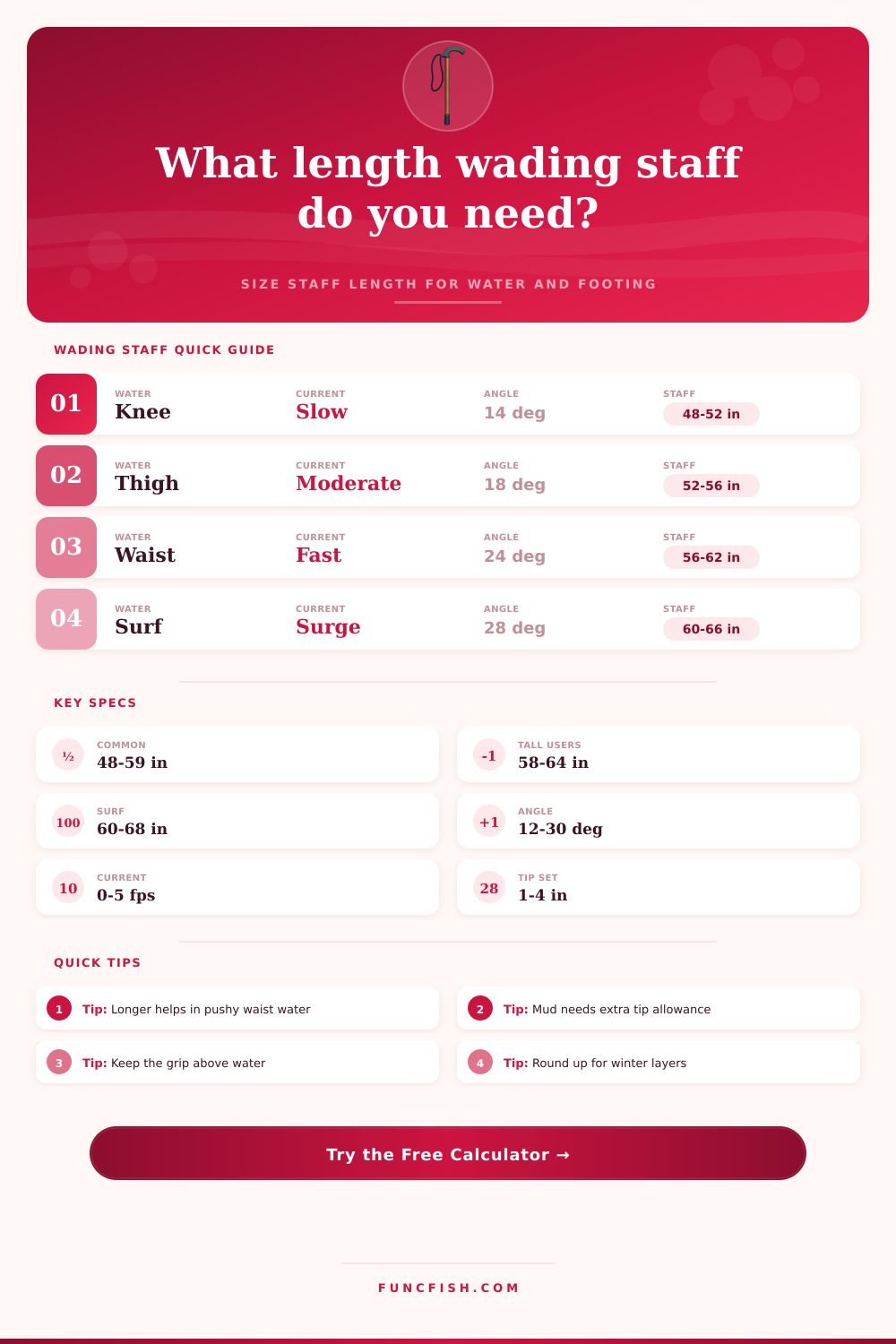
When bracing against current, you don’t hold your staff straight up in front of you. Instead, you plant it at some sort of an angle, between fifteen and twenty degrees upstream, to resist the lateral force trying to push you downstream. This means there is a lot more effective length to the shaft as it is planted in the current. For example, a fifty-two-inch staff held straight up will go into much less water than if that same staff were planted into the current at sharp angle.
To account for this, the tool asks for both current speed and target wading depth. It use depth as an indicator of how long the submerged section should be. Current speed determine the angle of planting required. A steeper upstream lean require a longer physical staff to ensure the tip remains planted. Your brace angle won’t be quite as steep when you’re wading knee deep pockets fishing slowly. You will need less length there.
But what if you cross a thigh-deep run where the flow is two feet per second? Now the math change. You must add some shaft to span the distance from your hand down to the bottom with that all important upstream lean. The beauty here is, the calculator converts those angles for you so you don’t of have to play trigonometry in your head in chilly water.
The rest of the equation hinges on foot type. In clean gravel, the bite from a staff with a carbide tip will give you solid footing while still not digging in too far. Not so with mud. Soft silt swallows up the tip of the staff and each time you reach down to plant it on another point, you’ll lose some of that usable shaft as it sinks before ever finding purchase.
To handle this, the calculator add a tip allowance depending on your bottom condition. For instance if you’re fishing sandy surf or marsh mud, it effectively tacks on inches to your recommended length to account for the sinkage. Again, it’s a small detail, but it help prevent the frustration of planting your staff only to have it sink into sludge at the exact moment you need balance.
Your comfort has some influence from construction style as well. Folding aluminum poles are popular because they pack up smaller, but the segmented joint may not feel as rigid as a single piece of fiberglass or hardwood under load. A telescoping option give you the ability to adjust if you’re fishing many different depth throughout the day. The chart on the page lays out how different constructions behave under pressure. That lightweight carbon trekking pole that could be perfect for slogging a lot of distance to remote flats may bend too far out on a strong river run. Stiffness vs. Portability. Use the calculator to understand whether the style you like can take the load your particular water conditions require.
People don’t think about other variables such as grip position either. In deeper water, for instance, you have more control and leverage by holding your staff higher up on your body. But you’ve changed the mechanical advantage as well. Someone with a high chest grip (versus one who holds theirs closer to the ribs) require a longer staff to get the same depth as the other person. With this tool, you can choose your favorite hand position and know your brace will work effective while keeping your arm comfortable. That is as much about comfort as it is about physics.
You want to feel stable. Reaching for a tool that is comically short or awkwardly long isn’t something you want. A wading staff is ultimately insurance for crappy footing. Something solid to concentrate on when the river wants to take you away. A way to plug your specific conditions in instead of guessing at generalized guidance so that the stick can do its job. That split second where you don’t slip out into empty space. From step one to cast number one; balance and confidence remain intact.