
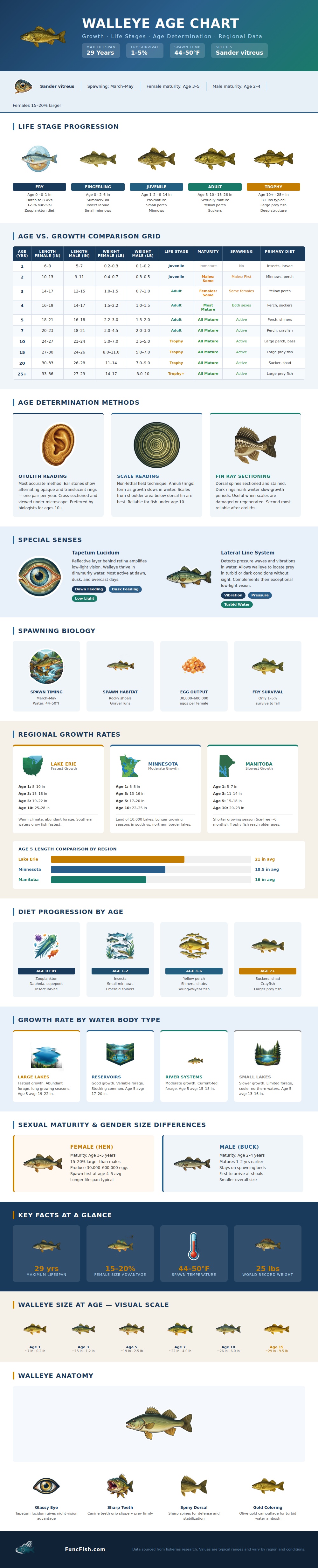
Where are the Walleyes? Walleye fishing has become mostly about the present moment. How deep should I be fishing? What speed should I use for my lures? How old is it? There’s nothing wrong with those questions except that they ignore biology of your prey. You can’t outsmart an animal if you don’t know how it works.
Knowing the probable age of a walleye helps you start to understand the fish. Everything from what it eats to what it will eat change based off age. Growth isn’t linear as indicated in the chart above. It’s made of clear biological transitions that affect behavior. A five-year-old adult is nothing like a one-year-old juvenile.
Why Walleye Age Matters for Fishing
Less than a pound and usually seven inches long, the yearling subsists on tiny insect larvae and zooplankton. It’s a floating mouth in shallow water; a fish that eat whatever comes by with no strategy at all. Fast forward four years and you get a two-and-a-half-pound predator. It is able to catch small suckers or even yellow perch. This is more than just size growth. There’s an entire shift in hunting logic. Ambush tactics around cover are what young fish must do, older fish acquire stamina for open-water pursuits.
If you’re fishing shallow weed edges with small lures, you’re targeting juveniles. Mid-August chasing that same spot will yield nada. Adults has gone deeper. The timing of when those milestones arrive depends on water temperature. And where you live make a difference in growth rate. In general, warmer, nutrient-rich waters like Lake Erie have much faster growing walleyes than the cold-water northern river systems and lakes in places like Manitoba. So a southern five year old may be up to almost twenty inches long, but their northern cousin might barely be sixteen.
Why does that matter? Because bigger fish need more weight to fight them effectivey and control them. Plus it means the trophy-sized fish are younger in faster growing systems. You would of get one earlier there… but it’s still not some ancient beast.
How old is it? It’s hard to say in the wild. To be exact, biologists don’t guess. Instead, they look at its ear stones which grow rings each year without fail. Scale readings are less accurate; they are typically used by anglers since they let the fish live. Bands are easy to see as it grows slowerer during the winter months. Want to know how a 10-year-old walleye will appear? Know that it’s seen ten winters. In fact, it’s consumed thousands of meals to get to that size.
Size matters Gender works the same way. Generally speaking, females is bigger and live longer. They mature a bit slower, but keep getting bigger well into their teens. Males matures quicker and remain smaller in size. This is why so many of those medium fish will never be trophies. Not only do they grow larger and live longer, but females can produces exponentially more eggs. Up to six hundred thousand depending upon her overall health. That high birth rate help keep the population up despite heavy fishing pressure.
Empty coolers happen because people treat all walleye as if they are the same. They aren’t some generic target. They’re dynamic predator fish with changing tactics according to their age. Make an educated guess at what’s biting based on size and behavior. Knowing if you’ve hooked a seasoned veteran versus a hungry yearling alters your bait presentation. It shifts a random bite into a planned encounter. The fish doesn’t care what you’re using. It just cares about survival. Knowing its life stage let you speak its language.