
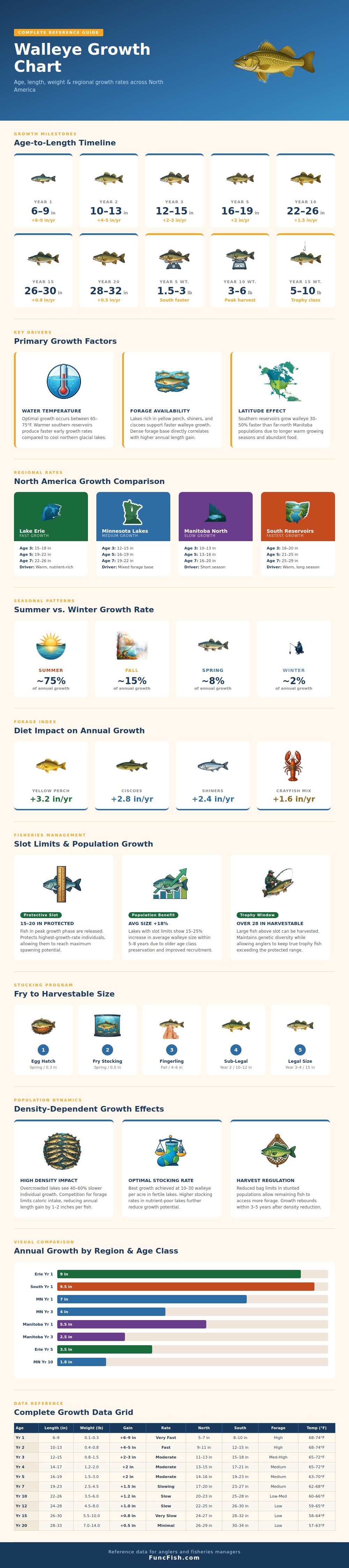
Several variables play into walleye size. Knowing them will help you predict your chances of catching walleyes in each situation. Here’s an infographic explaining the relationship between weight, length and age of walleyes throughout North America. It’s a road map that allows you to read the water before casting and determine what to expect.
In the first year, walleye grow like gangbusters. Depending off environmental factors, they’ll gain six to nine inches during their first year. This early growth spurt is essential as it enables them to outgrow their big-time predator.
What Makes Walleye Grow Big?
After the second or third year, the rate of growth dramatically decreases. In fact, older walleye will gain a couple inches annually at best. This isn’t a sign that they’re unhealthy. It’s simply how their bodies work. They expend their energy on survival and reproduction rather than linear growth. Many anglers fail to grasp this occurrence and assume all of the fish should of doubled their length with each passing season.
Few things affect how quickly a walleye grows as much as location. Northern glacial lakes grow walleyes slower then southern reservoirs with long warm seasons. The warmer water increases the metabolism which means the fish turn food into mass more efficienty. On Lake Erie or other southern systems, you’ll catch twenty-inch walleye at five or six-years-old. That’s what may take ten or more years in remote Minnesota lakes or out in Manitoba. Latitude matters. It helps explain why walleye trophies feel different when you’re casting for them.
Walleyes in the north are older, leaner, and gets to be big like they are because they’ve lived longer. Walleyes in the south are aggressive and grow fast. Temperature isn’t the only factor, diet is equally important. A walleye that feeds on high calorie forage such as ciscoes and yellow perch grows larger than one that lives on low-energy shiners and crayfish. Perch are an energy-dense meal that allows a walleye to grow fast in length. Expect younger walleye to be larger when a lake has lots of perch. The chart shows how annual growth rates connects to specific prey types. Bigger fish = more quality food. A stunted population means there is less food so every individual competes viciously for what is available.
Catch is also impacted by management strategies. Fisheries managers use slot limits as an effort to preserve the most fast growing age classes of fish from harvest. Releasing fish that are between fifteen and twenty inches will give those fish more time to grow and fully mature into their full spawning potential. Generally speaking this means larger average size over time. Productive fish remain in the pool longer. Again it’s a trade off. A keeper today may not be there tomorrow, but you are investing in a better fishery tomorrow.
Regulations are also used to balance population pressure against available resources. Growth rates can be crushed upwards of sixty percent when living at high density.
Growth occurs seasonally The fact that most of the walleye’s yearly growth occur between late spring through early fall. During these times forage is active and water temps are prime. In winter, growth slows nearly to a halt. The fall and spring add bit by bit but the majority occur in the heat of high summer. This can help inform how you schedule your excursions. Want to target walleye that recently ended an aggressive feed? Then plan on summertime.
There is no such thing as being too accurate with your casts in walleye fishing. But there’s also no substitute for knowing the ecosystem. Understanding the dynamic between food, temperature and space helps eliminate guesswork. And that helps you recognize patterns. Next time you’re on the water, consider what’s feeding your fish. That perspective makes the bite not only predictable but understandable. It makes waiting not just patient but strategic.